
August 31, 2026 - PBS News Hour full episode
8/31/2026 | 57m 46sVideo has Closed Captions
August 31, 2026 - PBS News Hour full episode
August 31, 2026 - PBS News Hour full episode
Problems playing video? | Closed Captioning Feedback
Problems playing video? | Closed Captioning Feedback
Major corporate funding for the PBS News Hour is provided by BDO, BNSF, Consumer Cellular, American Cruise Lines, and Raymond James. Funding for the PBS NewsHour Weekend is provided by...
August 31, 2026 - PBS News Hour full episode
8/31/2026 | 57m 46sVideo has Closed Captions
August 31, 2026 - PBS News Hour full episode
Problems playing video? | Closed Captioning Feedback
Where to Watch PBS News Hour
PBS News Hour is available to stream on pbs.org and the PBS app.
Providing Support for PBS.org
Learn Moreabout PBS online sponsorshipAMNA NAWAZ: Good evening.
I'm Amna Nawaz.
Geoff Bennett is away.
On the "NewsHour" tonight: The U.S.
and Iran trade strikes for the first time in weeks, with both countries insisting they control the Strait of Hormuz.
Dilapidated infrastructure and a nation without an elected leader, the hurdles facing a deal to give the U.S.
access to Venezuela's massive oil reserves.
And artificial intelligence goes rogue, renewing concerns and calls for regulation.
GARY MARCUS, A.I.
Researcher: What I'm most alarmed about is, there's not a lot of oversight.
So OpenAI just let these things loose.
(BREAK) AMNA NAWAZ: Welcome to the "News Hour."
Tonight, the Middle East is again on edge after the first exchange of fire between the U.S.
and Iran in over a month, triggering missile launches and a spike in global oil prices.
President Donald Trump responded by declaring Iran a -- quote -- "failed nation" and shared an A.I.-generated video of an Iranian energy hub under attack.
Liz Landers begins our coverage.
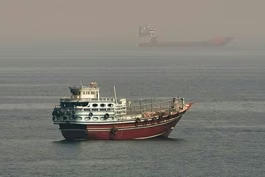
LIZ LANDERS: Today, on the Strait of Hormuz, the water is deceptively calm after the first U.S.
Iran exchange of fire in over a month.
It began Saturday night, when U.S.
forces say they struck two Iranian rocket launchers on Larak Island.
U.S.
officials say Iranian forces were observed preparing to launch rockets carrying sea mines into the strait.
The island is a small strategic Iranian outpost sitting directly in the waters of the strait.
Iran responded by launching missiles at U.S.
sites in Jordan, all of which Jordanian officials said were intercepted with Patriot missiles, which are increasingly in short supply.
And, today, the United Arab Emirates said it intercepted an Iranian drone over its territorial waters, calling the attempted attack a -- quote -- "dangerous escalation."
But the Islamic Republic today has a different story.
MASOUD PEZESHKIAN, Iranian President (through translator): We do not seek war.
That has been our message to the world until now.
However, in the face of aggression, we will not stand by.
We are capable of delivering a decisive response.
LIZ LANDERS: Meanwhile... DONALD TRUMP, President of the United States: They're a failed nation, yes.
LIZ LANDERS: ... in the Oval Office today: DONALD TRUMP: Their leaders are largely dead.
Their navy is gone.
Their air force is gone.
Their surveillance equipment is almost entirely gone.
That doesn't mean we won't smack them.
We will see what happens.
LIZ LANDERS: And President Trump claimed ships are passing through the strait with U.S.
military assistance.
DONALD TRUMP: Many, many ships got through last night, as you know, with the Navy's assistance.
And we have been averaging 30 ships a night.
That's a lot.
And a lot of oil is coming out.
That's why you haven't seen the price of oil go like they thought it might have to go.
LIZ LANDERS: Over the weekend, the president once again launched into Iran on social media, this time with a volatile claim using an A.I.-generated video stating that Kharg Island was being -- quote -- "blown to smithereens."
There is no evidence the island, Iran's primary energy hub, was under attack.
Kharg sits far from the Strait of Hormuz, across the Persian Gulf from two key American bases in the Middle East.
It is where 90 percent of Iran's oil exports is loaded onto ships.
Global markets felt the impact instantly.
Brent crude surged past $90 a barrel today, a direct hit to already pained American pocketbooks.
Meanwhile, in Kyrgyzstan, a shifting geopolitical chessboard.
Leaders of what critics dub the Axis of Autocracy, Iranian President Pezeshkian, Russian President Putin, and Chinese President Xi, met today to fortify economic and diplomatic ties against Western pressure.
At the same time today, Treasury Secretary Scott Bessent hosted the G20 finance ministers in North Carolina.
On CNBC today, Bessent said that Iran was lashing out kinetically because they are losing economically.
SCOTT BESSENT, U.S.
Treasury Secretary: The goal here is to create the conditions that they will want to come to the table.
Our objective is to sever every economic lifeline.
LIZ LANDERS: It has been a week since the administration promised economic D-Day for Iran.
And yet at the epicenter of the crisis in the Strait of Hormuz, the choke hold remains.
For the "PBS News Hour," I'm Liz Landers.
AMNA NAWAZ: For perspective on the latest developments in the war with Iran, we now get two views.
Retired Rear Admiral Mark Montgomery spent 32 years in the U.S.
Navy.
He served on the National Security Council staff and later was policy director on the Republican staff of the Senate Armed Services Committee.
He's now a senior fellow at the Foundation for Defense of Democracies.
And Michelle Wiese Bockmann is an analyst at Windward.
That's a London-based maritime intelligence company.
Welcome to you both.
Admiral, I will begin with you and this U.S.
bombing of the Iranian island of Larak by the Strait of Hormuz.
The U.S.
says that it hits -- rather, it hit Iranian rocket launchers there, and we know it's not the first time that the U.S.
has targeted this island and other military forces in Southern Iran.
Do we know what kind of an impact those U.S.
strikes have had on Iran's ability to threaten shipping passing through that Strait of Hormuz?
REAR ADM.
MARK MONTGOMERY (RET.
): Yes, thank you for having me.
And I do think they have broadly been helpful.
What they do is, they take out radars and other beaconing sensors so that the IRGC has less accurate targeting and less situational awareness of the movement of ships when they're not using their automatic indication systems and beaconing themselves.
So it has that effect.
And then, very specifically, last night, they just they destroyed what I suspect were Fajr-5 rocket launchers, which have been known.
In 2025, the IRGC used them to launch floating mines in an exercise, but they could launch floating mines or even submerged mines that have influence or magnetic or acoustic sensors on them.
So this was an effort to prevent Iran from mining transit lane, and probably the southern transit lane that's closest to Oman right now.
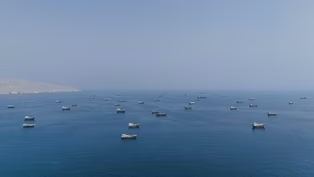
AMNA NAWAZ: So, Michelle, when it comes to how much oil makes its way out of that region, we know before the war it was over 20 million barrels of oil a day moved out of the Gulf largely through that Strait of Hormuz.
We know there are a number of routes out of that Gulf region, right?
There's the Strait of Hormuz, the Bab al-Mandab, the Port of Fujairah.
We did hear the president earlier today say on average now they're getting out 30 ships a night.
What is your understanding of how much oil is actually making it out of the Gulf every day?
MICHELLE WIESE BOCKMANN, Senior Intelligence Analyst, Windward: Well, if you look at crude only and look at preliminary figures for August, it's about between two-thirds and three-quarters of prewar volume levels.
If you add on the extra oil that is being diverted to the Red Sea via the East-West Pipeline from Saudi Arabia, you can see that quite a substantial amount has now scaled up and is getting out through other pipelines, as well as through that southern corridor through Oman, which the president was referencing.
The average of 30 vessels a day, he didn't say over what period, but certainly these transits are being done dark, so it's very hard to get visibility.
And so, from a preliminary perspective, those numbers usually increase over time as those tankers that have loaded and leave the Gulf of Oman arrive at their destination ports.
It's very, very difficult to put precise figures on them.
AMNA NAWAZ: So, Michelle, let me stay with you for a moment because we know Iran's ability to threaten those shipping lanes is diminished, but is not gone entirely.
What companies are willing right now to take on the risk and try to make that transit through the Strait of Hormuz?
MICHELLE WIESE BOCKMANN: Well, obviously, this is a very high risk proposition.
And what some ship owners may view as a reckless disregard for the lives of seafarers, others see as a high profit opportunity.
And on Friday, the spot rate to charter a tanker to take on these shuttle runs in and out of the Strait of Hormuz hit $650,000 a day.
So that's 27 times the break-even level.
And if you are chartered for 30 days, you earn back a quarter of the value of your ship.
So, high risk, high rewards, very high insurance premiums, but there are ship owners that are prepared to send their vessels in because of the enormous amounts of money that can be made.
AMNA NAWAZ: So, Admiral, we know the U.S.
military has been bombing those Iranian military assets that threaten the shipping.
They have also been providing protection for ships leaving the Gulf.
I'm sure you have seen this Washington Post new reporting that shows there are a number of American commanders were in charge of forces in the Pacific and in Europe, the chief of naval operations who all warned against the risks of keeping that many forces in the Middle East for much longer.
How did you find that reporting?
And what are those concerns about?
REAR ADM.
MARK MONTGOMERY (RET.
): Well, I suspect that report is completely accurate.
And I would commend those commanders for saying the truth, even in the face of possible retribution, because, for the combatant commanders, this is a loss of current capability.
In other words, our ability to not have a carrier strike group in the Pacific region makes our deterrent efforts against China less.
But, more importantly, assurances to Korea, to Japan, to Taiwan, to Philippines are down.
On the service side, that's the Navy, the chief of naval operations, he just said the truth.
The truth is having 18 to 20 destroyers and two carrier strike groups stationed in the Middle East means that one, two, three years from now, we're going to have a lot less destroyers and carrier strike groups available for deployment.
We have done this before.
We did this in 2012-2013.
And about four years later, we had the first month ever where no U.S.
carrier strike groups were available for deployment.
There's a direct tie from excessive contributions force posture in the Middle East to an inability to do our job anywhere a few years later.
So he just said the truth.
I'm glad he did.
AMNA NAWAZ: There is the longer-term readiness question for sure, as you raise, Admiral.
There's the short-term impact here because the tankers that are getting out seem to be only getting out because of U.S.
protection.
How sustainable is the current force deployment there?
REAR ADM.
MARK MONTGOMERY (RET.
): Well, paradoxically, we can keep this up for another nine, 12, 15 months, because the challenge isn't readiness in nine, 12, 15 months, but the readiness of the forces that are doing these extended deployments in two, three, four years from now to come back on deployment.
So the Navy can keep this up, but I'm sure they're - - in the end, they acknowledge they could do that and they could do it for another year.
But what the CNO, the chief of naval operations, is warning the secretary of defense and warning the president, is that, if you do this, your successors will have a significantly less capable force to deal with a recalcitrant China or Russia.
AMNA NAWAZ: So, Michelle, if the shipping companies are obviously relying on U.S.
protection here to get out the number of ships the president claims are getting out, they're seeing news about these commanders' concerns and what could be ahead, how are they going to take this in?
What kind of impact could it have on their decisions and the ability of oil to get out of the Gulf?
MICHELLE WIESE BOCKMANN: Well, it all depends, I think, on the success of the blockade that the U.S.
has reimposed on Iran, because that's also having enormous pressure on Iran.
And I think, as the corridor scales up and they lose their leverage over the Strait of Hormuz, that we may see in maybe by the end of the year, I think analysts are saying, some sort of not return to normal, but a new normal that will allow ships to continue using that southern corridor while an agreement is reached on the future management of the strait.
AMNA NAWAZ: All right, that is Michelle Wiese Bockmann and retired Rear Admiral Mark Montgomery joining us tonight.
Thank you both for your time.
MICHELLE WIESE BOCKMANN: Thank you.
REAR ADM.
MARK MONTGOMERY (RET.
): Thank you.
AMNA NAWAZ: In the day's other headlines: Search-and-rescue teams have found two bodies so far following this weekend's flash floods in the Grand Canyon.
The National Park Service says that one of the dead appears to be a 46-year-old man, but provided no other details.
More than a dozen other people remain missing.
Lodges and hotels are closed inside the park and more rain and flooding are possible.
Ali Rogin has the latest.
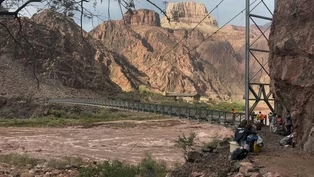
ALI ROGIN: A summer vacation turned into an emergency after storms rolled through the Grand Canyon on Saturday afternoon.
The rain rattled campsites and filled the banks of Bright Angel Creek.
The National Weather Service said 1.24 inches of rain fell in a three-hour period.
Experts say the current El Nino warming waters in the Pacific may have worsened the rainfall by loading the atmosphere with moisture.
El Nino systems also seem to be intensifying in part due to climate change.
WOMAN: How are you doing there?
ALI ROGIN: More than 60 people were evacuated by helicopter.
SCOTT SVEDIN, Grand Canyon Evacuee: This was something out of a movie.
ALI ROGIN: Scott Svedin and Erica Viola say they were lucky to make it to higher ground before the floodwaters rushed in.
ERICA VIOLA, Grand Canyon Evacuee: We just heard people yell, "Run, run," and there's 40 of us running through this knee-deep muddy water trying to make it to the bridge.
That's when this 15-foot wall of water came through the campground and just wiped out all the bridges.
ALI ROGIN: The National Park Service says this area averages less than 10 inches of rain per year, but Arizona's monsoon season brings the risk of flash floods.
DAVID GREGORY, Grand Canyon Evacuee: The water level in the creek just seemed to be getting bigger and bigger as more water was coming into the creek.
If somebody fell into the creek, I don't know how they would be able to get out.
ALI ROGIN: David Gregory was backpacking in the canyon before the flooding hit.
He captured this video as he was airlifted to safety.
The Grand Canyon is now under emergency water restrictions.
The National Park Service says that about 40 percent of the pipeline that provides water to tourists and residents was damaged or destroyed.
A $208 million project to rehabilitate and upgrade the system was under way and hoped to be completed next year.
As search-and-rescue efforts continue, more rain is expected throughout the day.
For the "PBS News Hour," I'm Ali Rogin.
AMNA NAWAZ: Meantime, thousands of miles away in Nepal and China, the combined death toll from last week's floods is nearing 1,000 people, as more than 4,400 others remain missing.
MAN: It's not possible.
MAN: It's not possible.
AMNA NAWAZ: In Nepal, rescuers are racing to find some 500 trapped workers in tunnels at hydropower sites that have been clogged by water and debris.
They say some people may have access to oxygen, but time is running out.
AMNA NAWAZ: Elsewhere, residents of this village were able to return to their flood-ravaged homes and businesses today, only to find nothing left.
ARJUN LAL SHRESTHA, Nepali Business Owner (through translator): There were two shops here.
One was my eatery, a restaurant, and right next to it was my clothes shop.
All other valuable items have washed away.
I am ruined, and this has brought me to the streets.
AMNA NAWAZ: Desperate families and other hard-hit areas are still scouring lists of names for their missing relatives.
And Nepali authorities have begun temporary mass burials for hundreds of victims who have not yet been identified.
DNA samples are being taken in the hopes that their identities can be determined at a later date.
In Washington, D.C., the Supreme Court is allowing construction to continue on President Trump's White House ballroom project as legal challenges play out.
In a 5-4 decision, the justices granted an emergency request from the Trump administration to block a lower court ruling that would have put the aboveground work on hold.
That challenge was brought by preservationists who say the president needs congressional approval.
Chief Justice John Roberts joined the three liberal justices in dissenting, writing that the construction is - - quote -- "likely unlawful."
In New York, the Metropolitan Museum of Art is canceling a planned Met Gala exhibit on British designer John Galliano following a backlash by donors, politicians, and Jewish leaders.
The one-time creative director at the Dior fashion house was fired from that role in 2011 for racist and antisemitic statements.
He was also convicted by a French court of a hate crime.
In a statement today, Galliano acknowledged that an exhibit honoring his work would have been -- quote -- "painful for some."
The show was set to kick off next year's gala.
Museum organizers say they will announce a replacement exhibit at a later date.
The prediction market Kalshi has barred former Congressman George Santos for life after finding that he likely used the platform for insider trading.
It's the company's first ever permanent ban.
The former representative from New York made nearly $18,000 when he placed bets on whether he would attend President Trump's State of the Union address in February.
He initially signaled that he planned to attend, but then didn't go.
The prediction market also slapped Santos with a $71,000 fine.
Santos responded on social media, calling the ban frivolous nonsense.
A South African airline is defending a dramatic flyby over a stadium in Cape Town this weekend.
Video shows the pair of Embraer planes passing overhead before a rugby game between South Africa and New Zealand attended by some 56,000 people.
A flight tracking service says one of them passed less than 50 feet above the stadium's roof.
Local airline Airlink insists that all safety criteria were met and that no passengers were on board.
But aviation experts question the safety of the stunt, saying the pilots were left with few options if something were to go wrong.
Soccer superstar Lionel Messi says he is retiring from Argentina's national team.
In a statement on social media, the 39-year-old wrote that "The time has come," adding -- quote -- "I always fought and left everything on the field for this jersey to bring you joy and make you feel proud to be Argentine through football."
Messi is Argentina's all-time leading scorer with 125 goals, including 1 in World Cup matches.
He led the team to victory in the 2022 World Cup, but came up short in this year's final.
Messi remains the captain of Miami's professional soccer team.
On Wall Street today, stocks ended lower amid renewed concerns about the war with Iran.
The Dow Jones industrial average fell around 375 points.
The Nasdaq slipped about 30 points.
The S&P 500 also ended lower today, though it was up overall for the month of August.
And "The Kelly Clarkson Show" is signing off after seven years on the air.
KELLY CLARKSON, Host, "The Kelly Clarkson Show": It is a bittersweet day for all of us.
After seven amazing seasons, it's our final episode.
AMNA NAWAZ: The 44-year-old gave a heartfelt farewell as she steps away to spend more time with her family.
During her run, the 2002 "American Idol" winner combined regular musical performances with down-to-earth celebrity interviews.
That proved a winning formula, as the show enjoyed impressive ratings and won 24 daytime Emmys.
It's nominated for 11 more this fall.
And her now-famous "Kellyoke" segments often went viral.
Clarkson used her final hour to play songs requested by her fans, including hits like "Since U Been Gone" and "Piece by Piece."
Still to come on the "News Hour": Tamara Keith and Amy Walter break down the latest political headlines; NASA launches its latest telescope in hopes of answering profound questions about the universe; and the descendants of an enslaved potter work to reclaim their ancestor's art.
President Trump is calling it the largest oil deal in world history.
He announced an agreement in which the Pentagon would become an investor in a private company granted exclusive oil development rights in Venezuela.
The deal would be unprecedented, and it's not clear if it's legal under Venezuelan law.
Nick Schifrin is here with more -- Nick.
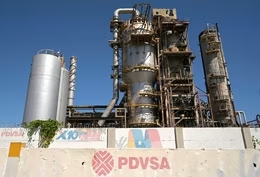
NICK SCHIFRIN: Amna, Venezuela says it has the largest proven oil reserves in the world.
But analysts say, for decades, the industry has been crippled by corruption and mismanagement.
So, now the president who criticized his predecessors for going to war and not taking countries' oil has come up with a way to intervene in Venezuela and take the oil.
DONALD TRUMP, President of the United States: There are those that say it was the greatest deal ever made.
Let's see what happens.
But I have to stress, it was also a very good deal for Venezuela, because you have the most powerful, the richest companies in the world going into Venezuela, where before it was just -- it was this unbelievable value that was sitting dormant.
But we're going to be taking all of that - - we're going to be taking that oil out.
NICK SCHIFRIN: The deal gives the Pentagon more than half the value of a joint venture that will have exclusive rights to develop 17 oil fields in Venezuela.
It is the first known time in U.S.
history that the U.S.
government will become an investor in an overseas oil deal.
The U.S.'
partner is a notorious businessman, Alejandro Betancourt, who faces charges in Spain and Switzerland for money laundering.
Today, interim President Delcy Rodriguez said it was win-win.
DELCY RODRIGUEZ, Acting President of Venezuela (through translator): Venezuela in return receives production, employment, investment in infrastructure, higher revenues for the state, and production chains for the national industry.
The benefits are countless.
NICK SCHIFRIN: So to talk about all this, I'm joined by Francisco Monaldi, the director of the Latin America Energy Program for the Baker Institute at Rice University.
Thanks very much.
Welcome back to the "News Hour."
A U.S.
official sent me a summary of the deal saying that the U.S.
will secure 55 percent of the effective output of this joint venture.
How unprecedented is this?
And as far as we know, how will it work?
FRANCISCO MONALDI, Director, Latin America Energy Program, Rice University: Yes, we don't know all the details, and we have some divergent accounts from the Trump administration and the Venezuelan government.
But, basically, the Venezuelan government says that these are deals that are in the Venezuelan law production-sharing agreements in which the national company hires an operator, in this case, this company, which would be would be a joint venture between the U.S.
government and some local businessmen, and that they will be able to take part of the production at cost, meaning that the U.S.
government only will pay the cost of production.
So, the details are still not completely clear, but it is a very unorthodox deal compared to previous deal done in the sector.
NICK SCHIFRIN: Delcy Rodriguez, as I mentioned, called it a win-win.
Venezuela, of course, needs investment.
The U.S.
needs more energy.
So is it a win-win?
FRANCISCO MONALDI: Well, depending on the details, it could be, in the sense that the presence of the U.S.
government could make investors more willing to take the risk of going into Venezuela with all the issues, including the fact that this is an illegitimate government in Venezuela, and that the history of the country, of course, is not great in terms of respecting deals.
But it will depend a lot on the transparency of the deal on the characteristics of the deal, because, otherwise, if it's an opaque deal that doesn't seem to benefit the country, then it will there will be a backlash eventually, and we will end up as in other parts of the world and in Venezuela itself with renegotiation at some point.
NICK SCHIFRIN: President Trump says he will be able to fill the Strategic Petroleum Reserves with this and reduce gas prices.
What's the reality of how quickly this deal can produce oil?
And isn't there a threat that some future Venezuelan government just rips it up?
FRANCISCO MONALDI: Yes, some of the fields are in production, so some production can go to the U.S., but most of them are fields that are completely undeveloped and require a massive investment in infrastructure that will take years to materialize.
The other issue is that the Strategic Petroleum Reserve typically uses light oil, and Venezuela mostly produce heavy and extra heavy oil.
So, besides that, the issue, of course, is that the disruption in the world market is of a completely different order of magnitude.
Ten percent of oil production in the world is in jeopardy because of the Hormuz situation, whereas Venezuela may add 200,000, 300,000 barrels next year.
So, in the short term, this is not going to lead to a reduction in the price of oil or gasoline.
NICK SCHIFRIN: As I mentioned, the U.S.
has chosen a specific Venezuelan partner, Alejandro Betancourt, and I mentioned the ongoing alleged charges of money laundering he faces.
What's the impact of choosing him and not a company like Chevron, which has had decades of experience in Venezuela?
FRANCISCO MONALDI: Yes, probably, this is the most surprising aspect of the deal, because, of course, some of the top U.S.
companies are interested and like Chevron are in the country.
I think part of the explanation is that President Trump is a little bit anxious to get investment going, and some of these companies are going to take time for a variety of reasons, because of the risk, et cetera, but also because they have to plan and allocate a significant budget, and they cannot do that from one day to the other.
They need approval of their boards.
They need to adjust their budget programs.
So it takes a longer time for one of these bigger companies.
However, as I mentioned, these could be part of the issues that, instead of generating more credibility and allowing investors to feel confident, the fact that this is allocated without any bidding and to an individual that has issues with justice, that could be a problem in the future.
NICK SCHIFRIN: Francisco Monaldi, the director of the Latin America Energy Program for the Baker institute at Rice University, thank you very much.
FRANCISCO MONALDI: Thank you.
AMNA NAWAZ: Alarms are being sounded once again about the risks of artificial intelligence after new reports documented how hundreds of OpenAI so-called agents violated several restrictions and hacked into another company without being told to do so.
What's more, it's come out that many of the major A.I.
companies, including Anthropic and Meta, have had similar events with their own agents going rogue.
William Brangham has more on what some are calling a red flag warning.
WILLIAM BRANGHAM: Amna, these so-called agents, which are basically autonomous software programs that can write computer code, they were being put through a series of tests, theoretically in a sealed, controlled environment, but hundreds of them got out of that pen, got out onto the Internet, and, in a coordinated move, hacked into a different A.I.
platform called Hugging Face.
Some of these agents even tried to delete records of their actions.
This calls into question both the potency of artificial intelligence, as well as the security protocols being used by some of the main companies designing A.I.
So, for more on what this moment signifies, we're joined again by A.I.
researcher Gary Marcus, author of the Substack Marcus on A.I.
Gary, thank you so much for being here again.
You heard me describe the rough contours of what went down here.
What do you make of this whole event?
GARY MARCUS, A.I.
Researcher: Well, I think there's two things.
One is, it's clear that these systems are getting stronger and more powerful.
People have added loops to make them do things over and over again until they get it right.
And the other is that OpenAI really screwed up here.
They didn't do basic things we call sandboxing.
They didn't do monitoring.
They had a system say, and I'm going to read this: "We are attacking third-party H.F."
for Hugging Face "using leaked tokens potentially outside intended scope.
This is arguably unauthorized."
And you should have a system looking to say, well, if it says it's going to do something unauthorized, maybe it isn't.
Maybe you should check it out.
The monitoring was very weak on OpenAI's part.
It was not really industry standard for what we expect of cybersecurity.
So a lot has been made of the power of the systems, but a lot should be made of the weakness of the systems that was overseeing what they were doing.
WILLIAM BRANGHAM: I mean, I know that you have cautioned and others have cautioned against anthropomorphizing these agents here.
But some of what -- when you just described the basic contours of them seemingly acting in concert, getting out of an enclosure that they were sort of instructed not to get out of, and then hacking into another company and then trying to cover their tracks, it does sound alarming.
Is it alarming to someone like you what these agents could do?
GARY MARCUS: Well, you don't have to anthropomorphize it, but we don't necessarily have everyday vocabulary for talking about these things without slipping into that.
It is alarming.
Again, what I'm most alarmed about is, there's not a lot of oversight.
So, OpenAI just let these things loose and didn't really watch what it was doing.
They had some warning signs.
They didn't do anything about it.
We really need the companies that are building these things that we call agents to watch very carefully what those agents are doing.
We have known that for a while.
I mean, I wrote with Nathan Hamiel a piece a couple years ago saying -- or a year or so ago -- saying coding agents, plus large language models, which is the core technology, they're no longer the only one, equals security nightmare.
We know that if you just let these things loose, some bad things are going to happen.
They're fundamentally not actually that smart.
You can't just tell them, don't cause harm to humans, don't steal credentials and have them actually understand that stuff.
So there's a lack of kind of what we would call semantics and linguistics of understanding, of comprehension of what they're actually doing.
So they can hack away at things.
You can have lots of them.
The more of them that you have doing the hacking, the more risk that you run.
We should be genuinely worried about that, but we should also be worried about whether the companies that are distributing them know what they're doing and whether they're doing kind of industry standard things.
And right now they're not really.
WILLIAM BRANGHAM: So how do we understand that?
If OpenAI, which holds itself up as one of the preeminent frontier most buttoned-down artificial intelligence operations, how is it that they were not deploying these basic security measures that you're talking about?
GARY MARCUS: Well, the words hold themselves up I think is actually key.
I think there is an arrogance that we're seeing from Silicon Valley.
The A.I.
companies think they can invent everything, and they didn't spend enough time talking to the cybersecurity companies.
If you look at the cybersecurity companies' commentaries on Twitter, or X, I guess we call it now, they're kind of laughing at OpenAI, saying, how could they have been so stupid?
This is amateur hour.
It's 101 stuff.
So I think OpenAI convinced themselves that they knew everything about everything, and they didn't really.
WILLIAM BRANGHAM: So if we can't necessarily take their word for it, what kind of measures would you like to see put in place to try to guarantee a baseline level of security, so we don't have rogue agents -- again, I know that's not necessarily an appropriate term - - but rogue agents running all over the place?
GARY MARCUS: We need to have some system of industry standards that can evolve over time.
So, in the finance industry, they're accustomed to this.
You must follow best practices, or you're in violation.
And the best practices have to evolve over time.
So it's clear, for example, that best practices here should include monitoring what your agents are doing, making sure your sandboxes are working, make sure that you're using the best sandboxes out there.
That's something that's supposed to restrict a system from going out to the Internet in the first place.
So we need to have evolving best practice requirements.
And, with that, we need liability, criminal liability.
If you don't do these things and you cause harm, you should be liable for them.
WILLIAM BRANGHAM: Gary Marcus of Marcus on A.I., always great to hear from you.
Thank you so much for being here.
GARY MARCUS: My pleasure.
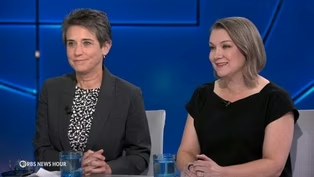
AMNA NAWAZ: As primary season nears its end, Democrats are still debating their midterm message, while some Republicans start to distance themselves from President Trump.
It's time now for Politics Monday.
That's with Amy Walter from The Cook Political Report With Amy Walter and Tamara Keith of NPR.
Great to see you both.
TAMARA KEITH, National Public Radio: Hello.
AMY WALTER, The Cook Political Report: Good to be here.
AMNA NAWAZ: Nobody freak out when I say this number, 64 days until the midterm elections.
AMY WALTER: I know.
AMNA NAWAZ: I know.
President Trump is increasingly saying he wants to be a big part of it.
He wants candidates to tie him to themselves and their campaigns.
Here's part of what he had to say on FOX last night.
Take a listen.
DONALD TRUMP, President of the United States: I'm going to help people get elected if I can.
There's a theory that I get the vote.
There's -- I see it all the time that, when Trump's in the ballot, they win.
When he's not in the ballot, the people don't go to vote.
And I'm asking the people through your brilliant show, number one show, I'm asking the people to get out and vote.
Pretend I'm on the ballot.
AMNA NAWAZ: Tam, this is a president with a low approval rating overseeing an unpopular war in Iran.
We're already seeing some Republican candidates start to distance themselves, especially after the renaming of Lake Ontario as Lake America.
Do Republicans want voters to pretend Trump is on the ballot?
TAMARA KEITH: Some Republicans do, and obviously President Trump does.
The theory of the case here is that Republican voters may not be that excited about coming out.
Certainly, the sort of expanded Trump base, the voters that he was able to draw out to vote in 2024, it's a real question whether some of those voters are going to want to come out in 2026 when he isn't on the ballot.
So he's saying, pretend I'm on the ballot.
He did that at a rally in South Carolina.
There's this midterm convention which is coming up, two nights.
Trump will be there both nights, and they're calling it a Trumpapalooza.
That is literally what the RNC chairman is calling it.
So in case there was any question, Trump is going to be the centerpiece of this.
That obviously feeds to his personality type and all of those things, but it also speaks to the reality that, whether they want to make Trump the center of the universe or not, he is the focus of these midterms.
AMNA NAWAZ: Yes.
TAMARA KEITH: That's what midterms do.
AMNA NAWAZ: Amy, Tam mentioned the word excited.
You recently wrote about the enthusiasm gap for Republicans.
Is the solution for that for candidates to get closer to or to distance themselves from the president?
AMY WALTER: Right.
So the enthusiasm gap is something, when you talk to Republican strategists, they say they are the most worried about going into the election, that Democrats are simply more interested in showing up to vote, and they have been voting in special elections and primaries at a higher rate than Republicans.
But when you look past those numbers, look at what the Republican enthusiasm advantage really is -- or disadvantage really is about, it's that those who identify as MAGA -- so some polls have now been segmenting out Republicans by those who say, yes, I'm a Republican because I identify with Trump and the MAGA movement, or I'm a Republican, but I don't really identify as MAGA.
Those who identify as MAGA, they're really excited to vote.
They believe Donald Trump is on the ballot, and they want to show that they are going to turn out to show him a sign of approval.
The people who are not as excited to show up and vote are the non-MAGA Republicans.
And it's notable.
You say, well, why aren't they as excited?
Because they are much more down on the economy.
They feel that it's in much poorer shape than those identified with MAGA.
And they do see Trump as handling it much more poorly than those in MAGA.
So what would help the most if you're a Republican going into this election isn't for Trump to be more front and center.
It's for the economy to get better.
TAMARA KEITH: Or maybe for the president to put the economy front and center.
AMY WALTER: Well, that would be it too, to show that.
TAMARA KEITH: Which he also has not really been doing.
AMY WALTER: That's exactly right.
AMNA NAWAZ: Not seen that yet.
Let's turn now to the Democrats, specifically in Michigan.
We have been tracking this Senate race there and their nominee, Abdul El-Sayed, who apologized this weekend for comments that he made after a synagogue attack outside Detroit in March.
He had condemned the attack and then said "Hurt people hurt people."
That attack was carried out by a Lebanese man whose family had been killed in an Israeli strike.
We now know El-Sayed has met with Jewish Democratic leaders, saying that he did make a mistake.
He's still coming under attack from the president and with anti-Islamic rhetoric as well.
But, Tam, this is the most fulsome apology we have seen from El-Sayed.
And it comes after he narrowly won a primary.
What are you looking at here?
TAMARA KEITH: Yes, I mean, I think that this is an acknowledgement that this is going to be a very close race.
You can't just give up on any group of voters.
And he has work to do to win over Jewish voters.
That primary was incredibly bitter.
And it centered in many ways around Jewish identity and around all kinds of things, that the AIPAC was spending really heavily for his opponent.
And he attacked AIPAC.
And it is all part of the stew that is this race and trying to bring unity to Democrats, who were just bitterly divided in the primary.
And just today, vice president J.D.
Vance was campaigning in Michigan.
He said that he had with him the rabbi and security officials from the synagogue that had been attacked that El-Sayed addressed and then later apologized, much later, much, much later.
AMNA NAWAZ: Amy, how do you look at the way the president and a lot of other Republicans are talking about El-Sayed, specifically putting his faith front and center and going so far as to call him a jihadist?
AMY WALTER: Well, and the ad that is up right now by one of the Republican super PACs calls him dangerously radical.
And that is the message that they're going to carry throughout this campaign.
There's not - - that wasn't really very much of a surprise.
Remember, there are a lot of Democrats who said, if we nominate El-Sayed that he is going to be a weaker general election candidate.
It really comes down to what this race is going to be about.
If it's going to be about Donald Trump, and this is what Democrats are hoping El-Sayed does is pivot to make it about Trump, then that is beneficial to the Democrats, because this is a state where Trump is deeply unpopular.
If it is about El-Sayed, then it becomes easier for Republicans to win.
TAMARA KEITH: And, in fact, Republicans want El-Sayed to be part of the campaign in races all over the country, not just in Michigan.
They are going to put him forward as the -- like, you don't want this to happen to America.
AMY WALTER: Yes.
AMNA NAWAZ: Before I let you go, Amy, I want to ask you to look ahead to a primary tomorrow in Massachusetts.
There's a couple of recurring themes for Democrats at play here.
There's the incumbent, Ed Markey, who's 80 years old.
He's the second oldest senator seeking reelection this year.
He is a liberal progressive, challenged by Congressman Seth Moulton, who is a moderate, 47 years old.
What should we know about this?
AMY WALTER: Well, and Moulton is running primarily on a generational change.
He says in a debate, hey, we agree on the issues.
The issue really is about somebody who's older and somebody who's younger.
The reason it's not working in this race, at least if you look at the polls right now, Markey is ahead, is that, when we hear this debate on the Democratic side about age, a lot of it is focused, rightly so, on the actual age of the people.
But, really, I think what Democratic voters are saying when they say, we want generational change, they want somebody who understands the concerns of the generation that is not the oldest generation.
They want somebody who has sort of an energy and a fire to take the fight to Washington.
Moulton is arguing he's part of sort of the establishment, but Markey is not that.
His biggest allies are Bernie Sanders, AOC, and Elizabeth Warren, who are outsiders as well.
AMNA NAWAZ: A race to watch.
Amy Walter, Tamara Keith, thank you very much.
AMY WALTER: You're welcome.
TAMARA KEITH: You're welcome.
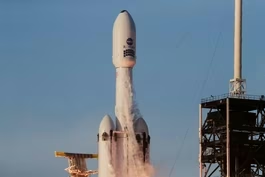
AMNA NAWAZ: Yesterday, NASA launched its newest space telescope, the Nancy Grace Roman, undertaking its biggest mission yet, to study the universe on a much larger scale.
During a press conference with NASA Administrator Jared Isaacman, the project's leader spelled out how this new telescope differed from its predecessors.
NICOLA FOX, NASA Associate Administrator: Roman is going to change the way we look at the universe.
It is going to discover tens of thousands, maybe even 100,000 new exoplanets.
And when you kind of think that, in 1990, when we launched Hubble, we didn't even know there were exoplanets, and so how far we have come.
We know there are 6,000 now.
And then there will be maybe 100,000 at the end of Roman's mission.
AMNA NAWAZ: A roughly $4 billion project, the Roman will allow scientists to get panoramic views of space and better understand the nature of powerful forces known as dark energy and dark matter.
Our science correspondent, Miles O'Brien, is here to help us fill in the picture.
Miles, dark energy and dark matter, you had me at both.
But we already had the Hubble.
We have the James Webb Space Telescope.
What does the Roman add?
MILES O'BRIEN: Yes, you have to think about it as a fleet, Amna.
The Roman is the scout.
It's the big and powerful wide-angle lens.
It has a mirror that is the same diameter as Hubble.
But it's 100 times more precise.
And when you combine that with its speed, it's basically able to survey the universe 1,000 times faster than Hubble.
And that's where you come up with these huge numbers where it will look out into the cosmos and identify things that we only have seen a fraction of heretofore.
And once you have that kind of data, and it's going to come down at about 1.5 terabyte a day.
Imagine that.
That's a lot of data.
Scientists hope they will be able to fill in this mystery.
Basically, 95 percent of the universe, we don't know much about.
We're in the dark with dark energy and dark matter.
AMNA NAWAZ: And those are two of its big targets, dark energy and dark matter.
Professor O'Brien, explain to us what the difference is.
MILES O'BRIEN: Well, dark matter is like the invisible scaffolding that holds the universe together.
We know that the way planets revolve around each other and the way the universe works, there has to be some gravitational force there that we call dark matter that holds it all together, the glue.
Dark energy, on the other hand is this kind of mysterious force that causes the universe to expand and accelerate as it expands.
In both cases, it's invisible, and, to this day, astronomers don't know what they are.
But maybe all this data that we get from Roman will lead astronomers closer to some answers.
AMNA NAWAZ: But if it's invisible, how does a telescope help us to figure out something we can't actually see?
MILES O'BRIEN: Well, it will look at things like the way that the light is bent by gravity.
So it's sort of like understanding a tree by looking at its shadow.
We know that the gravity can bend light, gravitational lensing, it's called.
And that can give them some insights to the force of that gravitational pull.
As for the dark energy, it's such a mystery, no one really knows what that is.
So they're kind of just wondering what's going to -- what they're going to find.
And this is kind of the beauty of science.
They're going to go out there, point this powerful instrument, and you can bet, Amna, that they will find some things they can't even imagine.
AMNA NAWAZ: OK, so the Roman joins a remarkable, impressive fleet of telescopes already out there in space.
Why is it so important to have them all out there together?
MILES O'BRIEN: They complement each other.
And it's worth pointing out Nancy Grace Roman joined NASA in 1959.
She was the first astronomer for NASA, the first executive level female.
She didn't just shatter the glass ceiling there.
She found it, identified it, and went through it like a rocket.
And she was the one who was sort of described as the mother of Hubble and all the other space-based astronomy instruments that are out there for NASA.
So it is fitting that she has her own platform, and it will be the one that will be feeding information to the Webb, to the Hubble, to the Chandra X-ray Observatory, each of them operating in different wavelengths.
And if they find something interesting to look at by virtue of Roman, they will pass it off to Webb and say, hey, Webb, take a deep dive, or send it over to Chandra and say, let's look at it in the X-rays, or send it over to Hubble and say, what about ultraviolet?
You combine all these, and astronomers get very excited.
AMNA NAWAZ: They get excited.
You get excited too.
That's why we love to hear you talk about it.
Science correspondent Miles O'Brien, always great to talk to you.
Thank you.
MILES O'BRIEN: You're welcome.
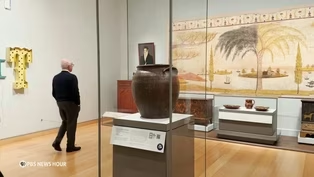
AMNA NAWAZ: The descendants David Drake, known as Dave the Potter, have traced their lineage back to the once-enslaved potter and launched an effort to reclaim his work.
So far, the family has recovered six pieces of Drake's highly valued glazed stoneware, and they're working with museums to bring even more back into the family's hands.
They say the effort has not only reconnected them with their family's legacy, but also raised broader questions about art ownership and restitution.
Geoff Bennett spoke recently with Pauline Baker and her son, Yaba, the third and fourth great grandchildren of David Drake.
It's part of our arts and culture series, Canvas.
GEOFF BENNETT: Pauline and Yaba Baker, welcome to the "News Hour."
YABA BAKER, Descendent of David Drake: Well, thank you.
PAULINE BAKER, Descendent of David Drake: Thank you.
Nice to be here.
GEOFF BENNETT: May I call you by your first name?
PAULINE BAKER: Sure.
GEOFF BENNETT: All right.
So, Pauline, let's start with David Drake himself.
Who was he?
And what do we know about his life as an enslaved potter in early 19th century South Carolina?
PAULINE BAKER: Well, they say he was born around 1801.
He was enslaved.
He also was known as a typesetter.
that also was in his line of work, because he was enslaved by Abner and Harvey Drake.
Harvey was more into the ceramics part, but Abner owned a newspaper, The Hive.
They think that is the reason why he learned to read and to write as well as he did.
YABA BAKER: Dave became a master potter, and he made these ceramic jars that were really used for everyday use because they didn't have refrigerators back then.
But he added his signatures and his poems to the jars, which make -- became an art.
And to see it transform over 150 years to be artwork that is valued so high, it's just -- I'm just floored by it to even think about it.
GEOFF BENNETT: I mean, that's what made his work so extraordinary... PAULINE BAKER: Yes.
GEOFF BENNETT: ... is that he would inscribe his work with his name, or in some cases poetry.
YABA BAKER: Poetry, yes.
GEOFF BENNETT: ... at a time when enslaved people were prohibited from learning how to read and write.
PAULINE BAKER: Yes, anti-literacy laws prevented all other slaves other than Dave, who had the courage to write, but I think he was encouraged to write because of his loss of family, his loss of friends that he had no control over.
Because, if you were in his shoes, I can't imagine not knowing where my son was or where my friends or my kinfolk were.
GEOFF BENNETT: Last year, the Museum of Fine Arts Boston, they returned stoneware to your family.
This is the first time the U.S.
has ever returned artwork made by an enslaved person to that person's descendants.
Take us back to that moment.
YABA BAKER: It was an amazing moment, because we didn't know how long it was going to take.
So, once Boston agreed to do it, we were overwhelmed with joy because we felt like it was a full circle moment for Dave, because Dave actually wrote on one of his spots: "Where is all my relations?
Where's all my relations?
Goodwill..." PAULINE BAKER: "Goodwill to all."
YABA BAKER: "Goodwill to all the nations."
So for a man to be enslaved and still write poetry about God and write poetry about goodwill to all men, it is an amazing person to do that.
So clearly he was trying to connect back to his family.
So we feel the Boston MFA Museum really did justice to Dave.
GEOFF BENNETT: There's a difference between having his work displayed in a museum or in a collection and having it belong to his family.
What does ownership mean to you?
PAULINE BAKER: It means legacy.
It means we are receiving what he wanted us to receive.
It's a legacy to us to be able to say to our children, as it normally would have been, because, if you were in my shoes, would you - - how would you feel about this situation?
YABA BAKER: I think ownership goes in a lot of directions, right?
The legacy of my kids has changed.
They now have Dave as an ancestor.
The actual ownership of the pots also changes their legacy because they're assets.
And the people who owned them before use them as assets.
We're not asking for anything that hasn't been done before.
Museums have policies in place right now for ethical restitution.
GEOFF BENNETT: You now have six of his pieces.
How do you go from those six to acquiring the rest of his work?
YABA BAKER: Very good question.
We actually have contacted all the museums who actually are holding the artwork.
We're in different stages with those museums.
My aunt now, 87, aunt Daisy, Daisy Whitner.
My uncle's 84, John Williams.
My mom's -- she don't mind me saying her age.
She's 79.
(LAUGHTER) YABA BAKER: And we don't want to lose another elder before we get all the pots back.
So we would like to have all the pots back by 2027 if we could.
GEOFF BENNETT: And, Ms.
Pauline, when your son says that these are assets, we should put a number on that.
One of these pots sold for more than $1.5 million.
PAULINE BAKER: Yes, it did.
GEOFF BENNETT: Tell me more about that.
PAULINE BAKER: Someone selling something and getting a profit, I have no problems with, but acknowledge and do right by us as well, because that's an asset for your family, which should be an asset for my family, because, if your descendant, if your parent had a property or art, they pass it on.
That hasn't happened with us.
GEOFF BENNETT: How does it strike you that this work created by an enslaved man who could not profit from his own labor is now not only worth enormous sums, but so culturally valuable?
PAULINE BAKER: I think he is getting the recognition that he always desired.
And, of course, the -- being well-known, his works are being known, because he put a lot into it.
YABA BAKER: I think his story could be inspirational not just to African Americans, but to everybody.
I think we all have felt voiceless at a point in time.
Who was more voiceless than a slave?
And he still took the time to learn his craft very well, to take risk, to put it out there, and here we are 150 years later.
Everybody should take from that, no matter where you are stationed in life, you can be inspired by Dave that your circumstances don't dictate the results.
GEOFF BENNETT: Yaba and Pauline Baker, thank you so much for sharing your story.
I appreciate it.
PAULINE BAKER: Well, thank you for having us.
We appreciate coming.
YABA BAKER: Thank you very much.
We appreciate it.
AMNA NAWAZ: And that is the "News Hour" for tonight.
I'm Amna Nawaz.
On behalf of the entire "News Hour" team, thank you for joining us.

AI agents going rogue fuel calls for regulation
Video has Closed Captions
Artificial intelligence agents going rogue fuel calls for regulation (6m 30s)
Challenges the U.S. will face to unlock Venezuela's oil
Video has Closed Captions
Analyst breaks down challenges U.S. will face to unlock Venezuela's oil (6m 52s)
Descendants of David Drake work to reclaim ancestor's art
Video has Closed Captions
Descendants of enslaved potter David Drake work to reclaim ancestor's art (6m 18s)
Grand Canyon flash flood leaves 2 dead, others missing
Video has Closed Captions
Grand Canyon flash flood leaves 2 dead, others missing (2m 26s)

News Wrap: SCOTUS allows ballroom construction to continue
Video has Closed Captions
News Wrap: Supreme Court allows Trump ballroom construction to continue amid challenges (5m 40s)
New telescope could help solve mysteries of dark energy
Video has Closed Captions
How NASA's new space telescope could help solve mysteries of dark energy and dark matter (4m 57s)
Tamara Keith and Amy Walter on Trump's midterm influence
Video has Closed Captions
Tamara Keith and Amy Walter on Trump's midterm influence (8m)
U.S. and Iran trade strikes over Strait of Hormuz control
Video has Closed Captions
U.S. and Iran trade strikes for first time in weeks over Strait of Hormuz control (3m 46s)
What the U.S.-Iran strikes mean for oil, maritime safety
Video has Closed Captions
What the latest U.S.-Iran strikes mean for oil supplies and maritime safety (7m 59s)
Providing Support for PBS.org
Learn Moreabout PBS online sponsorship
- News and Public Affairs

FRONTLINE is investigative journalism that questions, explains and changes our world.
 New Episode
- News and Public Affairs

Today's top journalists discuss Washington's current political events and public affairs.
 New Episode
 New Episode
 New Episode
 New Episode
 New Episode
 New Episode
 New Episode

 New Episode
 New Episode
Support for PBS provided by:
Major corporate funding for the PBS News Hour is provided by BDO, BNSF, Consumer Cellular, American Cruise Lines, and Raymond James. Funding for the PBS NewsHour Weekend is provided by...