Here and Now
Barry Burden on Lawsuits over Wisconsin's Congressional Maps
Clip: Season 2400 Episode 2422 | 7m 15sVideo has Closed Captions
Barry Burden on two lawsuits that seek to redraw Wisconsin's congressional district maps.
UW-Madison political science professor and Elections Research Center Director Barry Burden explains the premise and status of two lawsuits that seek to redraw Wisconsin's congressional district maps.
Problems playing video? | Closed Captioning Feedback
Problems playing video? | Closed Captioning Feedback
Here and Now is a local public television program presented by PBS Wisconsin
Here and Now
Barry Burden on Lawsuits over Wisconsin's Congressional Maps
Clip: Season 2400 Episode 2422 | 7m 15sVideo has Closed Captions
UW-Madison political science professor and Elections Research Center Director Barry Burden explains the premise and status of two lawsuits that seek to redraw Wisconsin's congressional district maps.
Problems playing video? | Closed Captioning Feedback
How to Watch Here and Now
Here and Now is available to stream on pbs.org and the free PBS App, available on iPhone, Apple TV, Android TV, Android smartphones, Amazon Fire TV, Amazon Fire Tablet, Roku, Samsung Smart TV, and Vizio.
Providing Support for PBS.org
Learn Moreabout PBS online sponsorshipand we lead it to victory in November.
for your time.
>> Thanks for having me.
>> Next week, Zach continues his interviews with candidates running for governor.
Look for more of his reporting on air and online in coming weeks.
The battle lines are drawn once again over voting district lines, this time Wisconsin congressional districts.
Republicans have blasted the order, but the Wisconsin Supreme Court assigned a pair of three judge panels to hear two lawsuits that argue that the state's congressional maps must be redrawn because they are unconstitutionally favoring of Republicans.
Six of the state's eight districts are currently held by Republicans.
The court playing out in the midst of a national redistricting battle, as President Donald Trump is trying to preserve a slim Republican majority in the House in the 2026 elections.
Director of the Elections Research Center and professor of political science at UW-Madison, Barry Burden is here with more.
And thanks very much for being here.
>> Thanks for having me.
>> So in your expert view, do Wisconsin congressional maps unconstitutionally favor Republicans?
>> Well, they certainly favor Republicans.
Whether this constitutional or not will be an issue for the courts.
You know, there are eight districts in the state.
Six of them are held by Republicans, two of the seats held by Democrats.
And it's been that way for a while.
That's one of the contentions, at least in one of the cases, is that it's been a durable and predictable outcome, that the drawing of those maps, which really began in 2011 under Scott Walker and Republicans continued essentially with a least change version of that after the 2020 census, that it has locked in A62 majority.
So in that sense, it's certainly tilted towards Republicans.
>> So other than the six two district margins, what stands out about these maps?
>> They're not competitive, at least for six of those seats are unlikely to be held by anything but a Republican or Democrat, sort of.
Regardless of who those people are and what the campaigns are like and what the issues are like, we know well in advance the second district, the eighth party is going to represent those seats?
Only two of the seats, the first and the third, are anywhere near competitive.
We have Republican incumbents in both of those districts.
They lean Republican, so there's always a there.
But even those have been reliable for Republican victories.
>> Why was congressional redistricting kind of left off the table when Wisconsin redrew and then passed into law?
New legislative maps?
>> We don't know exactly, because the Supreme Court wasn't transparent about that.
There were lawsuits brought to the Supreme Court focusing on the state legislative districts and the congressional.
They took up the state legislative districts, and that eventually resulted in new lines being drawn for the Assembly and state Senate, the congressional maps they decided not to touch and sent them back, really without any message as to why they were not taking them up.
It now, in retrospect, seems to be something about the process, because those same groups came forward essentially with similar lawsuits, but now filed in Dane County Court.
That's following an old process from 2011.
We might talk about that maybe is where the court was telling those litigants to go.
precedent is there for the Wisconsin Supreme Court to order circuit judge panels to hear the cases challenging these maps?
>> Well, it hasn't been done before, and that's because the law that enabled it was passed in 2011, ironically, by Scott Walker and Republicans, when they were unhappy that Democrats seemed to be filing suit in Dane County repeatedly, where they thought they would get a favorable hearing from a judge there.
This requires that any case that has to do with the apportionment or districting at the state level, has to result in three judge panels being appointed by the Supreme Court, and those judges can't all come from Dane County.
They've got to be scattered across circuits what the court did last week in creating two of these panels to deal with the two cases before them.
>> So in the redistricting battle, are those efforts about the actual fairness of of maps or directed toward partisan advantage?
>> It's all partisanship, I would say at this point.
And that comes also from the Supreme Court, which before this latest round of districting back in 2018 2019, dealt with a case that ended up with the court saying any level of partisan shenanigans in drawing districts, at least for Congress under federal law, is completely fine.
That's not a matter of law.
It's not a matter of constitution.
So it's noteworthy that these two cases in Wisconsin are under state law and state constitutions going to the state supreme Court.
So the litigants have decided to steer clear of the federal courts because there's no longer a remedy there, at least when it's about partisanship.
decision just released by the US Supreme Court on happens with redistricting going forward?
>> So Texas is where this all began.
This is a really strange era we're in that many states are redrawing maps in the middle of the decade.
We're sort of halfway between the last census and the next census.
Texas began with maps that were drawn to favor Republicans by adding about five seats there.
That would also take away about five seats from Democrats.
So a ten point swing.
Those maps were declared illegal, a violation of the Voting Rights Act.
The US Supreme Court yesterday decided to allow those maps to go forward, partly because they thought the court, the federal Court, intervened too close to the primary in Texas, which comes up very quickly.
Candidates are are beginning to file already just next week to get in.
And they weren't convinced that it was going to be a violation of the Voting Rights Act anyway.
So it looks like the new map in Texas is back on, and all of the activity in the other states is also happening.
>> So does that kind of create an arms race of changing maps across the country?
>> It does.
So Texas was first the the main response to that was in California, where Democrats decided to override their commission.
That draws districts by having a ballot proposition.
They've now created new districts that add about five Democratic seats.
So essentially canceling out what Republicans did in Texas.
Now we've got Missouri, Florida, Virginia, maybe Maryland, maybe Illinois, Indiana, some other states, Utah.
Because of a court ruling there, there's a lot of redrawing.
And it's not clear in the end which party is going to be advantaged, but it's the of this process we have ever seen.
>> In Wisconsin.
Is there any chance in your mind that new congressional maps could be drawn before the midterms?
that timeline gets met.
We're just now beginning to have hearings and, you know, in some motions and filings for those three judge panels that were appointed, there's going to have to be evidence brought.
The judges are going to have to rule over those cases.
If they decide the be struck down, then new districts need to be created by some process, either the state governor, or the courts appoint someone to do that process.
It all needs to be in place probably by the end of March, so that candidates know where to file the filing deadlines in June for a primary in August.
So this was, you know, a crunch when the were redrawn two years ago.
But the final maps were adopted around this time.
The rulings were just around Christmas time, and the maps came shortly thereafter.
Were behind that schedule.
It seems

Here & Now opening for December 5, 2025
Video has Closed Captions
Clip: S2400 Ep2422 | 1m 4s | The introduction to the December 5, 2025 episode of Here & Now. (1m 4s)
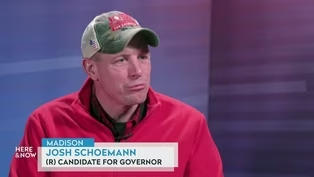
Josh Schoemann on the 2026 Primary for Governor of Wisconsin
Video has Closed Captions
Clip: S2400 Ep2422 | 5m 30s | Josh Schoemann on running for Wisconsin governor in 2026 and politics of the race. (5m 30s)

Mapping a History of Covenants and Segregation in Milwaukee
Video has Closed Captions
Clip: S2400 Ep2422 | 8m 51s | Researchers and volunteers examine where and how racial covenants shaped Milwaukee County. (8m 51s)

Tom Tiffany on the 2026 Primary for Governor of Wisconsin
Video has Closed Captions
Clip: S2400 Ep2422 | 3m 53s | Tom Tiffany on running for Wisconsin governor in 2026 and politics of the race. (3m 53s)
Providing Support for PBS.org
Learn Moreabout PBS online sponsorship
- News and Public Affairs

Top journalists deliver compelling original analysis of the hour's headlines.

- News and Public Affairs

FRONTLINE is investigative journalism that questions, explains and changes our world.












Support for PBS provided by:
Here and Now is a local public television program presented by PBS Wisconsin