
Bergstrom-Mahler Museum of Glass
Season 12 Episode 8 | 26m 48sVideo has Closed Captions
Take in vibrant glass art at the historic Bergstrom-Mahler Museum of Glass in Neenah.
At Bergstrom-Mahler Museum of Glass in Neenah, host Angela Fitzgerald delves into the collection of historic paperweights, Germanic glass and contemporary exhibits. She visits the archives and creates in their glass studio. Plus, discover the World’s Tallest Glass Christmas Tree in Williams Bay and the world’s largest accordion museum in Superior.
Problems playing video? | Closed Captioning Feedback
Problems playing video? | Closed Captioning Feedback
Wisconsin Life is a local public television program presented by PBS Wisconsin
Funding for Wisconsin Life is provided by the Wooden Nickel Fund, Mary and Lowell Peterson, A.C.V. and Mary Elston Family, Leon Price & Lily Postel, Stanley J. Cottrill Fund, UW...
Bergstrom-Mahler Museum of Glass
Season 12 Episode 8 | 26m 48sVideo has Closed Captions
At Bergstrom-Mahler Museum of Glass in Neenah, host Angela Fitzgerald delves into the collection of historic paperweights, Germanic glass and contemporary exhibits. She visits the archives and creates in their glass studio. Plus, discover the World’s Tallest Glass Christmas Tree in Williams Bay and the world’s largest accordion museum in Superior.
Problems playing video? | Closed Captioning Feedback
How to Watch Wisconsin Life
Wisconsin Life is available to stream on pbs.org and the free PBS App, available on iPhone, Apple TV, Android TV, Android smartphones, Amazon Fire TV, Amazon Fire Tablet, Roku, Samsung Smart TV, and Vizio.
Providing Support for PBS.org
Learn Moreabout PBS online sponsorship- Announcer: The following program is a PBS Wisconsin original production.
- Angela Fitzgerald: Coming up on Wisconsin Life: Check out a glass Christmas tree lighting up Williams Bay.
[bright accordion music] The woman running the world's largest accordion museum in Superior.
An art project connecting children around the globe.
- Ben: Yeah, looks great!
- Angela: And... - Go ahead whenever you're ready.
- Angela: ...a welder igniting a spark for future generations.
That's all ahead on Wisconsin Life.
[bright music] - Announcer: Funding for Wisconsin Life is provided by: the Wooden Nickel Fund, Mary and Lowell Peterson, the A.C.V.
and Mary Elston Family, the Stanley J. Cottrill Fund, UW Health, donors to the Focus Fund for Wisconsin Programs, and Friends of PBS Wisconsin.
[bright music] - Hello, and welcome to Wisconsin Life.
I'm your host, Angela Fitzgerald.
Our journey starts with one woman's passion for paperweights, as I peruse through the Bergstrom-Mahler Museum of Glass.
On the shore of Lake Winnebago in Neenah, this free museum was once the residence of Evangeline and John Nelson Bergstrom.
Evangeline was a glass enthusiast and expert in antique paperweights.
Her and her husband donated their home to the city to turn this mansion into a museum.
Ernst and Carol Mahler and other founding members worked to establish the museum in 1959 that celebrates glass art in an accessible way.
Visitors today can still view the Mahlers' Germanic glass collection or fall in love with glass paperweights like Evangeline Bergstrom did as a child.
Folks can engage in community programming... - Teacher: Beautiful!
- Angela: ...take hands-on classes, and visit one of the rotating exhibits.
We'll explore more of the collections and activities here later.
Before we do, let's meet another person sharing their talents with our state.
As we get in the holiday spirit in Williams Bay to see how an annual glass tradition is branching out into the community.
[gentle piano and bell music] - Jason Mack: What stands 36 feet tall, 17 foot wide at the base, has 3,000 pounds of glass on it?
[bright bell and string music] There's nothing else like it.
It's kind of my own invention.
My name is Jason Mack, creator of the world's tallest glass tree.
You really can't ask for a better backdrop for the glass tree than Yerkes Observatory.
- Attendee: Really cool.
- Jason: Thank you!
When the community comes to the event, they actually have the opportunity to put the glass on the tree.
And you're gonna take another step closer to the tree.
And then you're gonna let the glass drip down to the tree.
We gather the glass out of the furnace on a gathering iron, and we gather, you know, about two pounds at a time.
And just let the glass drip off the end of the pipe, and then the tree takes it around.
All the glass that we use to create the tree is donated by the community.
There's a nice blue one right there.
That's what we're looking for.
[glass shattering] We crush it up, shovel it in the furnace.
[furnace roaring] [glass clanking] - Wow!
- Yeah, so that's 2,000 degrees in there.
So you can see it when I dip the pipe in, it's just kind of like dipping a honeycomb stick into a jar of honey.
You can take a step closer and go a little higher if you want.
We add glass to it for about seven to eight days.
It takes about 3,000 pounds of glass to really cover the frame.
The star is five feet in diameter.
Placing the star onto the tree is kind of a nail-biting process, honestly.
So, we're lifting it up almost 50 feet off the ground to make room to drop the star on.
Slow, slow, all right, a little bit more.
Plus, we're doing it in front of hundreds of people as they watch.
The tree itself is 31 feet, and then once we put the five-foot blown glass star on it, it reaches a height of 36 feet.
[crowd cheering] One question I get a lot is, "What do you do with the tree after Christmas?"
We pull all the glass off the steel frame, and I remelt that glass, and I make about a thousand small spun glass trees.
So, that's one thing.
I love the whole life cycle of this project, how you're building something and then you're tearing it down, and then you're building something new with it.
Here you go, step on up.
Hold it up in the air.
I hope people get a sense of inspiration from this project.
I'm really kind of fortunate that this project has really struck a chord, and it's been a fun ride with this one sculpture idea.
I'm doing what I love to do.
[bright music] - Angela: Up next, we travel up north to Superior to meet the woman behind one of the world's largest accordion collections.
[upbeat polka music] Accordion music has danced across our state for nearly 200 years.
Brought from the Old World by European immigrants, that polka sound is synonymous with Wisconsin.
[bright accordion music] - Helmi Strahl Harrington: It's unique and beautiful.
Everybody loves it.
- Angela: That's especially true for Helmi Strahl Harrington.
- I've never known another Helmi.
It means "pearl" in Finnish.
- Angela: Helmi is a pearl like none other.
And she founded the world's largest accordion museum.
[bright polka music] - Helmi: It's nice that it happens to be Wisconsin.
And I say with absolutely no modesty that we are the best because we have the most, but we also have the most unusual.
And some of these are really quite remarkable.
For example, this is a table organ that is like an accordion.
This is for right hand, this is for left hand.
[playing scale on table organ] - Angela: A World of Accordions Museum in Superior is home to instruments that play a unique role in its evolution and history.
- Helmi: It's a very complex instrument that has developed over 200 years and now has 2,500 examples downstairs.
Look at how big these guys are.
This one has 220 buttons in the left hand, and this one has seven octaves in the right hand.
We started a collection of unusual accordions not to be sold, but to be cherished.
- Angela: The oldest instrument on display sits here.
- Helmi: Well, the patent is 1829 in Vienna, Austria, but it was already in progress in Germany, in Berlin and elsewhere.
- Angela: The accordion could also be described as an instrument of war.
It helped Helmi's family rise from the ashes of World War II.
- Helmi: If it weren't for accordions, my mother wouldn't have survived the war, and that included me.
My mother and grandmother had been evacuated from Cologne to south Germany, and that's where I was born.
We survived because my mother could entertain the troops at the Red Cross station.
My grandmother, my mother, and me.
And that's how it was.
I never took my eyes off what she was doing.
- Angela: The gift of accordion music would be her mother's gateway to America.
- She saved three accordions, and she took them on board ship when she came across the sea with me, and an American soldier decided nobody needs three.
So, he threw one over.
- Angela: The two accordions that still exist are here in the museum.
- This was the one that she taught thousands of people on.
I was eight and began to study how to play and then how to repair.
I stuck my nose in her business right away and loved every moment of it.
It was something that she loved, and therefore I loved it.
- Anglea: Passed from mother to daughter, the love of music survived war and endures on stage in a former church that houses the museum.
- We have about a million pieces of music in the music library.
We have a thousand books and several thousand recordings of the infamous and the famous.
We have repair shops.
- Well, it's not in great shape.
- Helmi: It doesn't matter how wonderful the musical sound is and how much enthusiasm it gives your soul.
It still is a piece of machinery that needs repair.
- Angela: Preserving accordions would prove to be a life's work for Helmi.
Now, in her golden years, she sees change on the horizon.
- I'm 78 years old now.
I have stage five cancer, and I've been on the fifth year of a two-year life expectancy for a long time now, and so I'm hoping it'll continue a little longer, but I make no illusions.
[bright accordion music] - Angela: Like her mother, the accordion has helped Helmi through her darkest hours.
And her passion has never wavered.
- Helmi: I started off playing just because I loved it, and I still do.
The music is what they say.
It keeps you happy, keeps your inside humming and strumming as it should.
- Angela: The accordion reflects Helmi's childhood in Germany, her history, and a museum celebrated around the world.
- Helmi: So much has happened in the last 200 years.
Things have been lost, have been burned, have been killed by bombs.
The history of the accordion, its construction and its music, falls into that risk category.
That's part of the passion because in the end, I'm proud not just of the result, but of what it took to get there.
The goal is to keep that going beyond me.
[gentle accordion music] - We're at the Bergstrom-Mahler Museum of Glass in Neenah, delving into this delicate art.
[bright string music] I met up with Executive Director Amy Moorefield to explore how the museum is working to make glass art accessible for all.
- Amy Moorefield: We provide extraordinary glass activities to spark fun, kindle creativity, and illuminate learning for all.
- I love that, 'cause when you think of glass as an art form, you don't typically think of necessarily fun, and then the "all" part.
- Amy: So, we are an admission-free institution, and our founder, Evangeline Bergstrom and John Nelson Bergstrom, wanted that.
That was a mandate.
It's part of our founding documents.
We reenvisioned our mission about three years ago.
We really wanted to have an outward approach to feel more welcoming, which is a really big charge, is to have people come in the door.
It's a little bit challenging for parents when they make that decision, whether they want kids in, because it's, you know, we hear a lot, "Hands at your sides, hands at your sides!"
[Angela chuckles] Glasswork is all about kind of equality, and, you know, it's a democratic approach in how it's made, and it's one of the oldest art forms in the world.
We just want people to feel a little bit more ease to come to the museum.
- Angela: I love that.
So you have child-friendly activities that still involve glass.
So tell us about some of the feedback that you've gotten from community members who come to visit the museum.
- It's not unusual to hear, "We've never known that this glass museum existed."
Our institution's been around since 1959, so there's lots of families who say, "Oh, I remember going on a field trip here or taking art classes here."
And so, that sense of kind of community pride and nostalgia is something that we really relish here at the museum.
- Angela: We left the gallery space for a look into the archives, which was full of surprises.
Oh, wow!
And it's glowing 'cause it's radioactive?
- Amy: Correct.
- Angela: Then I headed to Art Activity Day, which is held once a month and invites guests to create their own glass art.
I sat down with Taylor who manages the studio here to try my hand at this fragile art form.
- Taylor Moeller-Roy: We're gonna make some butterflies today.
- Angela: Mm-hmm.
- We have different wings cut out here.
We have different, like, sheet glass here, which are awesome.
Different pieces you can use to decorate your wings.
So they're symmetrical.
- Angela: Mm-hmm.
We also have stringers here that I like to break and use.
- Angela: Got it.
As I'm doing this, I'm recognizing I have not done anything artistic since, I don't know, elementary school.
[both laugh] The last time that I used glue for anything is elementary school.
So I feel like it is beneficial, right, to have this type of experience.
- Taylor: That's kind of the best part about things like this is we try to give people the skills to work with glass, but we try to keep everything as flexible as possible so that everyone can feel welcome and at home here.
- I love that.
- Even if they don't feel like they have a lot of artistic experience.
- Absolutely, and maybe they're tapping into something that they didn't know they had, artistically speaking.
- Taylor: Yeah, absolutely.
That's my favorite feedback, is when people say, "I love to bring my family here."
People who I see come back month after month for Art Activity Day 'cause it's their favorite day of the month.
- I don't think I've ever done glass art before.
So, you've checked a box off of my bucket list that I didn't know was there until today.
- Awesome.
- It's been added and completed.
So, thank you so much, Taylor.
[laughs] - Taylor: Yeah, happy to!
[playful music] - Angela: Now, let's head to Middleton to join the founder of a project that connects children across the world through art.
- Ben Schumaker: I knew how powerful it feels to study someone's face and try to capture every detail of their eyes and their smile to create the most personal form of art to give to that person as a gift.
It's extremely intimate.
It looks like an art project, but in truth, the real purpose is trying to bring youth around the world together in a positive way.
My name is Ben Schumaker.
I'm the director of the Memory Project.
The Memory Project is a youth arts organization that has a mission of creating a kinder world through art.
So, these photos were... We gather photos of children around the world, and then we give those photos to high school art students who study the children's faces and create handmade portraits as gifts for them.
And then we deliver those portraits to the children.
When we started 20 years ago, we were focusing mainly on orphan, children in orphanages.
We called it the Memory Project because many of those children didn't have any keepsakes that could be a special memory of their childhood.
We thought, well, let's create this beautiful portrait to really capture the child as a work of art and give them that special memory, something they can hold in their hand and take with them through the rest of their life and to know that, you know, someone cared enough to help them capture that piece of their personal life story, how their story began.
We've made portraits for kids in 57 different countries.
We started with children in orphanages, and then, over the years, we started to reach out to children in all types of different situations.
Children in refugee camps, children living in slums or extreme poverty, children living in conflict zones where they're literally hearing gunfire and bombs.
What we ask all of our students to create is on the front of the artwork, that's the portrait of the child.
Some students are using digital art, mixed media, however they want to portray that child, capture that child as a work of art.
But then, on the back of the portrait, that's where we ask the high school art students to put a photo of themselves so that the children who receive the portraits can see who made it for them.
And we also ask them to trace their hand so that the kids can touch hands with them symbolically.
- Abby Otteson: I have never seen our kids more focused on a project than the Memory Project.
I think their heart really goes into getting to know the kid.
It's really fun that the kids suddenly say, "Oh, this is my kid," and they take ownership over those little kids.
It's a perfect project to be able to have our kids give back with art.
And it does turn out to be the most meaningful project that our students take part in.
- Isla Holmstrom: I am painting Rachel.
She is seven, and her favorite things are reading and swimming.
Since she describes herself as fun, I want to use a lot of different colors and undertones to really bring out some of that colorful, fun energy that she has.
I just think it's cool to be able to really show who a person is and, like, capture who they are in an image.
But there's a different level of creativity and a different level of expression you can get when you're painting or drawing.
- Ben: At certain times of year, hundreds and hundreds of packages of portraits come into my mailbox.
My coworker, Sarah, and I, open every package.
Then we bring them here to my parents' house.
We get a whole bunch of their friends together, volunteers, for a whole day just to sort all of those thousands of portraits into numeric order.
And by the end of the day, we have all the portraits in order and then we can do our final processing of them, pack them into bags.
And ultimately, take them on an airplane to wherever they need to go.
And then we'll host a big event for the kids.
It feels like a big party.
And just, it's a wonderful celebration.
[children sing] We deliver all of these portraits.
Fresco, there you go!
It is amazing to see how the kids love to see the portrait, to see themselves for the first time.
Okay, who is this?
They're very surprised that someone would, that they've never met, that this stranger took the time to create this gift for them.
Hugh made that for you.
It's fantastic to watch their reactions.
There you go, good, good.
So you're touching hands with Margot.
[chuckles] We really hope that our art students will realize how impactful their action was, that they took this action to selflessly create this portrait or a piece of identity art, and that it resulted in this magnificent event on the other side of the world.
But I personally feel it's just as important to educate our nation's youth on how to be the most caring, kind people we can be so that we can create a kinder society, which is why the mission of the Memory Project is to create a kinder world through art.
Yes!
This was emailed to me yesterday from a teacher in Massachusetts who has been doing this for 14 years.
He said, "I have had a generation of students "take part in this project, and the experience has been invaluable."
Rachel!
It's beautiful!
"In addition to the international bridges "of goodwill and the lasting memories provided to those in challenging situations..." - Thank you!
- Ben: "... our students have benefited so much from participating."
- Thank you!
- Ben: "It is increasingly rare for students "to have the opportunity to perform a truly selfless act.
"So many of my students got to make art for a higher purpose "than a grade or a possession.
"Thank you so much, and I hope you you will keep the project going for a long time."
[gentle music] - Angela: For our last story, we arc over to Stoughton, where one instructor is sharing her passion for welding with future generations.
- Wanda White: Goodbye.
Leave everything outside that door... Thank you.
- Have a good night.
- Wanda: You, too.
...before you come in here, because you're gonna easily be distracted, and we wanna keep you focused.
So, leave everything outside that door.
My name is Wanda White.
I am a retiree that came out of retirement so that I can teach welding for students, young high schoolers, who is willing to learn the basic welding techniques.
So, today, we're gonna do T joints.
This type of field is very much in demand, so why not lift some of these girls and see if they are that interested and earn a decent paycheck?
I've been welding here at the company for about 30 years.
Gonna put that on the tube.
Right there, that's good.
When I first started, it was mostly male-dominated, so I had to prove myself, and because I was doing so well, they told me, "Oh, you've welded before.
"There's no way you coulda done this and you've never welded."
And they just kept telling me, "There's no way, there's no way."
And within a week, you know, I was out welding on the shop floor and getting better every day.
And then, next thing you know, I was teaching.
Go ahead whenever you're ready.
[tool grinding] I liked what I was doing over the years, and I liked working for the company.
And I thought, "What can I do to give back to the company "that gave me the opportunity to prove myself as a worthy employee?"
We focus on safety, I tell 'em, first, safety comes first, no matter where you are.
Don't forget, use this.
That's safety.
Well, you know what?
Why not teach some of these girls these skills, these welding skills?
I want you to tack right on the edge.
I've been teaching We Can Weld.
This is my fourth year.
All right, go ahead.
I get some great kids come through here.
I want it to be a six-week course.
That's not bad, not bad at all.
So let me get... Because I think that's enough to get the basics done.
I'll get your hook back on, and you should be fine.
- All right, thank you.
- All right?
And I don't mind teaching anybody if you're willing to learn.
- Anna Maudlin: Wanda?
Love her.
[laughs] - Alanah Wilson: I think she's great.
She's... She's probably one of the best welding teachers I've had.
- I constantly ask her questions on how I can be steadier, and, you know, just improve.
- Wanda: I'm always here for you guys.
- Oh, yeah, we can tell that she really wants to be here.
And just, like, you can feel it when she talks to you and when she helps you, so it's really nice.
- Wanda: Yeah, it just makes you feel good.
It makes me feel good.
It's a great accomplishment to me when they're learning a skilled trade that can only improve their life.
And I'm proud of all of it.
Every bit of it.
I have no regrets.
[groovy music] - It's crystal clear the Bergstrom-Mahler Museum of Glass has a lot to offer, just like the stories we've shared from around Wisconsin.
To check out more, visit us at WisconsinLife.org.
Reach out to us by emailing stories@wisconsinlife.org, or connect on social media.
Until next time, I'm your host, Angela Fitzgerald, and this is our Wisconsin Life.
Stay glassy!
Bye!
[bright music] - Announcer: Funding for Wisconsin Life is provided by: the Wooden Nickel Fund, Mary and Lowell Peterson, the A.C.V.
and Mary Elston Family, the Stanley J. Cottrill Fund, UW Health, donors to the Focus Fund for Wisconsin Programs, and Friends of PBS Wisconsin.
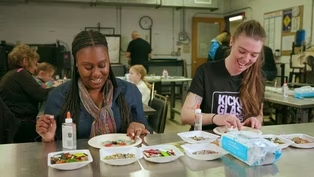
Bergstrom-Mahler Museum of Glass makes art accessible
Video has Closed Captions
Clip: S12 Ep8 | 3m 36s | The free glass museum in Neenah invites families to create art at monthly activity days. (3m 36s)
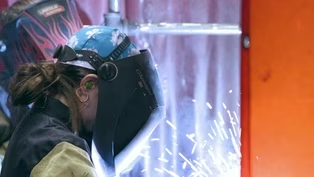
Mentoring the next generation of welders
Video has Closed Captions
Clip: S12 Ep8 | 3m 44s | Wanda White mentors teens in a six-week welding class focused on basics and safety. (3m 44s)
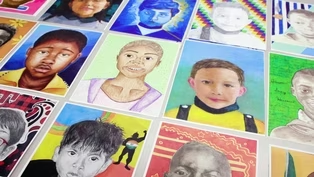
One portrait speaks a thousand words
Video has Closed Captions
Clip: S12 Ep8 | 5m 59s | The Memory Project aims to create a kinder world through art. (5m 59s)
Preview: Bergstrom-Mahler Museum of Glass
Preview: S12 Ep8 | 30s | Take in vibrant glass art at the historic Bergstrom-Mahler Museum of Glass in Neenah. (30s)
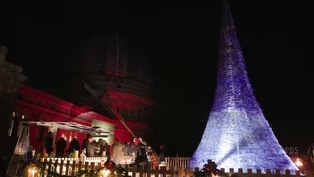
Creating the world's tallest glass tree
Video has Closed Captions
Clip: S12 Ep8 | 3m 38s | Glass artist Jason Mack helps create a one-of-a-kind holiday experience. (3m 38s)
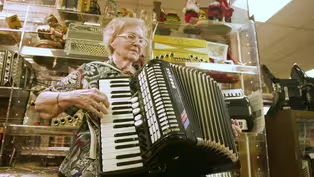
World's largest accordion museum preserves musical heritage
Video has Closed Captions
Clip: S12 Ep8 | 5m 23s | A musical family history inspired Helmi Harrington to create Superior's accordion museum. (5m 23s)
Providing Support for PBS.org
Learn Moreabout PBS online sponsorship










Support for PBS provided by:
Wisconsin Life is a local public television program presented by PBS Wisconsin
Funding for Wisconsin Life is provided by the Wooden Nickel Fund, Mary and Lowell Peterson, A.C.V. and Mary Elston Family, Leon Price & Lily Postel, Stanley J. Cottrill Fund, UW...