Here and Now
Dr. Ryan Westergaard on Hepatitis B Vaccination for Newborns
Clip: Season 2400 Episode 2423 | 5m 58sVideo has Closed Captions
Dr. Ryan Westergaard on continuing guidance to vaccinate newborns for hepatitis B.
Wisconsin Department of Health Services state epidemiologist Dr. Ryan Westergaard describes continuing guidance to vaccinate newborns for hepatitis B after a federal panel changed its recommendations.
Problems playing video? | Closed Captioning Feedback
Problems playing video? | Closed Captioning Feedback
Here and Now is a local public television program presented by PBS Wisconsin
Here and Now
Dr. Ryan Westergaard on Hepatitis B Vaccination for Newborns
Clip: Season 2400 Episode 2423 | 5m 58sVideo has Closed Captions
Wisconsin Department of Health Services state epidemiologist Dr. Ryan Westergaard describes continuing guidance to vaccinate newborns for hepatitis B after a federal panel changed its recommendations.
Problems playing video? | Closed Captioning Feedback
How to Watch Here and Now
Here and Now is available to stream on pbs.org and the free PBS App, available on iPhone, Apple TV, Android TV, Android smartphones, Amazon Fire TV, Amazon Fire Tablet, Roku, Samsung Smart TV, and Vizio.
Providing Support for PBS.org
Learn Moreabout PBS online sponsorship>> Wisconsin health officials are breaking from federal guidance on hepatitis B vaccinations for newborns, and saying babies should get the shot within 24 hours of birth.
A federal panel of vaccine advisors last week voted against recommending all newborns receive it unless their mothers test positive.
Those advisors were chosen by US Health Secretary Robert F. Kennedy Jr., an anti-vaccine activist.
State Department of Health Services Chief Medical Officer, Dr.
Ryan Westergaard, joins us with more, and doctor, thanks very much for being here.
>> Yes, good evening, how are you?
>> I'm well.
So, again, your guidance on hep B vaccines for newborns?
>> Our guidance from Wisconsin Department of Health Services is unchanged actually, and it's the same guidance that has been the standard of care in the United States for the past 30 years, and continues to be endorsed by the American Academy of Pediatrics.
And that is that all children should get vaccinated with three doses of the hepatitis B vaccine, and the first dose should be given in the first 24 hours of life.
This is a standard that has been going on for a very long time, and has been very successful in reducing the prevalence of hepatitis B in Americans.
>> So, why did Wisconsin break with the new federal vaccine guidance?
>> Well, we're not breaking with federal guidance as much as we are reaffirming the standard of care that has been supported by solid evidence for several decades.
The new recommendations that the Advisory Committee on Immunization Practice voted for, and I think it's worth noting that it doesn't have the force of a CDC policy until the CDC director endorses it and publishes it.
That hasn't happened yet, so really it was the committee, as you mentioned, the newly formed committee that voted to recommend something different than what has been the standard of care for many years.
And what they voted to recommend was to take these decisions on a case-by-case basis that people can get the vaccine at the so-called birth dose, but they didn't support or didn't recommend the standard practice, which is that it's the default recommendation for everyone.
And it's that universal, that routine aspect of vaccination at birth which has allowed the public health benefit of driving hepatitis B to very low levels.
And we're very concerned that if that were to change, that we would lose ground, that there would be more hepatitis B among infants, and that's very dangerous because hepatitis B can cause lifelong chronic liver disease and result in cancer and cirrhosis and problems that we have the ability to prevent.
>> How contagious is hep B for newborns or others?
>> Hep B is a bloodborne virus, so it's not contagious through casual contact or through the air or surfaces in the way that we think about colds, flu and COVID.
It's really from blood to blood.
So, during the birth processes, globally and traditionally, one of the ways that babies get infected, it's because there's transfer of blood during the birthing process, but can also occur after birth through contact with open cuts and sores and in routine health care.
In health care settings, most employers will recommend or require that people have evidence of vaccines for hepatitis B because of things like needle sticks.
So, it's very contagious if you do have an exposure like this, either through the childbirth process or a needle stick injury in health care, but not casual contact in day-to-day life.
>> Will insurance cover the shots for newborns in Wisconsin, continue to cover it?
>> Yes, it has been covered by insurance for many years, and our discussions from the health department with the Office of Commission of Health in Wisconsin, or the Commissioner of Insurance in Wisconsin is that it should continue to be expected to be covered.
Nothing should change as a result of the vote from the ACIP.
Our hope and what we're trying to affirm through the memo and through the communications that we as a health department are putting out is that the standard practice shouldn't change because the science hasn't changed.
There's been no new evidence that has come out as a result of this recent committee meeting that would change our conclusion that this is a strong, evidence-supported practice that will prevent infections going forward.
>> How are patients and families to kinda make sense of childhood or even COVID vaccine schedules when the federal advisors are guiding one thing and the state is coming back in and saying, "No, maintain our current guidance."
>> It's a really challenging situation.
The headlines are sending mixed messages, but our recommendation as a health department and what we've learned through dealing with a lot of communication and miscommunication during COVID is that the best source of information, the most trusted source of information for most people in the United States when they ask them is their personal clinician.
So, our hope is that we can put the best available science out there, communicate clearly on what we think that the science says, understand that people will have questions, encourage people to ask those questions of their clinician with whom they have a relationship.
And when the science is available and those conversations happen, we're confident that people can make the right decision.
And in this case, the evidence is pretty clear that hepatitis B vaccination for all children is the safest approach and the most effective approach to preventing this particular virus.
>> We leave it there.
Dr.
Ryan Westergaard, thanks very much.
>> You're welcome.

David Crowley on the 2026 Primary for Governor of Wisconsin
Video has Closed Captions
Clip: S2400 Ep2423 | 6m 4s | David Crowley on running for Wisconsin governor in 2026 and politics of the race. (6m 4s)

Here & Now opening for December 12, 2025
Video has Closed Captions
Clip: S2400 Ep2423 | 1m | The introduction to the December 12, 2025 episode of Here & Now. (1m)
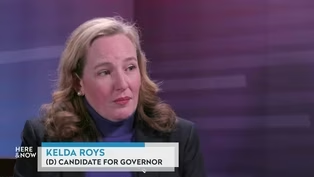
Kelda Roys on the 2026 Primary for Governor of Wisconsin
Video has Closed Captions
Clip: S2400 Ep2423 | 4m 41s | Kelda Roys on running for Wisconsin governor in 2026 and politics of the race. (4m 41s)
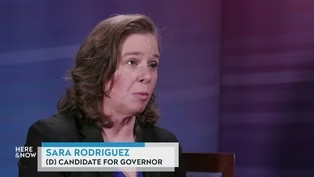
Sara Rodriguez on the 2026 Primary for Governor of Wisconsin
Video has Closed Captions
Clip: S2400 Ep2423 | 4m 43s | Sara Rodriguez on running for Wisconsin governor in 2026 and politics of the race. (4m 43s)

How Farmers at Risk for Suicide Can Find Mental Health Help
Video has Closed Captions
Clip: S2400 Ep2423 | 7m 50s | Family and therapists are increasing efforts to offer support to farmers facing despair. (7m 50s)
Providing Support for PBS.org
Learn Moreabout PBS online sponsorship
- News and Public Affairs

Top journalists deliver compelling original analysis of the hour's headlines.

- News and Public Affairs

FRONTLINE is investigative journalism that questions, explains and changes our world.












Support for PBS provided by:
Here and Now is a local public television program presented by PBS Wisconsin