
Furniture: A North Carolina Legacy | Trail of History
Episode 55 | 27m 4sVideo has Closed Captions
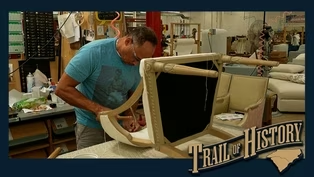
Explore the legacy of NC’s furniture industry, from its humble beginnings to global influence.
Furniture: A North Carolina Legacy explores the rich heritage of the state’s furniture industry, from its humble beginnings to global influence. Discover the craftsmanship, innovation, and cultural impact that shaped generations—a journey through history revealing the stories behind some of North Carolina’s most iconic furniture brands and the people who built them.
Problems playing video? | Closed Captioning Feedback
Problems playing video? | Closed Captioning Feedback
Trail of History is a local public television program presented by PBS Charlotte
Sponsored by Bragg Financial
Support provided by:

Furniture: A North Carolina Legacy | Trail of History
Episode 55 | 27m 4sVideo has Closed Captions
Furniture: A North Carolina Legacy explores the rich heritage of the state’s furniture industry, from its humble beginnings to global influence. Discover the craftsmanship, innovation, and cultural impact that shaped generations—a journey through history revealing the stories behind some of North Carolina’s most iconic furniture brands and the people who built them.
Problems playing video? | Closed Captioning Feedback
How to Watch Trail of History
Trail of History is available to stream on pbs.org and the free PBS App, available on iPhone, Apple TV, Android TV, Android smartphones, Amazon Fire TV, Amazon Fire Tablet, Roku, Samsung Smart TV, and Vizio.
Providing Support for PBS.org
Learn Moreabout PBS online sponsorship(uplifting music) - [Announcer] This is a production of PBS Charlotte.
(uplifting music) (energizing music) - [Narrator] It's all around us, in our homes, our offices, even in our backyards and favorite pubs.
(energizing music) It defines spaces and often our personal style.
(energizing music) It's furniture!
And for more than a century, the epicenter for its design and production, right here in North Carolina.
- Furniture is to this area as tech and computers are to Silicon Valley.
- [Narrator] The furniture industry today supports thousands of well-paying jobs.
- I've got upholsterers that drive very new F-150s and live in very nice homes and have very good lifestyles.
Because you can make a very good career out of the upholstery industry.
- [Narrator] But of course, there's been ups and downs.
Today, the biggest challenge, a lack of skilled labor to work in the industry.
But there's actually an academy aiming to change that.
- [Gary] We've graduated 800 students from this academy.
- The challenge is, of course, they can't generate enough students for the industry.
(energizing music) - [Narrator] Coming up, get a rare look inside local factories, from the people who build the furniture to the artisans who create the fabric and leather, plus the special destination where almost any style is within reach.
So, pull up a chair and kick your feet up as we explore our region's connection to North Carolina furniture on this episode of "Trail of History."
(energizing music) (bright acoustic music) Make a trip to North Carolina and then you'll likely hear it called the Tar Heel State.
(bright acoustic music) It's a popular nickname for the state, and home to some 11 million people and a bustling economy fueled by diverse businesses and industries.
(bright acoustic music) However, throughout much of the 1800s, North Carolina carried another nickname, the Rip Van Winkle State.
It was a title born from a stagnant, almost sleeping economy.
But that was about to change.
(vibrant guitar music) In the twilight of the 19th century, Western North Carolina stood on the cusp of its own industrial revolution and a growing regional identity.
Thanks to several key factors, the seeds were planted to transform the region into what many would come to call the furniture capital of the world.
(vibrant guitar music) According to historian and author of the book "Well-Crafted," Richard Eller says before large-scale furniture factories, the early settlers to the area had few choices when it came to furniture.
- When they came in, they made their own furniture.
But as soon as they were able, had economic means to do so, they began to look for other people to make their furniture.
So they'd either buy from a shop in Charleston and have it hauled up, or they'd get a cabinet maker.
You had all of these cabinet makers who were very good at their craft, and they apprenticed younger furniture makers.
So it's a multiple-generation thing that happened in order for that expertise to kind of build up in this area.
(vibrant guitar music) The other important factor is the availability of wood.
(vibrant guitar music) - [Narrator] What made all of this feasible, the advent of mobile steam-powered sawmills.
- They could drag those mills to the side of the wood, and that would give them the opportunity to fell a tree, saw it up, put it on some sort of wagon, instead of having to drag the whole trunk in.
(machinery whirring) (vibrant guitar music) Once the wood becomes available, and a lot of it was shipped out of the area, then you get people with the enterprising idea to say, "Why don't we turn that into something value added?"
The earliest one I have found was a guy named Daniel A. Smith, who was a retailer, furniture retailer.
Had a store in Charlotte, had one in Wilmington, and he got the idea that he should get into the making of it as well, because that was going to be a lucrative business.
(train choo-chooing) So, what he did was he went as far west as the train would take him in Western North Carolina, which was Old Ford at the time, and he built a factory, and this is around 1875, and was so successful with it that the head of the Western North Carolina Railroad bought his factory and moved it to Morganton.
- [Narrator] While skilled workers and plentiful timber were essential, the catalyst that gave the furniture industry its foothold in Western North Carolina... - It really is all about the railroads too, because the only reason Lenoir began to buy into that idea in 1889 was because the railroad got there five years before.
So you can bring your wood in, you can truck the finished pieces out, and that's the start of the furniture industry in Western North Carolina.
(bright acoustic music) - [Narrator] Fast forward to the start of the 20th century.
- Each of these towns had a cotton mill, but the furniture factories were in much greater abundance than the cotton mills.
Hickory gets involved in 1901 with Martin Furniture and Hickory Furniture, which shared a sidetrack to the railroad.
- [Narrator] Much like the textile industry, furniture offered new opportunities for people in the region.
- [Richard] It generally meant steady work, because unlike the farm, you got paid every week to work in a factory.
(bright acoustic music) - [Narrator] One thing is for certain.
Starting a furniture factory takes a certain type of person, someone willing to take risks.
Someone like Alex Shuford's grandfather, Harley Shuford Sr.
- In those early decades, it was kind of the wild, wild West.
You had a lot of true entrepreneurs, like my grandfather and others here, that were founding companies and growing them quickly, and some survived and some didn't.
A lot of fun family stories about the sort of boom-bust scenarios over time, I think he nearly went out of business three or four times.
- [Narrator] Harley's appetite for entrepreneurship didn't lead him directly to furniture.
- My grandfather got into the woven textile business in the '30s.
Valdese Weavers was a customer of theirs up in Valdese, North Carolina, and he bought them in the '30s.
The family legend goes he either won them in a poker game or bought them for a dollar and assumed the debt, right?
'Cause it was the '30s and everybody was struggling.
- [Narrator] Fast forward to the post World War II era and GIs returning home to the United States.
- My grandfather realized there was going to be a pretty unique need for furniture, and there were a lot of shortages.
And he knew a person that had access to springs, and of course he had an upholstery fabric company.
And so he started going around town and talking to a bunch of little upholstery manufacturers and saying, "Look, if I give you the fabric and I give you the metal springs and I tell you to make this particular item for me and buy all your production, will you do that?"
And he set up about 15, 16 little upholstery associations around town, and... - [Narrator] But that little association came with unforeseen issues that inspired Harley Shuford to take control of the whole process.
- The reason he started his own factory is he found a couple of his subcontractors were going behind his back and selling the furniture that he was supposed to be buying from them directly to his customers for less.
So he bought a little upholstery company in 1947 here in Long View, North Carolina, the original Century Factory.
And then a couple years after that realized that upholstery was fairly easy to get into, not a lot of barriers to entry, and that it would be much more difficult to be in the case goods or wood furniture business.
And so we started investing in a US case goods factory, which is actually the building we're in right now, in 1949.
- [Narrator] Now, every company needs the right name to stand out.
- We were competing with companies that had been around for 40, 50 years, like Hickory Chair, 1911.
But because we were the new company on the block, we wanted a name that sounded like we had been around forever.
So they named it Century.
(upbeat music) - [Narrator] Through all the ups and downs, nearly eight decades later, the company started by CEO, Alex Shuford's grandfather, is still going strong.
- Family-owned still, third-generation, and proudly North Carolina-based - [Narrator] Today, Century Furniture falls under the umbrella of Rock House Family of Brands.
- The Rock House Family of Brands is an assortment of what I would consider better-end or luxury furniture brands predominantly made in the United States.
We operate out of nine factories here in North Carolina, seven of which are upholstery factories, two wood product factories, across a brand portfolio of about six different brands.
- [Narrator] As you might imagine, they're a major employer in the region.
- [Alex] About 1,750 people here in North Carolina.
- [Narrator] The types of jobs vary as much as the furniture styles they produce.
(gentle acoustic music) Art Robles started a Century in 1998.
- [Art] I work on the product development department.
- [Narrator] When a new design comes off the drawing board that requires upholstery, Art gets to work, making sure the foam and the fabric fit just right before Century commits to full production.
- I enjoy working here.
It's stressful sometimes.
You got deadlines to turn in.
You know you got to be there.
This got to be done a certain time and a certain way.
- [Narrator] The industry veteran says it's rewarding work.
- I'm able to, you know, pay the bills, of course, and do well for my family.
And of course, I'm getting older now and just looking for a time to go out the door now, of course.
But it's been good.
I mean, it's a good ride and it's a good company to work for.
- [Narrator] Art's not the only family member making a career at Century Furniture.
Meet case goods product coordinator, Alee Robles.
- There's a little bit of everything.
So we kind of start from the initial design process and kind of what that looks like onto the maintaining of the skew, it's maintaining the price list, the website.
And a lot of it really is just like the design direction and where are we going, and kind of making sure that everything aligns, we have everything teed up that we need to to start that development process - [Narrator] When deciding on a career path, Alee had an obvious role model, her father, Art.
- He's always loved working here.
He's always had nothing but good things to say about here.
So when it came time in my career path that I was shifting and trying to figure out what I wanted to do and, you know, what does a career look like for me, I was like, "Well, let's explore and let's kind of see what that is like."
- [Narrator] While they don't work in the same facility, their paths do cross from time to time.
- I like that because, you know, she comes up the plant, like, "Hey, dad.
What's going on, man?"
You know, hang out at work, you know, at the plant.
But it's good.
(bright acoustic music) - [Narrator] There are hundreds of steps that go into getting a piece of furniture from the factory to your home.
Once a maker settles on a design, they need a way to get it in front of potential dealers.
- Furniture business is all about introduction of new style.
- [Narrator] In the 1950s, Hickory businessman J. P. Mull took a chance by seizing out an opportunity to help bring furniture makers and furniture dealers together.
(bright acoustic music) - When furniture dealers from across the country would come to Hickory to see each manufacturer's latest introductions, my grandfather at the time recognized a need for the manufacturers to have space where the dealers were staying and eating, for them to have space to show their furniture.
So, the Mart actually grew out of the basement of Mull's Restaurant - [Narrator] Mull soon brought in his son-in-law, Leroy Lail, to join the family business.
Today, Leroy's son, Brad Lail, is part of the third generation running the Hickory Furniture Mart.
- My father in the early '60s really took hold of the Mart, and that's when it really began to grow.
But there began to be two distinct areas of manufacturing and furniture influence.
Hickory and a town that's often confused with Hickory, High Point.
High Point began to organize a furniture exposition, which is what we were doing here at the Mart at the time.
- [Narrator] Over time, High Point's spring and fall markets started to disrupt business at the Hickory Furniture Mart.
- They built some big showroom spaces, and it became most cost-effective for the manufacturers to show in one location.
It wasn't really cost-efficient for them to show in Hickory and in High Point.
- [Narrator] But that didn't deter the Lail family.
We've had to adapt over the years.
From the '50s to the '80s, the Mart was only open to dealers.
Now the Mart is open to the public.
(bright acoustic music) Today, the Mart is one of the nation's leading destinations for home furnishings.
- [Narrator] Through the decades, the Hickory Furniture Mart has seen several expansions, and today is comprised of individual showrooms, giving potential customers almost countless options.
- We have showrooms here that have been here 30-plus years.
- [Narrator] One of those showrooms, Reflections Furniture.
- The Furniture Mart has been paramount to our success.
Hickory is the undeniable furniture capital of the USA.
It's the cornerstone of American manufacturing at its finest.
And this is where it all started.
- [Narrator] Reflections Furniture was the brainchild of Vanessa Guidi's father, Giovanni.
- When we opened at the Furniture Mart, it was very small and we grew, grew, and grew from 3,000 feet to today, 50,000 feet or more.
- [Narrator] These days, Vanessa handles the day-to-day operations at the store, while always taking a customer-first approach.
- It's very highly client-based.
We guide them as best as we can with... If they know what they want, we can certainly hone that in a little more.
But if they don't know what they want, we can hopefully help them try to understand what they want a little more.
- [Narrator] She recognizes the impact the Hickory Furniture Mart has on the industry.
- The visionary of creating this building to sell the furniture in such proximity to where it's made, it's a treasure, it's a gem.
- Eight out of 10 people, when they hear I'm from Hickory, will ask about furniture.
Hickory is just known for its furniture manufacturing.
And of those eight, four of them will specifically mention the Mart.
- [Vanessa] People don't realize they're walking through history when they walk through these halls.
It's just the pinnacle of furniture shopping.
(gentle acoustic music) - [Narrator] Before opening Reflections Furniture, Giovanni Guidi worked as an engineer for an Italian glass manufacturer.
When his company opened a plant in the region to supply the furniture industry, Giovanni then immigrated to the United States.
- I was 25 years old.
Then all the people I met around here being in the furniture industry because they were also a customer of the glass company.
- [Narrator] Through those connections, Reflections was born.
But he didn't stop there.
- Most of the Italian people I met were in the leather industry.
And so some Italian friends said, "Why don't you sell leather?"
- [Narrator] Giovanni took their advice and created Euroleather.
- [Giovanni] At the time we were just buying and selling leather from Italy.
- [Narrator] But he still itched to do more.
- Being an engineer, you know, had the envy to do something, you know, get my hands on it.
So, I bought a little piece of machinery and just start to finish some leather on our own.
- [Narrator] Using several processes, including a few proprietary ones, the company transforms imported leather hides into the countless colors and textures that the furniture makers desire.
(bright acoustic music) Located in Newton, Euroleather as a supplier is part of a greater furniture economic ecosystem.
- [Giovanni] The leather that we make is for the furniture industry.
And so this is where it's happening.
(bright acoustic music) - [Narrator] Just west of Hickory, in Valdese, you'll find another company with deep roots in supplying the furniture industry.
Inside this massive textile plant, the folks at Valdese Weavers design and produce fabrics used by the various furniture companies.
(bright acoustic music) If the name Valdese Weavers sounds familiar, it should, as it's the same company once owned by Century Furniture founder, Harley Shuford Sr.
(bright acoustic music) - Valdese Weavers has been around since the early 1900s.
And so it began as the Swiss Embroidery Weaving Company.
In the 1940s, Harley Shuford acquired the company, and that's really when the growth trajectory really took off.
- [Narrator] Today the company is employee-owned and led by president and CEO, Blake Millinor.
- Valdese Weavers is a manufacturer supplier of upholstery fabrics for the residential and contract markets.
We have four facilities within about a 10-mile radius and over 600 associates.
- The people is what makes this place.
And, you know, we are a family and we're all for one, one for all.
And it just makes you proud to be here.
- [Blake] We're always looking to promote from within, where someone can come in in an entry level position and have a lot of career options.
We're proud to be one of the significant employers in Burke County.
(bright acoustic music) - [Narrator] Blake says the company's long connection with the furniture industry gives them a distinct advantage.
- [Blake] Customization's been a huge part of our success.
The ability to provide short runs for the furniture manufacturers, for these custom options for the consumer has been a big part of our success.
- We don't rest on our laurels.
We are constantly striving to take that next step forward.
- [Narrator] Inside this century-old textile company, you don't have to look very far to find threads that weave their way into the region's furniture story.
- My husband's family and my family as well have been part of furniture industries, you know, in the Caldwell County and Catawba County for years.
- We're in a tight-knit community, and one which we go to church together, go out to eat together.
So, a lot of these customers are lifelong friends.
And that's been the case for generations.
- [Narrator] Besides bumping into friends in their community, it's also common for them to find their product.
- You're always like, "Oh, I think that's ours."
"Oh, I know that's our fabric."
"Oh, let's see what frame it's on."
And so it is just, the salespeople probably are like, "You know more about the product than we do because you recognize the fabric."
And I said, "Yes."
(laughs) - [Lisa] And to be able to say that we've been in business for well over 100 years, it makes me feel proud.
(bright acoustic music) - [Narrator] Now, it's not always been all rosy for the North Carolina furniture industry.
- I would tell you that every five or six years there is a unimaginable black swan event that hits this industry, you know.
And my grandfather dealt with numerous of them over the years, and my father and uncle and aunt dealt with a number of them.
And if you look at kind of the crop of companies that existed in and around that time, and then you take it forward, a lot of them aren't here anymore.
The Henredons and the Drexel Heritages and the Thomasvilles and the Broyhills, and a lot of great local names that really made this part of North Carolina, they don't exist anymore.
- [Narrator] The 1990s and early 2000s were particularly challenging.
- After NAFTA, they began the process of offshore.
And when they do, they don't need this southern labor.
That originally a lot of these companies were viable because the labor was so cheap.
I think it was 1996 or 7 Singer laid off like 700 people.
And it was so bad that the governor's office from the state of North Carolina sent an emergency team up here to get everybody signed up for unemployment.
That's how catastrophic it was.
- [Narrator] Hardest hit, the case goods sector.
- You would set up a case goods or a wood furniture factory and make 500 of the same chest of drawers.
And that method of construction lended itself very well to, you know, overseas production.
Because you could set up a foreign factory to make that same piece, but do it with labor that was 85, 90% less expensive.
The upholstered furniture industry really didn't suffer in the same way because it was a much more customized product.
People want to tailor it to their particular tastes from a fabric standpoint, size standpoint, et cetera.
- [Narrator] This all resulted in unintended consequences.
For most of the 20th century, thousands relied on the industry for work.
- [Richard] It was generally steady employment and multi-generationally.
People would go into the factory because they got a steady income every week.
- [Narrator] But now that reputation was tarnished.
- What happened is the industry got a black eye from an employment standpoint, and we lost out on an entire generation of young craftspeople that might have come into this business, but instead chose other industries.
That dislocation in that period of time created a real negative association for the industry within a group of employees who then spoke to their kids about, you know, "If you're looking at a career choice, don't pick furniture."
And that negative brand association kept people from coming into the industry as young trainees, and then 15, 20 years later, we as an industry are lacking that skillset.
(bright acoustic music) - [Narrator] Though case goods may never come back to the region in a significant way, upholstered furniture is still thriving.
Sofas and chairs with all their customizable options make them difficult to manufacture overseas.
But there's a shortage of labor.
Thankfully, one industry partner created a solution.
(bright acoustic music) On a warm August evening in Newton, the sounds of staple guns and sewing machines filled this 38,000-square-foot warehouse.
(bright acoustic music) It feels like you're inside a state-of-the-art furniture factory, but the makers here are students.
(bright acoustic music) Welcome to the Catawba Valley Furniture Academy.
- The purpose of the Furniture Academy is to support all of our business partners, the furniture industry in our area.
- [Narrator] The intense hands-on program specifically addresses the labor shortage facing the industry.
- We treat this just like a factory.
They clock in when they come in, so if they're late, they get talked to.
They can't clock out early.
I mean, we try to make it as real-life experience because that's what they're going to get when they leave.
- [Narrator] Catawba Valley Community College partnered with area furniture manufacturers, not only to craft the curriculum, but also... - [Gary] They supply the instructors who are with us tonight, working with our students, training them in the various skills.
And they're experts.
Most of them have 20 to 30 years experience.
- It's not an academic-type setting where you come in and say, "Okay, class, open the book.
I'm going to show you a video of a guy springing up."
It's nothing like that at all.
It's actually somebody that upholsters all day or it's a supervisor of an upholstery shop, and then they come here at night to teach.
- [Narrator] One of the newer instructors, Maria Rangel.
- [Maria] I actually work at Williams Sonoma, - [Narrator] Before she landed the job at Williams Sonoma, Maria first attended the very program she now teaches.
- And I feel like I'm giving back.
It's like they don't understand.
They think that I'm doing them a favor, but it wasn't that way.
It was the other way around.
They helped me and my family out.
(bright acoustic music) - [Narrator] With gratitude in her heart, Maria enjoys paying it forward.
- I'm able to translate.
So, it's like they don't have an issue with not being able to understand, because whatever the instructors are telling them, I just translate for them.
And I can also relate to them, how they feel.
Because whenever we first started, we didn't know the sewing language.
You know what I mean?
We didn't know what "double needle" or "top stitch."
We didn't know any of that.
And just knowing it makes you feel more confident and makes you feel better.
And me being able to show that to them and teaching them, it makes me feel really good.
- [Narrator] The program's success speaks for itself.
- That Furniture Academy is showing young people that, hey, there's not just a career choice here, but also it's based along a progression that you can get on board with.
- We've graduated 800 students from this academy, and they've all been offered jobs, and they successfully completed their course.
- The challenge is, of course, they can't generate enough students for the industry.
(bright acoustic music) - [Narrator] While successful, everyone admits there's still work to be done.
- We've got to get over that hump of what people thought back in the early 2000s, when their parents who might've been in the industry said, "Hey, do something other than furniture."
- [Narrator] But with each staple and each stitch comes a feeling of optimism.
- I enjoy seeing people come in here and when they leave, they will have a real job opportunity.
We're giving them a skill that they can go into a furniture company and have a job that's going to be a well-paying job.
(bright acoustic music) - [Narrator] The furniture industry in Western North Carolina, for more than a century, has meant more than a bottom line on a spreadsheet.
- I think the legacy was it gave this area identity.
It gave it a reason to be proud.
When Broyhill started giving their furniture or showing their furniture, "Oh, the price is right.
You know you could win it," and it said, "From Lenoir."
And that was just an incredible source of pride to a lot of people who said, "Yeah, I helped make that."
And this whole area, I think, gained a sense of who we were.
It gave us a reason to be.
- [Narrator] And like the early entrepreneurs that took a chance on the industry in the 1800s, the industry continues to reward those willing to take a risk.
- It's a dream comes true.
I mean, no other country in the world could offer you this, could make this happen.
Because you can work as hard as you want, you can be as smart as you want and put as much intention, but I mean, America made it so easy.
(bright acoustic music) - [Narrator] So, next time you curl up on your sofa to binge your favorite show or gather at the kitchen table with your family, you might just take a moment to appreciate what's so often taken for granted, our furniture and the people behind it.
Thank you for watching this episode of "Trail of History."
(energizing music) (energizing music continues) (energizing music continues) (energizing music continues) (bright orchestral music) - [Announcer] A production of PBS Charlotte.
(bright orchestral music)
Furniture: A North Carolina Legacy Preview| Trail of History
Preview: Ep55 | 30s | Explore the legacy of NC’s furniture industry, from its humble beginnings to global influence. (30s)
Providing Support for PBS.org
Learn Moreabout PBS online sponsorship















Support for PBS provided by:
Trail of History is a local public television program presented by PBS Charlotte
Sponsored by Bragg Financial