Here and Now
Here & Now for December 12, 2025
Season 2400 Episode 2423 | 26m 49sVideo has Closed Captions
Watch the entire episode of Here & Now for December 12.
Watch the entire episode of Here & Now for December 12.
Problems playing video? | Closed Captioning Feedback
Problems playing video? | Closed Captioning Feedback
Here and Now is a local public television program presented by PBS Wisconsin
Here and Now
Here & Now for December 12, 2025
Season 2400 Episode 2423 | 26m 49sVideo has Closed Captions
Watch the entire episode of Here & Now for December 12.
Problems playing video? | Closed Captioning Feedback
How to Watch Here and Now
Here and Now is available to stream on pbs.org and the free PBS App, available on iPhone, Apple TV, Android TV, Android smartphones, Amazon Fire TV, Amazon Fire Tablet, Roku, Samsung Smart TV, and Vizio.
Providing Support for PBS.org
Learn Moreabout PBS online sponsorship>> The following program is a PBS Wisconsin original production.
>> Winning candidates to be the next governor are pounding the snowy pavement and coping with stressful times.
Farmers find strength in connection.
I'm Frederica Freyberg.
Tonight on "Here& Now", we continue our interviews with candidates for governor.
Tonight we speak with the first of many challengers in the Democratic primary.
[MUSIC] Then a story of tragedy and hope.
As farmer suicides have increased over the years.
Increasingly, they're asking for help.
It's "Here& Now" for December 12th.
>> Funding for "Here& Now" is provided by the Focus Fund for Journalism and Friends of PBS Wisconsin.
>> As we continue our interviews with the candidates running in the Wisconsin primary election for governor, we start with current Lieutenant Governor Sarah Rodriguez "Here& Now" senior political reporter Zach Schultz with Moore Rodriguez.
>> Thanks for joining us.
>> Thank you so much for having me.
know who you are that well, tell us who you are and why you're running for governor.
>> So I am the current lieutenant governor here in Wisconsin, but I have spent most of my career in health care.
I'm actually a nurse by background, and I've worked in so many different roles within health care, whether it's night shifts in the E.R.
all the way to being an executive within a health care system, and one of my roles as lieutenant governor is that I get to go to all 72 counties, and I have done that every single year that I have been lieutenant governor.
And when I talk to people there, they're telling me the same thing, that they are doing everything right, but they're feeling squeezed.
And whether that's accessible, affordable health care, child care, we keep raising our taxes to pay for our public schools.
I mean, these are the things that people are talking to me about, and these are the things that I would like to be able to address as governor.
that drives you as a candidate, or perhaps a lane within the Democratic Party that may define you?
>> I think that I have so much experience within health care, which is a complicated space, and we've seen what's happening now in Washington, where they're taking away the subsidies for the people who are going to get their insurance on the exchange.
These are small business owners, these are farmers.
These are people who are trying to make a living, and their premiums are going to double, maybe even triple in Wisconsin.
And so having somebody who has that expertise in healthcare to be able to do that here in Wisconsin and actually make a demonstrable difference in people's lives, that's something that I'm really excited about.
>> How much money do you think you're going to need to raise in order to be successful in this primary?
know, I've been talking about this with so many different people, and it is going to be millions of dollars to be able to be successful in the primary.
But I've got support all over the state.
I've got endorsements in all 72 counties.
I got the first statewide union endorsement, it's AFSCME, it's the public workers, municipal municipality workers, and was just really proud and honored to be able to get that endorsement and excited about all the support that I'm seeing all across the state.
>> When it comes to a competitive primary.
How do you personally define the difference between negative campaigning versus defining differences between candidates?
>> Well, we're all going to have to make our arguments to the voters.
We're all going to have to say what we're bringing to the table and what type of experiences we have that are going to make us good governors.
And I would say for myself, I'm one of the only candidates.
I am the only candidate in the race who's actually been able to flip a district from red to blue.
I did that when I was in the assembly.
I'm also somebody who has extensive private industry experience elected office.
That's a good balance between those two things.
I know what it's like to work shift work.
I know what it's like to be an executive within a what it's like to be an elected official.
You're going to need all those skills to make sure that you have a governor who's going to be ready on day one.
at all these candidates should be thinking more in terms of which candidate maybe has an issue they most closely align to, or is it about electability?
>> I think it's both.
I think you can look at the issues for all the different candidates and values, but then we also have to look to the general to see who's going to be able to get across the finish line in November.
>> Most of the candidates in this race have connections to either Madison or Milwaukee.
What are you doing to reach the rest of the state?
Rural areas, exurban areas?
live in Waukesha County.
And so that is not that is very different than Milwaukee County.
But what I am doing in the primary is I am again going to all 72 counties.
We are doing listening sessions all across the state because I firmly believe you can't lead unless you listen.
And so that's how I'm doing my outreach.
I'm going to continue to do that tour all across the state, hearing what people want in their governor, hearing what's going on in their communities, because all politics is local and we need to be able to listen to our constituents.
>> What impact do you think Donald Trump will have on this election?
chaos in Washington right now.
And I think when we're looking at who could possibly be the Republican governor candidate, that's Tom Tiffany there is very little daylight between him and Trump.
And so if that chaos in Washington could absolutely trickle down into into Wisconsin, if somebody is going to be electing Tom Tiffany as governor.
>> Thank you so much for having me.
you'll get to know those running in the August primary for governor.
Last week, you heard from two Republicans in the race.
Up next, Zach sits down with Milwaukee County Executive David Crowley.
>> David Crowley, thanks for joining us.
>> So happy to be here.
Thank you for having me.
>> So for voters who don't elevator pitch, introduce running?
husband.
I'm a father.
I'm the Milwaukee County executive and a lifelong Wisconsinites.
And I was born and raised in the city of Milwaukee.
And I know there's so much that our entire state has to offer.
And so I'm running for in the state, I believe in its people.
But more importantly, I know how to deliver results.
And I know that there are a lot of people who are dealing with the affordability crisis.
And, you know, there are many families who are getting less, even if they're making more and more money today.
And so with life getting more expensive and families getting Streu's, it doesn't mean that we can't help Wisconsinites out.
And that's why I'm running for governor to be a governor for all of us.
>> Is there a single issue that drives you, or perhaps a lane within the Democratic Party that defines you?
affordability crisis because things are rising in costs, whether we're talking housing, whether we're talking groceries, we're seeing utilities and people are seeing the rise in inflation under this current administration, and they want somebody who's going to be there for them, not just the governor who's going to listen, but who's built solutions from the ground up, who's going to make sure that people are at the table who are directly impacted by the sure that they can be a part of the decision making.
At the same time.
>> How much money do you need to raise in order to be competitive and win this primary?
to tell you that it's unfortunate how much money is being spent in elections that we have been breaking many, many different records when it comes down to campaign spending.
We've seen that in the two Supreme Court races here locally.
But I also don't think that we should play behind the eight ball.
And so I'm going to continue to fundraise here locally to make sure that we have enough resources to get us over, not just the primary election, but to get us through the general as well.
>> When it comes to a primary like this, what is the line for you personally between negative campaigning against a member of your own party versus defining maybe some flaws or some issue differences between you and an opponent?
>> You know, these elections are opportunities for the electorate to know who each person is.
And so we're going to just stick to the facts, stick to the things that, you know, we have done on this, on this campaign trail, what I have done as Milwaukee County Executive.
This isn't about mudslinging.
This is really about focusing on how we are going to deliver results for those that we represent.
No matter if you live in an urban, suburban or rural area, this is about how to make sure that we're going to make life easier for those families, for those individuals, for those workers every single day.
And that's what we're going to focus on, because that's what matters.
That's not a Republican or about the Wisconsin agenda.
>> So for voters who only care about winning, of seeing their party win, do you think they should be focusing more on the issues that candidates represent >> Well, we got to focus on on both.
We got to focus on the issues that are affecting communities all across this entire state.
But we also need someone who has experience.
You know, I bring a very unique executive leadership, spending seven years in the state Capitol, but also serving as the county executive for the past five years.
And so I'm the only candidate in this race that has experience in the legislature, but actually running a government, balancing billion dollar budgets and really tackling the issues head on.
So I think it's a it's a combination of both, but it's about how do we outside of our comfort zone, go all across the entire state of Wisconsin to let voters know what we're putting on the table?
>> Most of the Democrats in this race have connections either to Madison or Milwaukee.
How do you reach the rest of the state?
Rural Wisconsin Outstate >> Well, I think it's no secret.
I'm uniquely positioned to bring out more Democratic votes out of Milwaukee County than any other candidate in this race, especially winning with 85% of the vote.
With my last reelection just in 2024.
But it's about showing up.
Folks want a governor who's going to listen, who's going to be there for them, and make sure that they're at the table when it comes down to figuring out those solutions.
And I'm the only candidate who has to, that has a proven track record that I can deliver on the things that we're talking campaign trail in 2023, you know, I worked together to build a coalition all across the state of Wisconsin, building stakeholders, government business leaders to pass act 12, which allowed for more money to come from Madison, to go to every local municipality, no matter its size, so they can invest in things that matter for them.
Things like fire, police, housing, transportation, the quality of life issues that matter to those local residents.
And I'm going to continue to do that as the next governor of Wisconsin.
>> What impact do you think Donald Trump will have on this primary, first of all, and on the election in general?
know, no matter who is in the highest office in the land, whether that's a Democratic Joe Biden or President Donald Trump, they're going to put their thumb on this scale.
But I think it's extremely important that it's not just about fighting back against many of these dangerous policies that we're seeing coming out of Washington, D.C.
it's about what vision, what agenda?
As Democrats are we going to put on the table?
I know that I'm frustrated with who's occupying the white House like many others, but also as a healthy level of frustration with Democrats and Republicans not being able to put an agenda on the table, not bringing a cohesive message to really energize the base and put something put an alternative out there.
And we're going to do this on this campaign, making sure that folks understand that this is going to be a new campaign, whether you're a Democrat, Republican or independent, or don't care about politics in general.
There's room on this campaign for you.
>> All right.
David Crowley, thanks for your time.
>> Thank you so much.
Thank you for having me.
>> Another of the total of seven Democrats running for governor, State Senator Kelda Roys tells us about her experience and candidacy in this interview with Zac Schultz.
>> Kelda.
Roys, thanks for joining us.
Zach.
elevator pitch, introduce yourself and say, why are you running for governor?
>> I'm running for governor because Wisconsin needs higher wages, lower costs and more freedom.
We face a huge threat from the Trump administration, and we need a governor who is willing to stand up to the bullies and billionaires and fight to protect Wisconsinites same time, we also have an incredible opportunity to actually elect a governor who is able to govern and pass laws with a new, fairer legislature.
>> Is there a single issue that drives you, or perhaps a lane within the Democratic Party that may define you?
>> I think it's all about making it possible for working people to have the freedom to thrive in this have seen their wages stagnate or even go down.
Meanwhile, the cost of living are skyrocketing.
Everything from housing to healthcare, childcare and utilities is going up.
We have to make Wisconsin a place where people can afford to live and have a good life.
need to raise to be competitive and win this primary?
And will that leave any room for the general election after that?
>> Yeah, I'm very confident that we're going to have a good pot of money that's been raised by the Democratic Party and national partners for whomever our nominee is.
I think the primary, it depends on who all is running, but I'm confident I'm going to have the resources needed to run a strong campaign and prevail.
>> When it comes to a competitive primary, you're no stranger to those.
your view, between negative campaigning against a versus defining differences between candidates?
>> Well, I think primaries are really important opportunity for voters to vet the candidates and see what their experience is, see how they perform under pressure.
There's going to be a huge spotlight on Wisconsin.
This is an incredibly important high stakes race in one of the most pivotal states in the country.
And it is essential that we have a governor who not only is able to stand up to the Trump administration when needed, but also capable of actually making the change that we need in this narrow window of opportunity that we're going to have.
>> When primary voters are looking at these candidates, should they be thinking in terms of which issue they most closely relate to, a candidate or simply electability?
>> Well, I think each voter is going to decide for him or herself what matters.
And I ask everyone in Wisconsin for your vote on August 11th and November 3rd.
But I really want to make the argument that whatever the issue that you care about is, the most important thing is having a governor who can win and who can actually get things done.
I have spent over 20 years working in and around state government in a variety of capacities as a legislator in the Senate and the Assembly, as the only candidate running that served on the Joint Finance Committee, small business owner, mom, attorney and I have been able to get meaningful legislation passed on a whole variety of issues through every split.
Those skills are going to be essential for our next governor.
If we want to actually make change in this state.
>> All of the Democrats running for office have connections either to Madison or Milwaukee.
What is your job in terms of introducing yourself to the rest of the state, especially rural Wisconsin, that may not recognize your name?
spent my career traveling around the state and building relationships and trying to build democratic power.
And I'm actually from Taylor County.
I was born in Marshfield, grew up in a one room schoolhouse in rural Taylor County, north of highway 29.
I'm the only candidate that had a pet goat as a child, and so it's been really fun for me to travel around the state, areas where I have deep family roots or other connections that I've built throughout my career, reconnect with people and meet new people, and the reception has been really strong.
impact of Donald Trump will be on this election?
>> I think that people in Wisconsin are feeling angry and hopeless about the economic situation, the chaos and the corruption that we are seeing by this administration is unprecedented, and we're also seeing him shredding our Constitution and the and as a patriotic American, I think that what Trump is doing is totally unacceptable, and we need to have strong governors who are willing to stand up and hold him accountable, you know, private paramilitary force that he's building with ICE.
We can have secure borders without violating people's rights and destroying the things that make this country good.
>> Kelda Roys, thanks for your time.
>> Great to be with you.
Thank you.
>> Wisconsin health new federal guidance on hepatitis B vaccinations for newborns and maintaining current guidance that babies should get the shot within 24 hours of birth.
State Department of Health Services Chief Medical Officer Doctor Ryan Westergaard shared more.
>> Guidance from Wisconsin Department of Health Services is unchanged, actually, and that is that all children should get vaccinated with three doses of the hepatitis B vaccine, and the first dose should be given in the first 24 hours of life.
This is a standard that has been going on for a very long time, and has been very successful in reducing the prevalence of hepatitis B in Americans, and we're very concerned that if that were to change that we would lose ground, that there would be more hepatitis B among infants.
And that's very dangerous because hepatitis B can cause lifelong chronic liver disease and result in cancer and cirrhosis and problems that we have the ability to prevent.
>> How are patients and families to kind of make sense of childhood or even Covid vaccine schedules when the federal advisers are guiding one thing and the state is coming back in and saying no, maintain our current guidance.
>> Our hope is that we can put the best available science out there, communicate clearly on what we think the science says, understand that people will have questions.
Encourage people to ask those questions of their clinician for whom with whom they have a relationship, and when the science is available and those conversations happen, we're confident that people can make the right decision.
And in this case, the evidence is pretty clear that hepatitis B vaccination for all children is is the safest approach and the most effective approach to preventing this particular virus.
>> In other health related news, the number of farmers facing significant mental health challenges has been increasing for decades.
But "Here& Now"?
Reporter Steven Potter has this story about the efforts of state funded programs and the growth in volunteer groups stepping up to meet the need and help farmers.
As a warning, the following story does discuss suicide.
>> He was always the the happy guy who had a good story to share, and everybody's like, I never would have thought your dad would have done this.
>> Growing up in northwestern Wisconsin, where her family has raised cows and grown crops on the same stretch of land since the 1880s, Jennifer Webster remembers her father as a proud farmer.
>> I think my dad chose to farm because he truly enjoyed it.
He enjoyed being a steward of the land.
>> She says.
The work was difficult but rewarding.
>> Especially like when you plant the crop, you see it through to the growing season and then you harvest it.
And he really enjoyed to to see all of his hard work pay off.
>> But over the years things changed.
>> He had had a rough spring just with how the farming economy was going.
He had mentioned to my mom that farming wasn't fun anymore a couple of months before he had died.
>> And then her father, Bryan Webster, made one last decision that would send shockwaves through his family and the local farming community.
>> He died by suicide, actually, on our farm in August of 2023.
>> While no one expected he would take his own life, her father did have known problems with his mental health problems he was trying to solve.
>> He was actually seeking medical care for depression.
He was on medication and actually was going to go to therapy.
But for whatever reason, he couldn't find a solution to to different things that were bothering him.
alone in the grief of losing a farmer and loved one to suicide.
According to the federal centers for Disease Control.
Suicide in rural parts of America increased 46% from 2000 to 2020.
That's nearly twice the suicide rate of urban areas.
More specifically, according to the National Rural Health Association, farmers and agriculture workers have a suicide rate that's 3.5 times higher than the general population.
Several individuals, organizations and government agencies are trying to make sense of these heightened suicide statistics.
One of them is Karen Endres, who runs the Farmer Wellness Program for the State of Wisconsin Farm Center.
>> When farmers don't take care of their emotional wellness, it becomes very challenging.
They're isolating.
They also overwork, and it gets to be very stressful.
The number one stressor for farmers is time management.
There's just not enough time in the day to get everything done that we need to get done to take care of our land, as well as take care of our livestock.
as a dairy farmer, Endres says that agricultural work is full of uncertainty.
>> We don't have a lot of stability, so that is a very large stressor for farmers is the market conditions.
And in the world we are today when we just we don't have control over trade agreements and other things, and that can add a lot of pressure when you don't know what your income will be.
>> Webster adds that there are several other stressors, like severe weather and sick animals.
>> You kind of have to be able to adjust.
>> But she says some farmers are not able to adjust and can't cope with the pressure.
so they kind of crawl into a hole.
Because farmers are very prideful, they think that they can manage it.
We're finding more and more farmers are experiencing depression because they're keeping it all bottled up.
So it's really hard to really be able to express those and put your pride aside and say, and raise your hand and say, I'm struggling.
>> There are state run programs designed specifically for farmers struggling with their mental health.
>> We connect farmers to either in-person or telehealth visits with licensed clinical social workers, counselors throughout our state that are interested in working with farmers.
>> Endres says.
A 24 over seven mental health helpline, as well as online support groups and therapy vouchers offered through the state's Farmer Wellness Program, have seen a spike in interest over the last few years.
increase in the volume of calls, whether that's more people being aware of the program or increased stress on our farms.
But it's all of us out there.
We're dealing in some very heavy times right now.
>> Overall, the 24 over seven farmer helpline has seen nearly 750 calls this year, and the therapy voucher system has grown from about 200 vouchers issued in 2021 to 500 vouchers issued this year.
Farmers are also becoming more willing to share with each other.
groups were up over 50% in attendance last year.
We created a new group last year just to fill the demand of people wanting to connect, wanting to talk.
>> Aside from the cost of a therapist and the and getting an appointment, there's another barrier from seeking help with their mental health.
And that's the stigma behind admitting that they need help in the first place.
>> They work really long hours, and a lot of them are just you're raised to be very independent and self-reliant.
Southwest Health Behavioral Services in Grant County, says that her client base of farmers and their problems continues to grow.
>> The biggest ones I probably see are like the depression and anxiety.
And then also, again, kind of starting to use substances to help cope because they don't know where else to turn.
>> But once farmers do get some help, things begin to improve.
>> Just helping to kind of get over that stigma or that that kind of sense of, I'm really hesitant to do this.
You can tell, like they're starting to take care of themselves a little bit more, or they're starting to feel like spirits are up a little more.
>> We're all working together to try to help farmers understand that it's okay not to be okay.
>> Families like the Websters know that nothing will bring their loved ones back, but they can try to help other farmers from sinking so deep into depression and hopelessness that they end their own lives.
And that's where organizations like the Farmer Angel Network come in.
is an organization that focuses around farmer to farmer suicide prevention.
We are an organization that, in western Wisconsin that really promotes fellowship and encouraging conversations in our community around farm mental health.
the network, Webster and others have raised awareness about the struggles farmers face by hosting community events like picnics and educating health care providers.
Their goal is to make farmers feel seen, recognized, and appreciated.
>> One other thing we do is we do what I call random acts of kindness.
So we give gift cards to farmers where, especially if you're a dairy farmer, going out for dinner with your family can be really challenging.
>> As she and her brothers and mother Steil at the Webster Farm know that help is needed now more than ever.
>> We definitely want to be able to give them a sense of hope that that that their life is, is worth living.
Their farm is worth, is worth the fight.
And just giving them a sense of of hope and opportunity and providing resources for them to help them cope.
>> Reporting from Pierce County.
I'm Steven Potter for "Here& Now".
>> I want to talk to you.
>> If you or someone you know is in crisis and need immediate mental health help, call the 988 Wisconsin Lifeline.
For more on this and other issues facing Wisconsin, visit our website at PBS Wisconsin and then click on the news tab.
That's our program for tonight, I'm Frederica Freyberg.
[MUSIC] >> Funding for "Here& Now" is provided by the Focus Fund for Journalism and Friends of PBS Wisconsin.
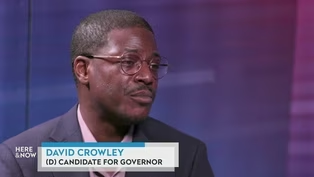
David Crowley on the 2026 Primary for Governor of Wisconsin
Video has Closed Captions
Clip: S2400 Ep2423 | 6m 4s | David Crowley on running for Wisconsin governor in 2026 and politics of the race. (6m 4s)
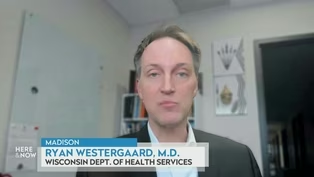
Dr. Ryan Westergaard on Hepatitis B Vaccination for Newborns
Video has Closed Captions
Clip: S2400 Ep2423 | 5m 58s | Dr. Ryan Westergaard on continuing guidance to vaccinate newborns for hepatitis B. (5m 58s)
Here & Now opening for December 12, 2025
Video has Closed Captions
Clip: S2400 Ep2423 | 1m | The introduction to the December 12, 2025 episode of Here & Now. (1m)
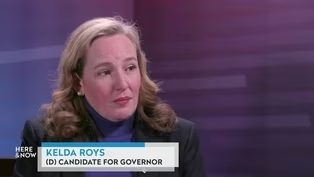
Kelda Roys on the 2026 Primary for Governor of Wisconsin
Video has Closed Captions
Clip: S2400 Ep2423 | 4m 41s | Kelda Roys on running for Wisconsin governor in 2026 and politics of the race. (4m 41s)
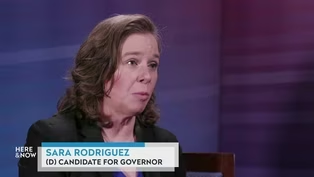
Sara Rodriguez on the 2026 Primary for Governor of Wisconsin
Video has Closed Captions
Clip: S2400 Ep2423 | 4m 43s | Sara Rodriguez on running for Wisconsin governor in 2026 and politics of the race. (4m 43s)
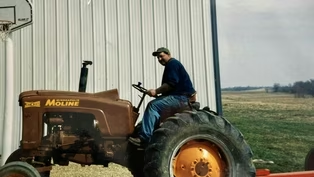
How Farmers at Risk for Suicide Can Find Mental Health Help
Video has Closed Captions
Clip: S2400 Ep2423 | 7m 50s | Family and therapists are increasing efforts to offer support to farmers facing despair. (7m 50s)
Providing Support for PBS.org
Learn Moreabout PBS online sponsorship
- News and Public Affairs

Top journalists deliver compelling original analysis of the hour's headlines.

- News and Public Affairs

FRONTLINE is investigative journalism that questions, explains and changes our world.











Support for PBS provided by:
Here and Now is a local public television program presented by PBS Wisconsin