Here and Now
Here & Now for December 5, 2025
Season 2400 Episode 2422 | 26m 52sVideo has Closed Captions
Watch the entire episode of Here & Now for December 5.
Watch the entire episode of Here & Now for December 5.
Problems playing video? | Closed Captioning Feedback
Problems playing video? | Closed Captioning Feedback
Here and Now is a local public television program presented by PBS Wisconsin
Here and Now
Here & Now for December 5, 2025
Season 2400 Episode 2422 | 26m 52sVideo has Closed Captions
Watch the entire episode of Here & Now for December 5.
Problems playing video? | Closed Captioning Feedback
How to Watch Here and Now
Here and Now is available to stream on pbs.org and the free PBS App, available on iPhone, Apple TV, Android TV, Android smartphones, Amazon Fire TV, Amazon Fire Tablet, Roku, Samsung Smart TV, and Vizio.
Providing Support for PBS.org
Learn Moreabout PBS online sponsorshipThe following program is a PBS Wisconsin original production.
>> A full house of primary candidates for governor adds another with the entry of former Lieutenant Governor Mandela Barnes.
As candidates on both sides prepare for an August runoff, even as the snow still flies.
[MUSIC] I'm Frederica Freyberg.
Tonight on "Here& Now", we begin our series of interviews with Wisconsin primary candidates for governor.
Tonight, the Republicans, an elections expert, unpacks the legal challenges to Wisconsin congressional maps and the shocking history of racial housing covenants in Wisconsin.
[MUSIC] It's "Here& Now" for December 5th.
[MUSIC] >> Funding for "Here& Now" is provided by the Focus Fund for Journalism and friends of PBS Wisconsin.
>> It takes two hands to count the number of candidates running for Wisconsin governor in 2026.
Tonight, we begin a series of interviews with them, conducted by senior political reporter Zac Schultz, which you'll see on this program over the next three weeks.
First up, Republicans in the race.
We start with a candidate with solid name recognition.
Wisconsin's seventh congressional U.S.
representative, Tom Tiffany.
>> Tom, Tiffany, thanks for joining us.
For voters who don't know who you are, introduce yourself and give us a sense of why you're running for governor.
>> Yeah.
Lifelong resident of Wisconsin.
I grew up on a dairy farm in western Wisconsin with my seven brothers and sisters.
We were up early in the morning milking cows, I worked my way through UW River falls, got an agricultural degree, and then ultimately settled in the Northwoods where I met my wife, Chris, and that's where we raised our three daughters.
that would say defines you, or maybe a a lane within your political party that may drive you?
>> You know, I think one thing that maybe a lot of people don't realize, the reason I ran for the state Assembly back in 2010, when I first gained elected office, was because of fiscal responsibility.
We had a $3 billion deficit at that point, and that's always animated me.
That government should spend within its means.
>> How much money are you going to need to raise in this primary and for the general election?
budgeting to raise $40 million.
We'll see if we get there.
But, you know, Wisconsin, because of that pass through loophole, I call it the billionaire loophole.
There's just so much money that comes into Wisconsin.
But, you know, you can cry about it or you can compete.
We choose to compete.
And but we're we're hoping to raise $40 million.
competitive primary.
How do you personally define the difference between negative campaigning versus defining the differences or issues between you and an opponent?
>> You know, if you're just hurling mud at your opponent, name calling, stuff like that, then I don't I don't think that's how Wisconsin voters talking about issues.
And some people describe negative campaigning as being that if you point out differences, I think that's the important part of the political process, is to point out the differences between you and your opponent.
And so that's what I always try to do.
>> As voters are tuning in.
Should they be more drawn to a candidate that has the issues that align with them, or should they be thinking about electability as well?
>> For the primary, electability is a is a big part of it, I think.
I think it's a combination of issues and electability.
Because if you're right on the issues, you're going to gain some voters.
And that's ultimately what it's all about, is getting 50, 50% plus one.
>> Obviously, you represent northern Wisconsin.
What's your what's your goal?
What's your plan to reach the rest of the state and introduce yourself there?
>> Well, we have a 72 county strategy.
Sometimes Republicans have not done that, including ignoring now in Dane County.
We will not ignore Dane County, the fastest growing county in the state.
And but we have a 72 county strategy, and we're going to cover every bit of it.
you think Donald Trump will have on this election?
>> You know, there will be some, certainly.
But I know one thing that Democrat, whoever the Democrat candidate is, they will try to make it about Donald Trump.
And part of the reason for that, I think, is that they don't have a strong set of issues that have been animating them that the voters want to hear.
I mean, when you see some of the stuff like defund the police or, you know, boys and girls sports, stuff like that, most of the voters in Wisconsin are like, yeah, we're not buying that stuff.
And so I think that's part of the reason why they try to make President Trump the central part of the campaign, rather than debating the issues.
I can assure the voters that I will be debating the issues.
>> Tom, Tiffany, thank you so much for coming in.
>> It's great to join you, Zach.
>> Up next is the other Republican in the primary race for governor, who was first to throw his hat into the ring back in May.
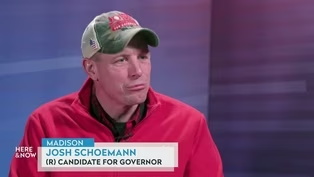
Washington County Executive Josh Schoemann.
>> Josh Schoemann, thanks for joining us.
>> Yeah, thanks for having me.
Good to be here.
>> So for voters who don't know you, give us the quick story.
Who are you and why are you running for governor?
is I'm a Christian.
First, I'm the son of a minister.
My my dad's ministry was in mostly northeastern was a registered nurse.
My wife and I have been married almost 25 years.
Both Wisconsin kids were raised our family and mostly in Washington County, and we now have an 80 acre farm in between West Bend and Grafton.
Love, Wisconsin through and through.
Aside from a tour of duty in Iraq in 2003, and I always joke a tour of duty in the Chicagoland suburbs while I was getting my master's degree at Wisconsin kid and been back working in public service my whole life.
Dedicated it to the service and sacrifice of the guys and gals who didn't make it back, and reflecting the Lord's love by loving my neighbor as myself in public service the last 12 years in Washington County.
>> So is there a single issue that would define you, or maybe a lane within the Republican Party that helps define you?
driven being very people focused and and mostly interested in solving problems.
That's why I got into public service.
I actually started in public administration because I little too volatile and too theoretical.
Public administration is really where the rubber hits the road, and you're dealing with people where they're at.
My first job back in Wisconsin was deputy clerk treasurer in Princeton, Green Lake County, and I ended up taking on responsibilities in public works, literally shoveling out lift stations.
So, you know, I think those are important things, making sure when you flush the toilet, it does what it's supposed to do and the garbage is collected on time.
And to this day, that's who I am as Washington County Executive and who I will be as governor.
think you're going to need to raise to win this primary?
And then what happens after that in a general election?
>> Yeah, I mean, it's it's embarrassing the fact that this is probably a quarter billion dollar race all in for for both sides and all the outside spending and just the candidate alone.
I'm told about basement floor, 20 million, first floor probably closer to 40 million.
So it's it's a serious endeavor and one that we're excited about.
>> When it comes to a competitive primary.
Where do you personally draw the line between negative campaigning versus just defining the differences between yourself and an opponent?
gets personal, that's really the the dividing line.
There's certainly differences in on our side of the aisle.
There's only two of us in this race right now.
And there's certainly differences between policy approach.
I think those are important to point out.
And I think that's the essence of the primary process.
But once it becomes personal attacks, I mean, I think that's where we've seen primaries in the past go awry.
And I have no intention of going down that, that lane.
And I hope the door swings both ways.
aware of the candidates, should they be looking at which candidate has the closest issues to them or general electability?
>> Well, I think it's both.
I mean, first and foremost, I think this has got to be about the people and local communities a little bit more about Washington less about Washington, D.C.
but then I also think there's there's something to be said about the types of attributes it's going to take to win a general election.
Generals are, of course, much different than Republican side in particular, we've spent a little bit too much time focusing on who can win a primary purity tests of of sorts, and we need to spend more time thinking about what can win in the general election.
I think when you when you put my resume next to anybody, I think the answer is clear.
If we want to be in the governor's mansion in January of 2027, I think not only me, but my profile and our campaign is the type that wins.
>> This is an interesting contrast because we have the northern Wisconsin, which is kind of the the new prime territory in Wisconsin for Republicans versus the old guard, the wow counties, which obviously represent.
So how do you view that that matchup.
that's one of the main contrasts north versus certainly a generational difference.
But I also think it's, you know, local and and personal versus kind of state and DC Madison in Washington DC, I think those are basically the dividing lines.
And I think it's a good contrast for people to really wrestle with what's best for us to choose in August, to put up in November for the best shot, to have the governor's mansion in January.
>> How do you think Donald Trump will impact this race?
>> Oh, huge.
I mean, you know, it's the president's party.
And that's been clear for the last ten years.
But I think one thing to keep in mind is President Trump came on the scene in 2015 after the 2010 Tea Party wave.
Republicans basically ran on three major points, reduced the debt, eliminate deficits, and repeal and replace Obamacare.
Here we are 15 years later, and we're still talking about those three things.
Sometimes President Trump one pushing the needle on any of those by himself that can't.
That's unacceptable.
And I think it's why we continue to feel a churn in politics across America.
So he's he's got a humongous impact.
I certainly am going to work my tail off to earn his support and endorsement and show him that he can have the confidence in me that I've got this race.
Once we get past August and and we lead it to victory in November.
for your time.
>> Thanks for having me.
>> Next week, Zach continues his interviews with candidates running for governor.
Look for more of his reporting on air and online in coming weeks.
The battle lines are drawn once again over voting district lines, this time Wisconsin congressional districts.
Republicans have blasted the order, but the Wisconsin Supreme Court assigned a pair of three judge panels to hear two lawsuits that argue that the state's congressional maps must be redrawn because they are unconstitutionally favoring of Republicans.
Six of the state's eight districts are currently held by Republicans.
The court playing out in the midst of a national redistricting battle, as President Donald Trump is trying to preserve a slim Republican majority in the House in the 2026 elections.
Director of the Elections Research Center and professor of political science at UW-Madison, Barry Burden is here with more.
And thanks very much for being here.
>> Thanks for having me.
>> So in your expert view, do Wisconsin congressional maps unconstitutionally favor Republicans?
>> Well, they certainly favor Republicans.
Whether this constitutional or not will be an issue for the courts.
You know, there are eight districts in the state.
Six of them are held by Republicans, two of the seats held by Democrats.
And it's been that way for a while.
That's one of the contentions, at least in one of the cases, is that it's been a durable and predictable outcome, that the drawing of those maps, which really began in 2011 under Scott Walker and Republicans continued essentially with a least change version of that after the 2020 census, that it has locked in A62 majority.
So in that sense, it's certainly tilted towards Republicans.
>> So other than the six two district margins, what stands out about these maps?
>> They're not competitive, at least for six of those seats are unlikely to be held by anything but a Republican or Democrat, sort of.
Regardless of who those people are and what the campaigns are like and what the issues are like, we know well in advance the second district, the eighth party is going to represent those seats?
Only two of the seats, the first and the third, are anywhere near competitive.
We have Republican incumbents in both of those districts.
They lean Republican, so there's always a there.
But even those have been reliable for Republican victories.
>> Why was congressional redistricting kind of left off the table when Wisconsin redrew and then passed into law?
New legislative maps?
>> We don't know exactly, because the Supreme Court wasn't transparent about that.
There were lawsuits brought to the Supreme Court focusing on the state legislative districts and the congressional.
They took up the state legislative districts, and that eventually resulted in new lines being drawn for the Assembly and state Senate, the congressional maps they decided not to touch and sent them back, really without any message as to why they were not taking them up.
It now, in retrospect, seems to be something about the process, because those same groups came forward essentially with similar lawsuits, but now filed in Dane County Court.
That's following an old process from 2011.
We might talk about that maybe is where the court was telling those litigants to go.
precedent is there for the Wisconsin Supreme Court to order circuit judge panels to hear the cases challenging these maps?
>> Well, it hasn't been done before, and that's because the law that enabled it was passed in 2011, ironically, by Scott Walker and Republicans, when they were unhappy that Democrats seemed to be filing suit in Dane County repeatedly, where they thought they would get a favorable hearing from a judge there.
This requires that any case that has to do with the apportionment or districting at the state level, has to result in three judge panels being appointed by the Supreme Court, and those judges can't all come from Dane County.
They've got to be scattered across circuits what the court did last week in creating two of these panels to deal with the two cases before them.
>> So in the redistricting battle, are those efforts about the actual fairness of of maps or directed toward partisan advantage?
>> It's all partisanship, I would say at this point.
And that comes also from the Supreme Court, which before this latest round of districting back in 2018 2019, dealt with a case that ended up with the court saying any level of partisan shenanigans in drawing districts, at least for Congress under federal law, is completely fine.
That's not a matter of law.
It's not a matter of constitution.
So it's noteworthy that these two cases in Wisconsin are under state law and state constitutions going to the state supreme Court.
So the litigants have decided to steer clear of the federal courts because there's no longer a remedy there, at least when it's about partisanship.
decision just released by the US Supreme Court on happens with redistricting going forward?
>> So Texas is where this all began.
This is a really strange era we're in that many states are redrawing maps in the middle of the decade.
We're sort of halfway between the last census and the next census.
Texas began with maps that were drawn to favor Republicans by adding about five seats there.
That would also take away about five seats from Democrats.
So a ten point swing.
Those maps were declared illegal, a violation of the Voting Rights Act.
The US Supreme Court yesterday decided to allow those maps to go forward, partly because they thought the court, the federal Court, intervened too close to the primary in Texas, which comes up very quickly.
Candidates are are beginning to file already just next week to get in.
And they weren't convinced that it was going to be a violation of the Voting Rights Act anyway.
So it looks like the new map in Texas is back on, and all of the activity in the other states is also happening.
>> So does that kind of create an arms race of changing maps across the country?
>> It does.
So Texas was first the the main response to that was in California, where Democrats decided to override their commission.
That draws districts by having a ballot proposition.
They've now created new districts that add about five Democratic seats.
So essentially canceling out what Republicans did in Texas.
Now we've got Missouri, Florida, Virginia, maybe Maryland, maybe Illinois, Indiana, some other states, Utah.
Because of a court ruling there, there's a lot of redrawing.
And it's not clear in the end which party is going to be advantaged, but it's the of this process we have ever seen.
>> In Wisconsin.
Is there any chance in your mind that new congressional maps could be drawn before the midterms?
that timeline gets met.
We're just now beginning to have hearings and, you know, in some motions and filings for those three judge panels that were appointed, there's going to have to be evidence brought.
The judges are going to have to rule over those cases.
If they decide the be struck down, then new districts need to be created by some process, either the state governor, or the courts appoint someone to do that process.
It all needs to be in place probably by the end of March, so that candidates know where to file the filing deadlines in June for a primary in August.
So this was, you know, a crunch when the were redrawn two years ago.
But the final maps were adopted around this time.
The rulings were just around Christmas time, and the maps came shortly thereafter.
Were behind that schedule.
It seems very difficult to get that done in time.
>> All right.
Well, Barry Burden, thanks so much.
>> Thanks for having me.
>> In other news, to understand why Milwaukee ranks as one of the most segregated big cities in America, two Wisconsin based researchers have been taking a close look at housing records and the racially charged language in them.
Here and now, reporter Murv Seymour shows us how the Mapping, Racism and Resistance project inches toward the finish line.
Despite the recent loss of federal funding, some viewers might find the language in this story disturbing.
>> This project is incredible.
It's important.
It is not historical.
It is alive.
>> From a place known as the hub for learning.
>> And it needs to flourish so that we can continue to push back against racism and segregation.
>> Something historic is happening at Milwaukee's downtown public Library.
>> It's one thing to say, oh, there's systemic racism.
It's another thing when you see the language.
>> It's jarring.
>> Whites only, Caucasians only colored people.
>> University of Wisconsin-Milwaukee professors Anne Bonds and Derek Handley have been busy for nearly three years.
>> These covenants cover housing that is now predominantly occupied by African Americans in Milwaukee.
>> The two have been leading an effort that peels back the hateful history of racial covenants in Milwaukee County, and has helped shape Milwaukee along racial lines.
Racial covenants a clause written into property deeds that forbid the sale, least or occupation of a property to a person because of their race, ethnicity, or religion.
>> We have this deep history of racial and I've been wanting to know more about it, and I started digging into racial covenants.
students, you know, why do you think there are Black communities in these different cities that you go in?
By seeing these maps, you can get a better understanding to that question.
A lot of Milwaukee was part of or the Black population were part of the Great Migration.
They came here with hope.
There were certainly jobs over a period of time.
Black people knew what places they were not supposed to be.
>> After searching nearly 5 million documents from 1910 to 1960, the Mapping Racism and Resistance Project found.
Get this 32,506 racial covenants blended into the language of housing deeds throughout Milwaukee County.
certain kinds of language words like whites only, Caucasians only.
We knew that terms like and colored and African and Ethiopian would probably appear, because that's the language that was being used at the time.
>> We've seen covenants that mention no Italians.
We've seen covenants that mentioned no Mexicans.
>> According to the research, not every racial covenant explicitly said no Blacks or no colored person.
Some said white only or Caucasian only.
And bond says in practice, all of the covenants they found targeted Black people.
The one exception Blacks could live in white only communities if they were working there as a servant.
>> Derrick and I could never have identified all of these racial covenants without the work with the community.
California, more than 6000 volunteers, many of whom transcribe their findings.
They used a site called Zooniverse to discover and meticulously document racial covenants and the language used in them.
Mary Roberts says she became a transcriber because of her passion for history.
>> You'd have one, two, three, four, five items of things that you couldn't do on a property, and then all of a sudden, there it was a racial covenant.
It's one thing to learn in your history books about how segregation happened, or to read about the Fair Housing Act and to read about the civil rights marches.
But it was really a whole nother experience to be reading property deed after property deed after property deed with these racial covenants in it.
>> Once found, each racial covenant is verified and documented by five different people, word for word, regardless of its racially discriminatory tone.
>> One person was so offended by the language that was used in the covenants that they didn't want to transcribe that language.
>> Some of these are like a they're they're a sucker punch.
People find these, and the general reaction is, whoa, like, I don't I don't want this.
I don't want to be associated with this.
And and for many people of color, they encounter these.
It's very devastating to think about living in a place that was constructed through this kind of racial exclusion.
has always been known within the Black community.
And now we have the evidence to show people.
>> Racial covenants prevented access to the best and most well resourced neighborhoods.
>> We learned the story of the Columbia Savings and Loan.
>> What did this bank near North Avenue?
The 16th Street Bridge on the south side, a historic landmark to the north, and a 1950s Wauwatosa home to the west, all have in common.
>> The founding of that institution was because of racist housing covenants.
>> They represent examples of resistance in the Mapping, Racism and Resistance project, located in the heart of what's known as the Bronzeville community on fond du Lac Avenue, this Columbia Savings and Loan bank rescued Black families by offering mortgages at a time when white owned banks wouldn't.
More than 100 years later, from a new building, the bank remains in business.
Today, it's Wisconsin's only Black owned bank.
This historic landmark celebrates Boniface and its fearless priest, Father James Groppi.
Groppi once led nonviolent civil rights marches for 200 straight days across the 16th Street Bridge, which at the time was considered an imaginary racial boundary between the predominantly Black north side of Milwaukee and the then predominantly white south side of town.
And when you think of Wauwatosa, Derek Handley says.
>> Think about Zeddie Hyler and his brothers sitting at night with shotguns.
>> Zeddie Hyler migrated from Mississippi to worked at Milwaukee's downtown post office.
In 1955, he became the first Black property owner in Wauwatosa.
just a very stark reminder of what was going on during the day.
sharing a tiny piece of the story of his.
Against all odds journey to build his dream home in Wauwatosa.
>> He was very ambitious.
I have photos of him, and he's posing with an all white contingent of privates, and he's the sergeant.
>> Mr.
Hyler and his brothers was would sit out there with shotguns in the evening to protect the property from being from being vandalized.
This is Kern at the same time as the Montgomery Bus Boycott in Alabama.
>> Lora Hyler tells this audience uncle Z was able to build his dream home in Wauwatosa thanks to multicultural resistance.
The home is now considered an historic landmark.
>> There were 37 or 39 white women in the city of Wauwatosa who were upset with the treatment that he was receiving, showing up for the meetings, getting denied, and they basically pulled together a petition, which all of them signed.
>> And he had his white friend buy the property.
And then after the white friend bought the property, he then sold it to to Z.
>> And they said, given the Bill of rights, this man has a right to live any place that he can afford to.
So we demand that his approval be granted.
>> Haley Anne Bonds say the history and impact of racial covenants in Milwaukee is only part of the story of segregation in Milwaukee.
The site is still being tweaked, but they encourage people to interact with the Mapping, Racism and Resistance website to learn about racial covenants in their community.
>> You can zoom into neighborhoods, and you can look to see where the racial covenants were and what the language was, the year that they were implemented.
We can get rid of these in our records, but that doesn't mean that they haven't already done the job that they were meant to do.
>> To help set the record straight, while helping fix housing failures of the past, Anne Bonds says Wisconsinites should pay close attention to what's happening in Washington state, which has done similar research.
>> There's a new state law that allowed people to, you know, actually pay to have these records removed and the funds that were raised through that removal process that were then reinvested in a fund for first time home buyers.
>> There's a lot of generational wealth that was that, that one whole segment of our society was cut off from building.
We really have to to face that if we're going to try and solve it.
I'm Murv Seymour for here.
>> Now.
For more on this and other issues facing Wisconsin, visit our website at PBS Wisconsin.
Org and then click on the news tab.
That's our program for tonight I'm Frederica Freyberg.
Have a good weekend.
>> Funding for "Here& Now" is provided by the Focus Fund for Journalism and Friends of PBS Wisconsin.

Barry Burden on Lawsuits over Wisconsin's Congressional Maps
Video has Closed Captions
Clip: S2400 Ep2422 | 7m 15s | Barry Burden on two lawsuits that seek to redraw Wisconsin's congressional district maps. (7m 15s)

Here & Now opening for December 5, 2025
Video has Closed Captions
Clip: S2400 Ep2422 | 1m 4s | The introduction to the December 5, 2025 episode of Here & Now. (1m 4s)
Josh Schoemann on the 2026 Primary for Governor of Wisconsin
Video has Closed Captions
Clip: S2400 Ep2422 | 5m 30s | Josh Schoemann on running for Wisconsin governor in 2026 and politics of the race. (5m 30s)

Mapping a History of Covenants and Segregation in Milwaukee
Video has Closed Captions
Clip: S2400 Ep2422 | 8m 51s | Researchers and volunteers examine where and how racial covenants shaped Milwaukee County. (8m 51s)

Tom Tiffany on the 2026 Primary for Governor of Wisconsin
Video has Closed Captions
Clip: S2400 Ep2422 | 3m 53s | Tom Tiffany on running for Wisconsin governor in 2026 and politics of the race. (3m 53s)
Providing Support for PBS.org
Learn Moreabout PBS online sponsorship
- News and Public Affairs

Top journalists deliver compelling original analysis of the hour's headlines.

- News and Public Affairs

FRONTLINE is investigative journalism that questions, explains and changes our world.











Support for PBS provided by:
Here and Now is a local public television program presented by PBS Wisconsin