Here and Now
Here & Now for December 6, 2024
Season 2300 Episode 2322 | 26m 49sVideo has Closed Captions
Watch the entire episode of Here & Now for December 6.
Watch the entire episode of Here & Now for December 6.
Problems playing video? | Closed Captioning Feedback
Problems playing video? | Closed Captioning Feedback
Here and Now is a local public television program presented by PBS Wisconsin
Here and Now
Here & Now for December 6, 2024
Season 2300 Episode 2322 | 26m 49sVideo has Closed Captions
Watch the entire episode of Here & Now for December 6.
Problems playing video? | Closed Captioning Feedback
How to Watch Here and Now
Here and Now is available to stream on pbs.org and the free PBS App, available on iPhone, Apple TV, Android TV, Android smartphones, Amazon Fire TV, Amazon Fire Tablet, Roku, Samsung Smart TV, and Vizio.
Providing Support for PBS.org
Learn Moreabout PBS online sponsorshipThe following program is a PBS Wisconsin original production.
>> The Union busting act ten gets upended.
What happens next?
And our Medicare Advantage plan, as advantageous as the name suggests.
I'm Frederica Freyberg.
Tonight on "Here& Now", Congressman Mark Pocan on his bill to rename these so-called advantage plans.
What's next for the controversial law that broke Wisconsin unions?
Is affordable housing feasible under Trump policies and the immutable and emerging needs of foster care?
It's "Here& Now" for December six.
>> Funding for "Here& Now" is provided by the Focus Fund for Journalism and Friends of PBS Wisconsin.
>> The airwaves are flooded right now with ads from insurance brokers wanting to sell health care plans, because open enrollment for Medicare closes tomorrow, December 7th.
Many of the ads are for plans through private insurers called Medicare Advantage.
56% of Wisconsinites are in Medicare Advantage plans, which have grown in popularity because of marketing and because many plans charge no premiums and offer benefits not offered in traditional Medicare like dental, vision and hearing coverage.
For no additional cost.
It's easy to see why such plans are attractive to seniors, but there's a bill in Congress called the Save Medicare Act, designed to make clear the advantage.
Plans are not what they say they are.
Wisconsin District two Congressman Mark Pocan is sponsor of the bill.
And thanks very much for being here.
Fredricka.
clear?
The advantage plans are does it do that?
>> It's largely educational at this point to make sure people understand that only Medicare is Medicare.
Some very smart lobbyists a few decades ago got a bill that allowed these plans to be called Medicare Advantage.
We don't allow you to call yourselves the United States Postal Service and pizza delivery.
We don't allow you to use any other federal program in a private company's product.
But that's exactly what Medicare Advantage plans are, is a private alternative to Medicare.
And they are in some cases for people, you know, advantageous, right?
They think that they can get dental vision or hearing, which we should cover in Medicare, and we don't.
And they can get that through that plan.
membership or something else that gives them a little extra.
The problem is then there's the rest of the story, and a lot of the complaints that we get in my office are from people who have Medicare Advantage programs, who for example, need health care.
Suddenly they may not maybe in their 60s when they signed up, but by their 70s or 80s they do.
And you have to get prior authorization.
Now, you don't do that with Medicare, but often it gets denied millions of cases a year due.
And the odd part is when they get appealed, over 85% of those are overturned.
So really it's just nickel and diming trying to save some money by the insurance companies.
But it's delayed health access for people who have those plans.
Also, if you are out of network, you're traveling and there's no one in network you have to pay out of pocket.
There's a lot of little fine print, and we just want people to think about it and understand only Medicare.
That you've paid for all your life is Medicare.
There are alternative programs.
Sometimes they work well for people, but often by the complaints we get in the office, they don't.
>> How confusing is this for people looking to sign up?
>> Intentionally.
Very confusing, right?
You know, just the fact that the loan in the name is Medicare Advantage.
And when I asked people in town halls how many people are on Medicare, how many on Medicare Advantage, people really don't know if Medicare is in the name, and they assume that's what they have.
And yet it is a private insurance alternative.
And agai, for some people, especially the younger folks in their 60s, it might be just fine.
But it's also hard once you're on that to then suddenly go back to Medicare.
That's not easy either, because it's made complicated by, again, some pretty smart and I'm guessing wealthy lobbyists back when this law became in place.
So again, a lot of this is education.
We just want people to realize, look very closely, look at your health situation.
Do you travel?
Then maybe those plans aren't as as good.
Do you have a health concern or a future, something genetically in your family that it maybe you don't want to wait for prior authorization, or they make you do something other than what your doctor and you have decided is your best care.
They might make you stage up to that and lost time is lost health.
So I just want people to be well aware of what decision they're making.
It's and the other thing don't forget is Medicare doesn't advertise like these.
Medicare Advantage plans.
So the only thing you see are private plans, advertising and the federal a business.
So we don't do the same thing.
And sometimes people don't get a chance to really know what Medicare is and understand that difference.
>> Do these plans end up, in the end, being more expensive, notwithstanding some of the perks like zero premiums and coverage for these other things?
>> It's generally more expensive in terms of your health, right?
If you can't get the care you need right away, like you would with Medicare, that could cost you.
If you have to wait 3 to 6 months longer because they're making you do other treatments first or they denied it, and you have to appeal it 3 to 6 months on, some types of health care could literally be, if not your life, at least your the quality of your life.
And that's the complaints we get all too often.
And then some people, you know, signed up in their 60s, it was worked out fine.
And now in their upper 70s, they need health care.
It's really hard to go back to Medicare.
And that's also part of the problem.
So there's a whole lot we're working on this.
A lot of us in Congress are working on this right now, trying to make it work better.
And my hope is that that will happen at some point down the road.
But for now, just having the right information allows you to make the best choice for you and your loved ones.
>> Now, traditional Medicare has so many parts to it at at extra cost.
What about a way to simplify and streamline that?
>> Trust me, there's I would love to do some changes to Medicare.
I'd like to include dental, vision and hearing because clearly that is health care.
And there's some other things that we'd like to do as well.
But, you know, Congress isn't exactly a fast moving body.
There's a reason why we're moving so slow.
Right?
That's just part of the reality.
So until we get to those things, that's why these Medicare Advantage programs can look better.
But again, looks can be deceiving.
If you have to get prior authorization.
And if you get turned down like millions of people do a year and you've lost that ability to get quick care, is that really in your best interest?
If you're traveling in California and you're out of network and now everything is completely out of pocket, is that in your best interest?
And there's so many other examples like this that we get calls into our office every single week.
>> All right.
Congressman Mark Pocan, thanks very much.
>> Sure.
Thank you.
>> The Madison Teachers Union is demanding to bargain with the district after a Dane County judge this week restored collective bargaining rights for most Wisconsin public employees that were effectively eliminated under former Governor Scott Walker's act ten.
But how long will that window of bargaining opportunity last before a higher court stays?
The Dane County order as it moves along the appeals process?
We turn to Bryna Godar, a staff attorney at the State Democracy Research Initiative at the UW Law School.
Thanks very much for being here.
>> Thanks for having me.
>> So as to that question, the Republican legislature already appealed this Dane County order.
How long might this window last for unions hoping to exercise their bargaining rights under the Dane County order?
>> So it could be pretty short.
The legislature is almost certainly going to ask the Court of Appeals for a stay of the lower court's decision, meaning it would be on pause and wouldn't go into effect yet.
And then if that happens, it could be months before we actually get a final resolution in the case or before that stay is lifted.
And that would likely require the Wisconsin Supreme Court to weigh in eventually.
in a in a moment.
But does the legislature have a good basis for appeal in your mind?
>> So I think it's a tough case.
I think it raises some complicated legal issues.
And so there are strong arguments on either side.
So they certainly have a basis to appeal the decision.
County ruling focused on the separate treatment of public safety employees under act ten.
What was the legal argument supporting overturning the law on the basis of this separate treatment?
in on how public safety employees were defined.
And the court said that it was fine for the legislature to distinguish between public safety employees and general employees, so could distinguish between police officers and firefighters and the like and other employees.
But the way that it had drawn those lines was not rational or reasonable.
And so what it really looked at was things like that group included municipal firefighters, municipal police officers, state motor vehicle inspectors, state traffic certain groups like UW police, Capitol Police or conservation wardens who you might expect to be in that group.
And so what the court really looked at was, was there a way that you could sort of define that public safety group in a way that was Rafter rational or reasonable, and it didn't find a clear reason on which to draw those lines.
>> Well, even from the outset of the signing of this law, it always seemed a little like, why them but not them?
>> Yeah.
And that's that's what this case came down to.
And because he determined that you couldn't draw that line in a rational way, he decided you needed to strike down that distinction.
And the result of that was that the general employees category now has the same collective bargaining rights as those who were previously carved out under the public safety category.
>> So how likely is it that other unions, like the Madison Teachers Union, would scramble to reinstate collective bargaining following the ruling?
>> So I think it depends sort of on how long the stay lasts on sort of strategically, how much it makes sense to mobilize those resources.
But I do think it's worth noting that unions have still.
Excuse me, been able to exist and do some limited collective bargaining.
And so they can still do organizing preemptively, even if this decision is stayed to sort of prepare for those upcoming negotiations.
If this decision is ultimately upheld.
>> So as we've discussed, the likely path for this is that it lands in the Wisconsin Supreme Court.
The balance of that court right now is a liberal majority.
We know we are coming into a spring election.
How dicey is that for both sides in this case?
>> I think the biggest thing is that it just is going to mean that act ten is a really salient issue in the upcoming election.
So it's highly unlikely that the state Supreme Court will decide the issue before the April election.
But they very well could decide it before August, which is when that next justice would be taking their seat on the court.
>> So do you think it becomes a salient issue to the extent that it kind of turns into a referendum on act ten, potentially.
>> I think act ten has really been off the radar for a lot of people for quite a while now, and so I think it might become more of a referendum on it.
This time around.
I think in addition to some of the other issues that we already saw in the prior election, like abortion as a as a matter of law, how surprising was it that this lawsuit actually stuck when so many against Act ten failed?
Yeah.
So I think it definitely is something that people kind of weren't paying attention to anymore and didn't necessarily expect to see this time around.
The legislature was making those arguments that essentially the it was too late to bring these claims and that they should have been brought in prior lawsuits.
But the court rejected those arguments, and it really looked at the fact that this case did bring distinct legal claims from those prior cases, and that they weren't the same plaintiffs as those prior cases.
all will be watching this Bryna Godar, thanks very much.
Thank you.
The housing crunch, especially for affordable housing, is at crisis levels, according to experts.
How might the incoming Trump administration help or hurt the need?
We turn to UW-Madison professor of urban planning Kurt Paulsen.
Thanks for being here.
>> Thanks for having me.
>> So what is the scope of the crisis in the housing system here in Wisconsin?
And nationally?
the national trends, which is that home sales are down year over year since the pandemic started.
That means there's just a lot less inventory for people to buy, and prices are going up.
When you combine prices going up with higher interest rates, it means that for your starter home, your first time home buyer, millennials, Gen Z, younger workers or seniors who want to move down to some something smaller, there's just no product available and anything that's available is really expensive.
And so we see it in the trends in Wisconsin, which is that we have really low home ownership rates for our workers under the age of 30.
On the rental side, of course, rents have gone up significantly 20 to 30% over the last couple of years.
Add to that the crisis is that the cost of building anything new has gone up 40% since the pandemic, so it really is a perfect storm where you have rising prices, rising rents and not rising incomes at the same level so that middle class families can't afford to buy a home.
First time homebuyers can't afford to buy a home, and most lower wage workers can't afford any decent rental housing anywhere near where they want to live.
>> That is a crisis.
Yeah.
So the incoming Trump administration has argued that mass deportations will result in more housing and drive down costs.
How accurate is that assessment?
research from Harvard and other universities that show that the rise in housing prices really preceded the rise in immigration.
So the immigrants driving up house prices is not true.
On the other side, we have to recognize that the construction workforce is 20 to 30% immigrants.
And in particularly high cost states like Texas or California, but also here in Wisconsin, you have a significant shortage of workers in construction and a substantial portion of the workforce is immigrants.
So mass deportation, if it's actually carried out, would lead to a significant worsening of the labor shortage in housing.
And construction, which would also tend to drive up house prices.
And of course, the big issue turns out to be whether tariffs are inflationary and that might lead the Federal Reserve to have to raise interest rates to try to reduce inflation, which makes housing less affordable.
>> Tariffs also play into the supply of building materials.
Yes.
How so?
>> So one way to think about it for your listeners is about 50 to 60% of the cost of any house is the materials and the labor that go into it.
So that's everything from gypsum board, drywall, lumber, steel, electrical appliances, electrical transformers and then across the board tariff would also raise housing prices because those are significant inputs into housing construction.
Now, we did see in the first Trump administration tariffs on Canadian lumber, which the Biden administration maintained and the estimates are that that adds 15 to 20,000 to the cost of a home.
But across the board, tariffs that would also affect cement and steel and all the components that go in, could also drive up housing prices.
>> Wouldn't the tariffs that have been talked about under the Trump administration be at an even higher rate than the existing ones?
estimates are that he would put 10 to 25% across the board tariffs, depending on whether it's Mexico or China.
And the truth is about 15 to 20% of the inputs into construction are imported materials.
>> What what federal programs targeting affordable housing >> So it's somewhat difficult to predict based on what they've said in project 2025 and their plans.
So it's important to understand there's two big kind of buckets of affordable housing programs.
The first is on the production side and that's the housing tax credit.
And we think that one's safe because that has strong bipartisan support.
In fact, we would love to see that strengthened and increased.
But of course, that's expensive.
And it's going to compete with other priorities in the budget.
On the helping people to afford their home.
The main demand side program is the section eight program for rental assistance, and that covers the needs of about 1 in 5 of our lowest income households.
And in the project 2025 documents they have talked about adding work requirements and time limits to these programs.
And for many of our working families at 30 or $40,000 of income and below this, housing assistance is a vital lifeline.
And so if there are these significant cuts to HUD assisted housing, you can expect to see homelessness and housing insecurity really increase.
cutting regulations or taxes help home builders and offset the kind of need for housing stock?
carefully about what are the regulations that we want to reduce.
Now, the truth is that local government land use regulations that kind of require you to build a large house on a large lot, that's a significant contributor to house prices going up.
So if we could find some way to incentivize local governments to approve more housing, that would really help us on the supply side and on the price side.
administration kind of listen and understand the voice of the experts, like yourself and others around all of these issues?
differently, which is that even Red state governors and red state mayors recognize that they have a housing affordability crisis.
They have tremendous portions of their budget that come from the federal governmen, whether it's housing assistance or community development block grants and so I think we can ask red state mayors to be part of the voice, to explain to say that listen, housing affordability, the housing crisis affects rural areas, urban areas, red states, blue states.
And so we're kind of hoping that there's that bipartisan consensus that says we have to do something and we can't just cut our way to housing affordability.
>> All right.
Kurt Paulson, thanks very much.
>> Thanks for having me.
>> Some 7000 children in Wisconsin are in need of foster care families who provide them out of home care when their immediate families cannot.
Of critical need.
Families who provide treatment foster care.
This can be for physical, developmental or emotional needs of the child as part of Children's Wisconsin, a health care system and child welfare agency.
Foster children and their families can get wraparound services here to discuss is Amy Basting, a foster home recruiter and the treatment respite foster care lead at children's.
And thanks very much for being here.
>> Hi, Frederica.
Nice to have time to spend with you today.
>> So we understand again that there is a dire need for treatment.
Foster families across Wisconsin.
What does that need look like?
How many children are waiting?
>> Well, in across the state of Wisconsin, there are like you mentioned, are about 7000 children in need in in foster homes.
Really in terms of children waiting?
None.
We need to get them into homes ASAP.
So there are children placed into foster homes, but sometimes it takes a little bit longer and they have to wait in.
Maybe group care where they would just do better in a treatment foster home.
>> Is it is it difficult to get licensed as a treatment?
Foster parent?
And then what about the commitment?
Is that difficult physically, emotionally or financially for these foster families?
treatment foster parents are a little bit higher, but it's nothing outside the nothing really difficult.
You know, you might have to you have to maybe have some experience parenting five years experience parenting a lot of people can knock that right off.
So the qualifications are pretty easy to meet.
The toll it takes as far as on your emotions or your health.
There is so much support that Children's Wisconsin treatment, foster parent treatment, foster care Program offers that we hope we are supporting our treatment.
Foster parents at the level that they need so that they can take breaks using respite care when they need to take care of themselves.
You know, if there's health needs that they need to take care of, need to take care of themselves, we're going to make sure they take care of themselves.
those wraparound services in a moment, but what does it mean to be a treatment?
Foster parent treatment?
of foster care.
So if you compare it to its counterpart, general foster care, that would be to capture the needs of kids with lower to low to moderate level needs and then moving up the scale treatment.
Foster care is there to capture the needs and care for children with moderate to high level needs.
So we are looking at caring for that population that is beyond the scope of general foster car.
>> What are the rewards for the foster parents?
>> Well, they tell me that it's very it fills their heart.
They feel so rewarded when they see the children meet.
Some treatment barriers and exceed and grow and change and get healthier.
And they know they were a part of that.
So the rewards are great in terms of just feeling personally successful as a parent.
>> Well, what does children's offer families and foster children in its wraparound program?
>> So in treatment, foster care, we wrap our foster parents with more support beyond, like I mentioned, the general foster care program.
So in addition to support meaning visits from visits and contact from a social worker, our treatment foster care program gets additional staff that come to the home and support and advocate for both the foster parents and children.
We reward our treatment.
Foster parents with respite, and it's kind of like how you earn rest or vacation time, or paid personal leave at work.
Our foster parents are getting some paid time off to take care of themselves.
Our treatment foster care program also offers clinical consultation, a mentoring program we have in teen Incentive program built into our treatment foster care program for those homes that are willing to care for our older youth, which is greatly needed.
>> So what are the end goals for children in foster care?
>> The end goals would be hopefully, reunification with would be that the children meet some of their treatment goals, whether they are health related, mental health related, behavioral.
So we really want to see children gain a sense of well-being and thrive in our treatment.
Foster care programs.
>> All right.
Well, we leave it there.
Amy Basting, thank you so much.
>> Thank you.
>> And finally, tonight we remember former Wisconsin Supreme Court Justice David Prosser.
Justice Prosser began his career as an attorney in the U.S. Department of Justice and as a district attorney before turning to politics, serving nearly two decades in the state Assembly as a Republican representative, rising to speaker, he was first appointed to the Wisconsin Supreme Court by former Governor Tommy Thompson in 1998, and reelected in 2001 and 2011.
Prosser made headlines during the days of the historic act ten protests in Madison, when he clashed with liberal justices on the court and in one case, a physical altercation.
He retired in 2016, serving 18 years on the High Court.
David Prosser passed away Sunday evening following a battle with cancer.
He was 81.
For more on this and other issues facing Wisconsin, visit our website at PBS Wisconsin.
Org and then click on the news tab.
That's our program for tonight I'm Frederica Freyberg.
Have a good weekend.
>> Funding for "Here& Now" is provided by the focus Fund for Journalism and Friends of PBS Wisconsin.
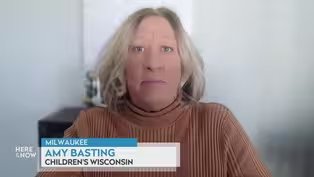
Amy Basting on a Critical Need for Foster Care in Wisconsin
Video has Closed Captions
Clip: S2300 Ep2322 | 5m 44s | Amy Basting on commitments and rewards of foster care for thousands of kids in the state. (5m 44s)
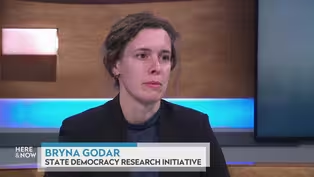
Bryna Godar on an Act 10 Reversal and the Politics of Appeal
Video has Closed Captions
Clip: S2300 Ep2322 | 5m 14s | Bryna Godar on a court ruling to reverse Act 10 and the 2025 state Supreme Court election. (5m 14s)
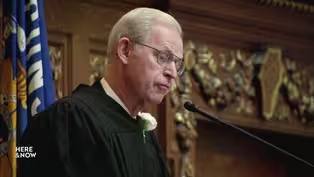
Former Justice, Assembly Speaker David Prosser Passes Away
Video has Closed Captions
Clip: S2300 Ep2322 | 55s | Former Wisconsin Supreme Court Justice and Assembly Speaker David Prosser passes at 81. (55s)
Here & Now opening for December 6, 2024
Video has Closed Captions
Clip: S2300 Ep2322 | 1m | The introduction to the December 6, 2024 episode of Here & Now. (1m)
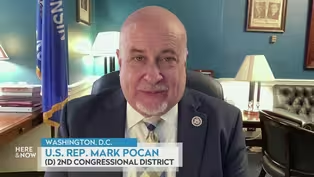
US Rep. Mark Pocan on Medicare Versus Medicare Advantage
Video has Closed Captions
Clip: S2300 Ep2322 | 6m 16s | Mark Pocan on the Save Medicare Act bill to limit private health insurance marketing. (6m 16s)
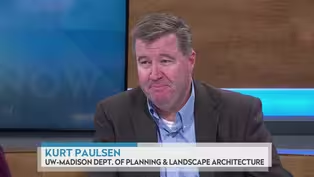
Kurt Paulsen on the Housing Crisis and Trump's Policy Plans
Video has Closed Captions
Clip: S2300 Ep2322 | 8m 34s | Kurt Paulsen on housing shortages and possible impacts of the second Trump administration. (8m 34s)
In Focus with David Maraniss: Covering News, Writing History
Video has Closed Captions
Clip: S2300 Ep2322 | 41m 28s | Murv Seymour talks with David Maraniss about writing histories and biographies. (41m 28s)
Providing Support for PBS.org
Learn Moreabout PBS online sponsorship
- News and Public Affairs

Top journalists deliver compelling original analysis of the hour's headlines.

- News and Public Affairs

FRONTLINE is investigative journalism that questions, explains and changes our world.








Support for PBS provided by:
Here and Now is a local public television program presented by PBS Wisconsin