Here and Now
Here & Now for January 16, 2026
Season 2400 Episode 2427 | 26m 48sVideo has Closed Captions
Watch the entire episode of Here & Now for January 16.
Watch the entire episode of Here & Now for January 16.
Problems playing video? | Closed Captioning Feedback
Problems playing video? | Closed Captioning Feedback
Here and Now is a local public television program presented by PBS Wisconsin
Here and Now
Here & Now for January 16, 2026
Season 2400 Episode 2427 | 26m 48sVideo has Closed Captions
Watch the entire episode of Here & Now for January 16.
Problems playing video? | Closed Captioning Feedback
How to Watch Here and Now
Here and Now is available to stream on pbs.org and the free PBS App, available on iPhone, Apple TV, Android TV, Android smartphones, Amazon Fire TV, Amazon Fire Tablet, Roku, Samsung Smart TV, and Vizio.
Providing Support for PBS.org
Learn Moreabout PBS online sponsorshipPBS Wisconsin original production.
>> Injustice anywhere is Injustice Everywhere.
>> Wisconsin congressional members respond to ICE's clash with protesters in Minneapolis, and speculate if that fight could move closer to home.
[MUSIC] I'm Frederica Freyberg tonight on "Here& Now".
Wisconsin's U.S.
senators address health care premiums and the ACA enhanced tax credits, cost of living and ICE use of force in Minnesota.
Governor Evers lays out his roadmap for his final year in office, and Zac Schultz reports on the legislative priorities from the candidates vying to be the next governor.
It's "Here& Now" for January 16th.
>> Funding for here and Now is provided by the Focus Fund for Journalism and Friends of PBS Wisconsin.
>> Fallout from federal immigration enforcement in Minneapolis continues this week with six federal prosecutors.
They're resigning over the assignment to investigate the widow of the 37 year old mother shot and killed by an Ice agent.
And Thursday was the last day of open enrollment for marketplace Affordable Care Act plans, with early indications showing 1.4 million fewer enrollees than last year.
But the U.S.
House last week voted to extend those credits, with 17 Republicans joining, including Wisconsin third Congressional Representative Derrick Van Orden.
To check where that measure goes in the Senate, we turn to Wisconsin's U.S.
senators, Democrat Tammy Baldwin and Republican Ron Johnson, who joins us now.
Senator, thanks very much for being here.
>> Thanks for having me on.
>> So what do you know about any compromise to be had on the extension of these ACA enhanced credits?
>> Well, I appreciate you reporting it accurately.
We're talking about the enhanced credits for the supposedly 24 million people on the exchanges.
More than 22 million will still get the Obamacare subsidies, which were very generous.
The only people losing subsidies are people making over 400% of the poverty line.
That's about 1.6 million people.
And I'm actually working with the couple Democrat senators to address those individuals because they are facing unbelievably high premiums because of Obamacare.
It is so destroyed.
The individual market.
Some of these folks close to retirement are facing premiums of 36, $38,000 a year.
So I'd like to help them.
But again, I really have there's no reason to extend the enhanced temporary pandemic subsidies for people who still will retain the Obamacare subsidies.
>> What kind of traction is that?
Getting your proposal to maintain credits for those at 400% above poverty?
>> Well, what I've been told is there are enough Democrats who will co-sponsor that.
But right now, I think they're still holding out hope that they can extend all the subsidies.
I just believe that's dead on arrival here in the Senate.
We voted that down multiple times during the shutdown.
That's that's just not going to happen.
>> Were you surprised by the 17 Republicans in the House who voted to extend those enhanced credits?
>> No, I think the issue has been so misreported.
It's been so misrepresented that I think there are people in very close districts were concerned about that misrepresentation.
They constituents that, no, they want to help them handle the extremely high premiums.
But but remember, the reason premiums are so high is because Obamacare is just flawed.
It's it's it's an awful structure.
It forced a very small percentage of the American population.
Those 24 million people on the individuals change to completely bear the cost of covering people with preexisting conditions.
So that's the reason why premiums, since the implementation of Obamacare have increased four times rate inflation.
So again, it's completely failed.
And the only thing the subsidy is doing right now is they're masking that.
It's certainly helping people.
ought to fix Obamacare.
We repair the damage done and transition to a system that would actually work like.
Well, the root cause of our health care financing system is the third party payer system.
Somebody else is going to pay the the.
Provider, the, you know, the costs of, of the procedures and, and the medical services.
All we pay for is insurance.
It's way too high or we pay our taxes.
So until you actually reintroduce consumerism, where consumers know what things cost and they're concerned about what things cost.
Right now, doctors don't know.
Nurses don't know, patients don't know.
The only people know are the bean counters.
So that's a completely flawed system.
You've removed all the benefits of a free market, competitive system out of health care.
So you don't have lower costs, you don't have better quality, you don't have better service.
So again, return consumerism, free market competition in there.
Now providers aren't going to incentive in our current health care system is to increase prices because everybody is taking a percentage cut off it.
They'd rather take a percent cut off something cost $10,000 rather than five.
So it's about consumerism.
That's the >> On immigration enforcement.
Minneapolis obviously continues to be a powder keg.
How does the president, invoking the Insurrection Act, bringing in U.S.
military help or hurt?
What's going on there in your mind?
>> Well, what you ought to do is take a look at different states, those cooperating with Ice as we try and administration tries to clean up this enormous mess left behind by Biden and Democrats, who opened up our borders versus those states that are resisting where local law enforcement actually holds illegal immigrants that have committed crimes so that Ice can pick them up peacefully at the jails.
You're not seeing a problem.
Where you're seeing a problem is where you have insurgents like Governor Walz and the mayor inciting people to resist and obstruct justice.
And that led to the tragedy of that one woman's death.
>> Do you have concerns that Wisconsin will be similarly embroiled?
>> I would hope that Wisconsin county sheriffs and local officials would cooperate with Ice.
I think generally they do.
We don't we do not have, you know, pockets of large illegal immigration, immigrants in the state of Wisconsin.
So it's not as big an issue here as it is with the Somali population and others in Minnesota and some of these other big cities.
>> Do you feel like public benefits fraud in Minnesota justifies the Trump administration to surge ice there?
>> That's not why they're doing it.
They're two totally separate issues.
>> And yet that has been something that the president has spoken to.
>> Well, again, you have a, you know, large Somali population that now we are seeing evidence of how much they are defrauding the federal government on a host of government programs, you know, flying $700 million of cash out of the Minneapolis airport.
Again, there's some real problems there, but that's separate from the illegal immigrants.
And quite honestly, the sanctuary cities, sanctuary states like Minneapolis and Minnesota, where you don't have local officials working with Ice to peacefully turn over people they've detained, have committed crimes.
Other states that do it.
You don't have these problems.
>> You stated this week that you do not want to see immigration enforcement action on farmers.
Do you have any assurances on that?
>> Just that, you know, for example, President Trump was not happy with the raid, I think the Hyundai plant.
So people here that are working, contributing, that is not the people that Ice is, is primarily going after right now.
They're going after the criminals.
Now, if you're associating yourself with people who have committed crimes, if you get caught up in those enforcement actions, I mean, if you've come to this country illegally, you've committed a crime as well.
But that's not who the Trump administration is >> Do you support on the kind of world stage do you support the administration's actions in Venezuela, or threats against Iran, or even looking at Greenland?
Do you support that kind of foreign policy.
>> Is undeniably good, that Maduro is no longer the illegitimate leader and destroying Venezuela.
Now, what comes next?
I don't know if the mullahs could be replaced by the Iranian people.
That would be a good thing for the world.
They are a menace.
Greenland.
From my standpoint, I'm not worried about a military invasion there.
I think it's appropriate for President Trump to understand and point out what a strategic how strategically, strategically important Greenland is.
And I think there's probably more and more intelligence coming out, exactly what Russia and China may be doing there.
And we need to make sure that Greenland is protected for NATO and for for America and for our own national security.
>> What do you think average Wisconsinites care most about right now?
Do you think it's the cost of living?
>> Sure.
Always has been, always will be.
And it's difficult to, you know, once you've devalued the dollar to the extent we have over the over the decades, a dollar held in 1998 is only worth $0.51 as recently as 2019, that dollar's worth $0.80.
And so the 40 year high inflation incurred during the Biden administration that permanently devalued the dollar.
So, you know, those a lot of those prices, they're not going to go back down.
Now there are certain commodities like energy gasoline you noticing because we actually are encouraging drilling and energy production.
Gasoline prices are going down.
You know, I think a more rational approach to bird flu is is probably bring down the price of eggs.
So there are certain things we can address.
President Trump right now is and I had a briefing in terms of what he's doing to make sure that European countries or other developed countries pay the same price we pay for drugs.
So they don't free, free, free load off of our innovation.
That will also help things, you know, in terms of pharmaceutical pricing.
>> All right.
Senator Ron Johnson, we'll leave it there.
Thanks very much for your time.
>> Have a good day.
>> Democratic U.S.
Senator Tammy Baldwin was on the Senate floor this week to, in her words, rail against Republicans repeated attacks on the Affordable Care Act.
Senator Baldwin joins us now.
Thanks very much for being here.
>> It's a pleasure.
Thanks for having me.
>> So you say that, but Congressman Van Orden and 16 other Republicans in that body voted in favor of extending the enhanced tax credits.
Does that represent some movement toward that in the Senate?
>> You know, it was it.
We had a moment in the Senate to take up the bill that was passed in the House of Representatives that would have extended the tax credits for three years, and my Republican colleagues blocked it, pure and simple.
We have known for well over a year that these tax credits would expire at the end of 2025, and I have worked tirelessly to try to extend these tax credits so that working families can afford their health care premiums if they buy through the Affordable Care Act.
But we're seeing the numbers start to come in.
Thousands of Wisconsinites have dropped health care coverage, and we expected only to get worse, as some who were automatically enrolled get their premium bills and figure out that it's just not in their budget to continue health care.
And so while I will never throw in the towel on fighting for affordable health care for all, I can tell you that for some it is too late.
In this particular year to repair the damage that has been done.
And as to my colleague from Wisconsin in the House, he has railed against the Affordable Care Act, supported repeal of it in its entirety for for years now.
And this at the last minute, in my mind, does not recover, does not, does not make him now a fan of the program.
>> So we just spoke with Senator Johnson and and he is proposing maintaining the tax credits for people at 400% above poverty.
Is that something that you would support?
>> Look, I believe that there is a lot of room for negotiation on the extension of the Affordable Care Act tax credits, and there is no reason in my mind that we can't have reasonable income cap, or to have a provision that says that you can't be expected to pay more than a certain percentage of your income on health care.
I just want to relate a story that I shared on the Senate floor.
I have a constituent who is paying 40% of their income on their health insurance premium.
That's how much it's gone up.
In the absence of these Affordable Care Act tax credits.
And so I think we have to be reasonable here, capping the percentage of people's income that should be contributed towards health insurance.
But I think we can look at a reasonable limit for higher wage earners to have that tax credit taper off.
>> On immigration enforcement.
Do you think the president, invoking the Insurrection Act to bring in the military helps or hurts what's going on right now in Minneapolis?
>> You know, when you see this president surge, what is now close to 3000 armed masked Ice agents into neighborhoods, schools, residential areas, I think that makes our communities less safe, not more safe.
And the chaos that is going on in in Minnesota by these unaccountable actions taken by these Ice agents, is the part that is causing tensions to rise.
And I think that the Trump effort to change the narrative and blame residents who are peacefully protesting this presence is wrongheaded.
He's been talking about reckoning and retribution.
That's what I think this is all about.
And it is very, very disconcerting to see this surge.
Right now, Ice agents outnumber local law enforcement 3 to 1.
>> What do you think about invoking the Insurrection Act?
>> I think it's entirely wrongheaded and is about the retribution campaign that this president is on and inappropriate.
>> Do you think this kind of powder keg comes to Wisconsin?
>> You know, I think we need to be watching and vigilant about what's happening in our neighboring state of Minnesota and be ready.
I think it is very responsible for our local leaders and state leaders to be talking actively about what this would look like in Wisconsin.
>> On foreign policy, US threats against Iran, the incursion into Venezuela and the play on Greenland.
In your mind, where does all this leave the US in the world?
>> You know, first of all, it's so clear that the president is distracted and trying to distract the attention of the American public.
When he ran for president, he said on day one, I will bring costs down, and on day one, I will end our international conflicts, our endless wars.
And instead, he has promoted policies that have increased prices of everything from groceries and consumer goods to energy, housing.
And he has, instead of bringing an end to conflict, he has proposed or actually engaged in more.
This president is totally distracted from what he promised he would do for the American people.
>> Because what do you think Wisconsinites care most about right now?
Is it the cost of everything, including housing.
>> Including housing, including health care?
As we just discussed, many are making facing these impossible choices and actually dropping something as essential as health care coverage because they can no longer afford it.
Because of policies that Donald Trump has promoted, the economy is by far the number one concern that I hear from my constituents.
And it's, you know, the cost of things feels just impossible to them right now.
Housing costs have skyrocketed, and we have seen grocery prices accelerate in terms of inflation in recent months.
And the president's energy policies are going to create a significant price price hike for people.
And so, again, this president is distracted and he is not focusing on the very things that Wisconsinites who voted for him would like him to.
>> Are there fixes to this that you may be working on across the aisle?
>> There are certainly there are fixes to everything.
As I said, I won't throw in the towel on health care costs.
I continue to work with my Republican colleagues on ways in which we can bring down the cost of prescription medication, ways in which we can reform the health care system, which is terribly broken right now on housing.
I certainly reach out to my Republican colleagues to join with me and others to to make sure that private equity firms and large corporations aren't gobbling up all the single family homes that make them take them off the market and make homeownership so more, so much more difficult for first time homebuyers.
You know, the average age of the first homebuyer is now 40 years old.
Imagine that.
And the price in the last decade or so of of housing has nearly doubled in our state.
And so we have to squarely focus on these issues of affordability, so that being in the middle class means something, means you're getting ahead.
>> We leave it there.
Senator Tammy Baldwin, thanks very much.
>> Thank you for having me.
>> Governor Tony Evers this week laid out a list of his priorities for his final year in office, as the state legislature has a matter of weeks left in its schedule to advance any unfinished business to the floor.
It's unclear how much of the governor's affordability agenda will make it through.
>> Whether it's prescriptions for insulin or other daily out-of-pocket costs, or the skyrocketing price of health care coverage.
Things are simply not affordable, and paychecks aren't going as far as they used to.
I'm asking the legislature to approve $1.3 billion in property tax relief to prevent property tax increases for average Wisconsin homeowners and help lower property taxes for working families, veterans and seniors across our state.
Under this proposal, we can make sure the average homeowner will not see the property property tax increase.
Period.
>> With so many candidates running for governor, it can be hard to remember all the names, much less where everyone stands on each issue.
Last month "Here& Now", senior political reporter Zac Schultz sat down with nine of the leading candidates.
You can find those interviews on PBS Wisconsin Organic Valley.
In addition, over the next few months, you'll hear from the candidates on individual issues everything from school funding to data centers to creating more affordable housing.
Tonight, we kick things off with their highest priorities what each candidate would work on first as governor.
>> For the first time in 16 years, you can legitimately say control of the Wisconsin legislature is up for grabs in the next election, which means the incoming governor could actually pass their agenda.
So we asked each candidate what the first bill would be that they want to sign into law.
The most common answer had to do with dealing with the rising costs of everything.
>> So the things that I want to make sure that I'm signing into law are things that are going to reduce costs for Wisconsinites, and that's going to be health care costs primarily.
But also looking at child care, we've got other states that we can look at for examples where they've been able to subsidize child care.
For folks, treating that as infrastructure is going to be something that's going to be a priority for me.
>> Well, the first thing I want to sign is about, you know, how do we really tackle this affordability crisis?
You know, I would love for us to focus on affordable and attainable housing in every corner of of the state of Wisconsin.
I would like for us to focus on fully funding our public schools, making sure that there are good paying jobs, no matter where they are in our state, and making sure that our young people are ready for the jobs of today and tomorrow.
>> No matter what we do, the first thing we need to do is work on affordability.
I think there are any number of ways in which we need to ensure, whether it's on the issues of stable housing around the state, or whether it's on the issues of health care, Medicaid expansion, which the governor has tried to do over the course of his eight years, hasn't been able to do.
Those are the types of things that can be done under with a Democratic majority, and those are the types of things that I'd be eager to do right away.
>> Well, I think there's a laundry list, and that's part of our challenge.
But one of the things that I want to see first is things that are focused on affordability, property taxes and income taxes in particular.
It's embarrassing to me that our top bracket of income tax is almost double what Illinois's is.
I'd like to see it flattened out and then slowly eliminated, and then property taxes.
I'd like to see us go from 4 or 5 entities on property tax bills down to 2 or 3.
The goal of cutting them by 50%.
You make a moonshot, and if you hit the stratosphere, you've won.
>> Well, the first thing that the governor comes in and does in at any time when there's a new governor is write the budget.
And so I will be working closely with whoever's in the legislature to make sure that we have a budget that is immediately addressing challenges that Wisconsinites are facing, things like healthcare and child care costs.
But also we have a real challenge around public education.
We need to reinvest in our teachers and our schools, and we need to make sure that our university and our tech colleges are funded in a way that helps them move forward.
It's all about investment.
BadgerCare expansion right away.
Day one special session if necessary.
I refuse to sign a state budget that does not include BadgerCare expansion.
If we have not already gotten to that point.
We're one of nine states.
We are one of nine states that has yet to expand our Medicaid program under the Affordable Care Act.
It's it's a travesty that that is not the case.
Republicans and legislature have denied people the care that they deserve.
>> Boy, you know, I don't think we have any choice at this point, but we got to deal with education.
I just saw some data this week where almost half of first graders cannot read at grade level.
We have fallen behind Mississippi and education.
That is unacceptable.
I don't care if you're Republican, Democrat or whatever political persuasion.
We have always had a long, proud tradition of educating children well, and we've got to get that back.
Otherwise our state cannot succeed.
But I think next is the cost of living, and it is getting the cost of energy down, reducing taxes, things like that that make Wisconsin more affordable.
budget that raises wages for people, restores people's rights, lowers costs on the biggest ticket items like health care and funds our public school system.
Our kids have been getting shortchanged for a generation, and it's not fair.
And it's actually terrible for our economy.
Big signature policy items that I'm interested in passing is opening up the state health insurance and the state pension systems to any person to be able to buy in.
>> Red flag laws and background checks and safe storage.
I think gun safety is a universal issue, and we have to meet we have to ensure that we're protecting our kids.
Then public education and universal child care.
I think when we put our kids first, working class families all win.
>> Reporting from Madison.
I'm Zac Schultz for "Here& Now".
>> For more on this and other issues facing Wisconsin, visit our website at PBS Wisconsin and then click on the news tab.
That's our program for tonight I'm Frederica Freyberg.
[MUSIC] >> Funding for "Here& Now" is provided by the Focus Fund for Journalism and
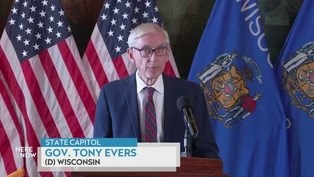
Evers Calls for Property Tax Cut as His Term Comes to an End
Video has Closed Captions
Clip: S2400 Ep2427 | 1m | Gov. Tony Evers has set a list of priorities for his final year in office. (1m)

Here & Now opening for January 16, 2026
Video has Closed Captions
Clip: S2400 Ep2427 | 1m 6s | The introduction to the January 16, 2026 episode of Here & Now. (1m 6s)

What Wisconsin's 2026 Governor Hopefuls Want to Pursue First
Video has Closed Captions
Clip: S2400 Ep2427 | 5m 18s | Candidates in Wisconsin's 2026 race for governor share policies they would pursue first. (5m 18s)
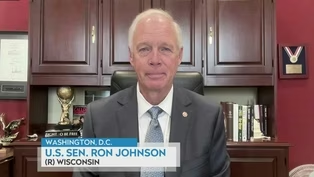
US Sen. Ron Johnson on Issues Congress Faces as 2026 Opens
Video has Closed Captions
Clip: S2400 Ep2427 | 9m 22s | Ron Johnson on ACA tax credits and federal actions in Minnesota and Venezuela. (9m 22s)
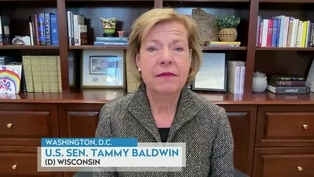
US Sen. Tammy Baldwin on Issues Congress Faces as 2026 Opens
Video has Closed Captions
Clip: S2400 Ep2427 | 9m 24s | Tammy Baldwin on ACA tax credits and federal actions in Minnesota and Venezuela. (9m 24s)
Providing Support for PBS.org
Learn Moreabout PBS online sponsorship
- News and Public Affairs

Top journalists deliver compelling original analysis of the hour's headlines.

- News and Public Affairs

FRONTLINE is investigative journalism that questions, explains and changes our world.











Support for PBS provided by:
Here and Now is a local public television program presented by PBS Wisconsin