Here and Now
Here & Now for January 2, 2026
Season 2400 Episode 2425 | 56m 47sVideo has Closed Captions
Watch the entire episode of Here & Now for January 2.
Watch the entire episode of Here & Now for January 2.
Problems playing video? | Closed Captioning Feedback
Problems playing video? | Closed Captioning Feedback
Here and Now is a local public television program presented by PBS Wisconsin
Here and Now
Here & Now for January 2, 2026
Season 2400 Episode 2425 | 56m 47sVideo has Closed Captions
Watch the entire episode of Here & Now for January 2.
Problems playing video? | Closed Captioning Feedback
How to Watch Here and Now
Here and Now is available to stream on pbs.org and the free PBS App, available on iPhone, Apple TV, Android TV, Android smartphones, Amazon Fire TV, Amazon Fire Tablet, Roku, Samsung Smart TV, and Vizio.
Providing Support for PBS.org
Learn Moreabout PBS online sponsorship>> The following program is a PBS Wisconsin original production.
>> I just remember walking in and she had it written down on a piece of paper, no longer covered by insurance.
>> What would you do?
>> We always assume that he kind of ran some life choices and said rent or this, and thought he could do without it.
>> If your medicine was suddenly not covered by insurance.
>> We need $13,000 before we can ship this.
[MUSIC] And I said $13,000.
>> If you had to pay hundreds or thousands of dollars up front.
>> Yes.
to be delivered without insurance.
>> Before getting a life saving prescription.
>> Because the patients really don't understand what's going on with their benefits.
>> And it all seems too complicated to understand.
[MUSIC] survival mode, and you're just trying to figure out, like, do I go to work and make money?
Or do I deal with this disease?
>> We have the fifth highest health care costs in the nation, and our quality does not reflect that.
>> These patients are confused, they're overwhelmed, and they're forced into impossible decisions about their health.
>> Good evening.
I'm Marissa Wojcik, series producer of Here and Now.
Tonight on our program, we're bringing you a series of stories about prescription medication becoming increasingly unaffordable in Rx Uncovered.
We'll dive into the complex systems driving these trends and the stories of patients facing life or death choices.
We look at how and why more health plans are not covering life saving medication.
The real life impacts this is having on Wisconsin patients, who's trying to change it, and what you should know about your plan.
It's "Here& Now" for January 2nd.
>> Funding for "Here& Now" is provided by the Focus Fund for Journalism and Friends of PBS Wisconsin.
>> Have you ever gone to pick up a routine prescription?
And the co-pay is suddenly very different.
But your plan hasn't changed.
This is what's called a flexible formulary, and they're actually quite common.
Now, the companies that manage prescription plans say that this allows them to save you money, but it can have the opposite effect as well.
Our first story is about a young man with chronic asthma, and when he went to the pharmacy, couldn't afford the sudden spike in the price of his medicine.
>> Well, we got told, you know, just simply that he would never wake up.
>> Bill and Shannon Schmidtknecht had just heard the worst news of their life.
>> That all I remember is collapsing on him and the nurses sliding chairs behind us.
>> Their oldest son, Cole, suffered an asthma attack.
His roommate rushed him to the ER, and his heart stopped beating two minutes before they arrived.
>> When he arrived at the hospital, he was lifeless.
He had no pulse.
They had to resuscitate him.
>> But the prognosis wasn't good.
>> They were no longer seeing the brain activity.
They were no longer seeing any hope that there would be any type of recovery.
That essentially what we saw laying in the hospital of our son was all that he would ever be.
>> The 22 year old laying in that hospital just days earlier was happy and healthy.
Bill and Shannon were mystified.
>> Yes.
When I grab on to him like I just couldn't, you're like, this cannot be happening.
>> In the days that followed, Bill and Shannon watched their son fulfill an organ donation before watching him take his final breath.
>> Cole had had asthma his whole life.
He was on a great medication that stabilized his asthma for the past decade or more.
So we were like, this cannot be.
>> Still in shock.
They didn't understand how this could have happened and why Cole didn't have his medication.
day.
>> Their quest for answers began as grieving parents.
More than a year later, they retell Cole's story, hoping for change.
>> We always felt there was something that was unanswered.
>> The little they did know was from Cole's best friend and roommate, who said Cole did go to the pharmacy days earlier but couldn't get his asthma medication refilled.
don't know.
We tried to get it a few days ago and he couldn't afford it.
It was like $500 and we were like, no, no, no, no.
There has to be like.
>> Something.
>> Something happened.
Like he didn't give.
>> Both Cole and his father managed the same chronic asthma their whole lives.
They used the same prescription inhaler and they worked for the same company, meaning they had the same health coverage.
>> Probably a few weeks later, texted her, hey, can you swing by the pharmacy and grab my steroid medicine too?
>> I just remember walking in and she had it written down on a piece of paper, no longer covered by insurance.
She worked her magic and made a phone call.
Even stayed after they were open and, you know, did what she had to do to get something for me to take home so that he had something.
>> This was the first glimpse into what may have happened in the days leading up to Cole's death.
Health coverage from the employer had changed, and with it, the out of pocket cost.
>> They were told specifically as employees that it would be a seamless transition.
Pharmacy benefits would be seamless.
Prescription coverage would be seamless.
>> The unique thing, though, is we stayed with the same pharmacy benefit manager.
>> What did change without their knowledge was their prescription benefits formulary.
The list of preferred drugs covered by the health plan.
These lists are compiled of name, brand, and generic medications categorized into tears.
Tier one is the most preferred by the plan and has the lowest co-pays.
The higher the tier, the more the patient pays out of pocket.
>> I will never forget that leaving that pharmacy and being like, oh my God, the this is what happened to Cole.
>> The preventative asthma medication that Cole relied upon was moved to a higher tier that he suddenly could not afford.
>> We always assume that he kind of ran some life choices and said rent or this, and thought he could do without it.
Five days after that, he texted me that he was having a hard time breathing.
>> The parallel details around Bill and Cole's condition, medication and health plan helped the Schmidtknecht understand how Cole's pharmacy visit differed from Bill's.
>> The difference is he didn't have this pharmacist or any caring independent pharmacist or whomever to stop for five seconds.
>> Bill's pharmacist made sure he got the lifesaving medication he needed.
>> She was like, so we got to figure this out.
You're not leaving here with nothing for for him, for Bill.
for sure what happened to Cole at the pharmacy that day, many, including Bill's pharmacist, are convinced.
>> Honestly, she believes this is what contributed to Cole's death was the fact that he didn't get his medicine walking out of the pharmacy.
You know, she she can't make that judgment for sure, but she felt that way.
>> And you could tell he was the love of our life.
One day with him and I were laying in the yard looking up at the sky.
He looked at grandpa.
When you eat the habit, will you save me a seat?
Right here.
>> In March of 2025, Senate President Mary Felzkowski reintroduced legislation that she and the Schmidtknecht believe could have helped Cole get his medication.
>> At some point, somebody has to say enough is enough and put some guardrails around this.
>> The bill contains a number of measures aimed at protecting independent pharmacies and adding regulations against pharmacy benefit managers, or PBMs.
>> PBMs are essentially a middleman hired by insurance companies to manage patient prescription drug benefit programs.
>> And they're actually adversely driving up the cost of drugs and controlling whether or not you get the medication that's been prescribed to you.
>> Newly dubbed Cole's Act, this is the third time the multi-pronged legislation has been authored.
>> I watched what happened with the first PBM bill.
It got really stripped down in the Assembly.
We're not going to allow that to happen this time around.
We are going to pass meaningful legislation.
>> One part of the bill deals specifically with drug formularies, saying a plan cannot change a drugs tier except at the time of coverage renewal.
Historically, employer and insurance groups have opposed this legislation, fearing it will increase costs.
>> Marketplace events occur throughout throughout the year that impact the price of prescription drugs.
By implementing a frozen formulary, payers and plans will be limited in their ability to take advantage of new reduced prices.
Generic.
hard on showing them through data from other states that have allowed that have the same legislation, where it's actually lowered the cost of health care.
>> I can't believe it's been almost a year that he's gone.
Yeah, exactly.
>> One year after Cole's passing, his parents filed a negligence lawsuit against the pharmacy benefit manager and the chain pharmacy where Cole went to try and pick up his inhaler.
The complaint says no notification went out that the formulary had changed, and the pharmacist should have offered a generic alternative.
It lists a number of points of failure, many of which violate Wisconsin law.
In a motion to dismiss, the PBM argues that because Cole's health plan is what's called self-funded, these types of employer sponsored benefits are not technically health insurance.
They're largely not subject to state law and exclusively a federal concern.
>> We can't keep waiting for Washington.
My constituents can't afford to keep waiting for Washington on a number of things.
And I believe in states rights.
And it's time that the states need to step up.
You know, we have the fifth highest health care costs in the nation, and our quality does not reflect that.
>> Congressional committees and federal agencies have been sounding some alarm on practices rampant across the industry.
The Federal Trade Commission released a 2025 report investigating the top three PBM companies for inflating drug prices, seeing UnitedHealth group's Optumrx, CVS Caremark and Cigna's Express Scripts increased prices hundreds or thousands of times over, putting $7.3 billion back into their pockets from 2017 to 2022.
Amid a complex system, Cole's parents believe more should have been done.
>> How will this bill have saved Cole?
>> I'm going to defer to Cole's dad for that.
>> The reality is, any portion of a bill that would prevent the slowdown at the pharmacy counter, there's so many.
Had he done this or had he went to this type of pharmacy?
The ultimate thing, no matter totally preventable.
I mean, like, it was preventable.
Please don't let another parent stand where we are today.
>> We've just taken a totally different look at so many things in life.
It's all because this can not happen.
This cannot happen to another family.
>> As you just heard, Cole's health plan is what's called self-funded.
And as we learn in our next story, self-funded health plans are not technically health insurance.
While they both do a lot of the same things, self-funded health plans do not adhere to the same laws as health insurance.
Our next story is about a leukemia patient who learned this the hard way.
Despite the promise of a life saving treatment, his self-funded health plan wasn't going to help.
>> All of a sudden, my numbers were at like 167,000, compared to like 4 or 5000.
>> Kevin Walz has what's called chronic lymphocytic leukemia, or CLL, a type of blood cancer.
He was suddenly in urgent need of treatment.
>> My cancer center.
I can't say enough about him.
>> His oncologist had a prescription that was promising, but it came at a price.
>> We need $13,000 before we can ship this.
And I said $13,000.
Yes.
That's what this drug costs to be delivered without insurance.
>> He soon discovered his health plan wouldn't be covering a dime of his medication, calling it a nonpreferred specialty drug and putting him on the hook for 100% of the cost.
>> Nobody can do that.
I don't care who you are.
>> This specialty drug costs $13,000 per month.
It's a non-chemotherapy treatment and the first FDA approved medicine for people with a high risk form of CLL with no generic equivalent.
>> I got lots of denial letters and stuff over the months saying that there was nothing they could do.
And I'm running low on my month's supply.
And what am I going to do next month?
>> His clinic pleaded with his health plan to cover some portion of his life saving medication under the Affordable Care Act.
Health insurance plans have cost sharing requirements and limits to what a patient has to pay out of pocket.
Covering prescription drugs is considered an essential health benefit.
However, Kevin's health plan doesn't fall under the ACA because it's not technically insurance.
Instead, his health coverage through his employer is what's called a self-funded plan.
These plans are also known as self-insured, which is a bit of a misnomer.
>> We don't cover that because we're a self funded insurance company.
>> Self-funded plan is not insurance.
>> Sarah Davis is the director of the center for Patient Partnerships, a research and advocacy program at UW-Madison.
>> Being insurance is what triggers state regulation, and there are rules those companies need to follow in terms of mandatory benefits they need to cover, right.
If there are claims being denied the protections that that consumer has are reduced in self-funded plans.
>> Today, self-funded plans are the most predominant form of health coverage in the US because they help employers save money.
>> Self-funding lets the employer take control of the second or third biggest line item on their budget.
>> Mike Roach is the director of business development at the Alliance, a Wisconsin organization that helps employers design self-funded health plans.
>> If you're if you're not trying to manage it and you're fully insured, you're going to get an increase probably every year.
The last few years, that's been a double digit increase.
And it's getting more and more difficult for employers to find a way to control that cost.
>> Making it difficult for employers to afford health coverage.
>> The reason that self-funded plans came about is that employers realized they were paying a fixed amount to the insurance company, and then it was the insurance company had that, while holding the risk could make the profit.
And so employers realized, hey, we if we hold all that money ourselves and only pay a certain percentage in claims, we're keeping that profit.
The concern I have as a health advocate is that a large motivation for having a self-funded plan is to save money, and the place that the that the money is saved is in paying out less claims.
>> A recent study shows the top issue for Wisconsin businesses is to make health care more affordable.
That same study says the majority of people in Wisconsin are very worried about their cost of health care.
>> Knowing that your self-funded and that there's value to be found if you, as the employee, are good stewards of the plan and seek value, that should have a trickle down effect so that the next year you don't see your part of that premium go up.
You may not have to change deductibles or coinsurance so you can get some stability in your plan.
>> But it's often difficult for people to even know what kind of plan they have.
>> It takes advocates and patients, sometimes quite a bit of time to parse out and figure out that it is not insurance.
>> A lot of it comes back to transparency.
What employees need to know is that your employer has now become the insurance company.
You know, whether you're fully insured or self-funded.
That plan, doc, is the same.
I think as long as an employee understands the high level pieces of their plan design, deductibles, coinsurance, what's on their formulary list from their PBM, who's in network from a doctor and hospital standpoint, that's going to cover 95 to 98% of everything they do during the year.
>> So who pays for the big ticket items?
>> You know, there's a couple of drugs coming out.
They're going to be $3 million apiece.
How am I going to cover those?
And how does that trickle down to the humerus and the stellaris that folks need on a more regular basis, but are still, you know, thousands of dollars a month?
>> Advocates say self-funded plans can create a conflict of interest for employers who suddenly have an employee with expensive health needs.
>> Maybe you could check into going part time and see if Medicare or something would help out.
And I thought to myself, really?
You want me to go part time now?
I'm going to lose benefits.
I'm going to lose my insurance, and I'm going to be part time.
Is this a way to weed me out eventually.
>> In an insurance situation?
Right.
The employer wants to protect the employee, right?
They want to get the most for their money.
Once we're in a self-funded situation, the employee is at odds with the employer.
>> The side effects of dealing with it all took a toll.
>> One day I sat on my phone on hold from one of the drug companies for over six hours, just stressing me out to the point where I was not paying attention to my healing.
>> Advocates at his clinic didn't let up.
>> They're very persistent, very persistent.
>> Exhausting every possible avenue to access his medicine.
After months of setbacks, good news arrived from his clinic.
>> She kept calling me and calling me and calling me.
She couldn't tell me the news fast enough that they had come through.
>> The drug manufacturer said they were going to provide the remaining dose of his treatment at no cost.
>> I don't think anybody should have to fight for their life like that.
It's hard enough just to sit back and think about me not being here for the people around me.
I worry about not being here.
Normal.
I guess.
>> I worry for people who don't have hours and hours and hours to read fine print and, you know, make sure that they're going to get what they need.
If, you know, if they get ill.
>> In the end, Kevin hopes some good will come from his experience.
>> My dad died from CLL several years ago.
Even after he would go and have spinal taps and stuff, he always said if they can learn something from my treatments for the next people, I've accomplished something in life.
I say the same thing.
If they can get something out of me for other people.
I've done exactly what I wanted to do in life.
>> These two stories are examples of some of the direct impacts patients are experiencing.
But if we zoom out, the big picture has many moving parts that make up the system of prescription medication.
From research and development to manufacturing, wholesalers, prescribers, and pharmacies.
One piece can't be moved without causing ripple effects to all the others.
And for one of those pieces, pharmacies, the ripple effects have turned into a crashing wave.
>> We have been in business for over 70 years.
>> The local drugstore was, once upon a time, a staple in communities across the country.
>> We look at.
>> Our financials every month, and it's scary.
And we think about how how long can we last?
>> Today, whether it's the local drugstore or a chain pharmacy, the brick and mortar presence is dying.
>> The feasibility.
>> Of having an independent pharmacy is becoming very challenging.
>> Nicole Schreiner is the CEO of Streu's Pharmacy in Green Bay and board president of the Pharmacy Society of Wisconsin.
>> We get up in the morning because we want to truly help serve our patients.
>> Alongside her commitment to the mission, she takes on her new dual roles in one of the most challenging times for pharmacies.
As millions of Americans now live in pharmacy deserts.
From 2010 to 2021, 30% of drugstores in the US closed in 2024 alone.
Some estimates show 2800 pharmacies closed, half of them being small or mid-sized businesses.
And in 2025, even the big chains like Walgreens closed hundreds of locations.
>> It's creating an access issue for patients we oftentimes talk about in rural areas, you know, patients having to travel, you know, perhaps 20 miles to find a pharmacy that would be able to provide their medications.
And but we're having that even in urban city areas.
>> For some, a visit to the pharmacy is a quick step, picking up 1 or 2 prescriptions.
But for many patients, it's much more than that.
>> Your pharmacist a lot of times will be a critical component of your medical care team.
>> Senate President Mary Felzkowski authored legislation trying to help local pharmacies keep their doors open.
>> We saw our small, independent pharmacy starting to go out of business in rural Wisconsin.
>> When it may take months for a patient to get a clinic visit.
Pharmacists say they bridge that gap.
Available for anyone to walk in and ask questions at any time.
And prevention leads to health care savings.
>> For patients with asthma.
We did a study with the Pharmacy Society of Wisconsin and showed that when they sat down with a pharmacist on two 30 minute interventions, that they reduced the number of ER visits, the number of hospitalizations.
These difference in overall reducing health care dollars spent.
>> Like with most retail stores, it'd be reasonable to assume that internet sales are putting pharmacies out of business.
And while mail order and online retailer giants like Amazon do compete with on site service advocates, diagnose a much deeper and chronic issue.
>> PBMs pharmacy benefit managers have been around for a very long time.
>> Pharmacy benefit managers, or PBMs, act as middlemen between drug manufacturers, wholesalers, providers, insurance companies and pharmacies.
>> And they've monopolized and they've gotten in between prescribers and the delivery of drugs, driving up the cost of drugs instead of lowering them.
>> The three largest PBM companies accounted for 80% of prescription claims last year.
>> They'll claim to negotiate with drug manufacturers and pharmacies, reduce overall prescription drug costs.
However, despite these claims, PBMs regularly inflate what patients pay and force pharmacies to operate a loss.
>> It's become very powerful, and independent pharmacies like myself have no negotiating power anymore with these PBMs.
>> The impact of PBMs that PBMs are having on rural pharmacies is staggering.
>> The legislation takes aim at a number of their practices, including not allowing patients to fill prescriptions at certain pharmacies.
>> PBMs dictate where prescriptions can be filled.
>> Punitive audits against pharmacists who inform patients of lower cost options.
>> What to charge a patient.
>> And perhaps the biggest of all for pharmacies.
>> What they will reimburse a pharmacy.
>> Reimbursing the price of medications below cost.
>> And when they'll pay the pharmacy.
>> Forcing them to take losses.
At a Senate health committee hearing, numerous local pharmacies attested to this issue.
>> That my pharmacy is currently operating in the red right now solely due to PBM reimbursement rate.
>> Margins estimated to PBMs have increased by 46%, and during the same time, margins to pharmacies have decreased by 47%.
>> The contracts have become basically take it or leave it.
They've continued to erode year after year after year.
And it's estimated that independent pharmacies, depending on your particular location in the country, can have anywhere from 20 to 40% of their claims are actually reimbursed below cost.
>> But not all health industry experts agree.
>> We believe all these provisions will be associated with increased costs to health plans and sponsors.
>> Those in opposition to the bill, such as health insurers, say it will increase prices for health plans, employers and patients.
The exorbitant cost of drugs, they say, begins with the drug manufacturers.
>> Instead of taking away the few tools that health plans and employers use to address ever increasing drug prices, the legislature should focus on fixing the market distortion caused by drug manufacturer pricing schemes.
>> We're going to work very hard on showing them through data from other states that have allowed that have the same legislation, where it's actually lowered the cost of health care.
>> Whatever the cause, the impact on the patient is real, like the ability to obtain diabetes medications.
>> GLP ones, those some pharmacies are just choosing not to carry them because they get reimbursed below their cost.
>> Or having your insurance accepted.
>> Some pharmacies are choosing not to carry particular plans because of the poor reimbursement.
>> Every day my pharmacy, I witness patients facing exorbitant co-pays, sometimes exceeding $500 for medications they cannot afford.
These patients are confused, they're overwhelmed, and they're forced into impossible decisions about their health.
>> For a patient having to fill prescriptions at multiple pharmacies, the consequences can cost them their lives.
>> Recently, when interviewing a patient, we learned that they had a duplicate prescription that was at another pharmacy from a different doctor.
If they had gone home and taken both, they would have needed emergency care and it could have been fatal.
>> From the extremes of the pandemic to the work they do every day, independent pharmacists say their commitment is to their community.
>> What happens if PBMs continue to drive us out of business?
Who will step up during this crisis?
Who's going to be doing seven day a week testing?
Who's going to deliver meds late at night for a hospice patient who's going to get a call at 2 a.m.
I just got that last week.
It won't be a mail order pharmacy in another state that's doing that.
>> Being able to provide that service to patients, and to be part of making sure that they are taken care of, is really what we want to ultimately do.
>> Advancements in modern medicine have created some amazing treatments to manage or even cure diseases and conditions once thought untreatable, but these advancements come with a huge price tag.
In our next story, we look at an increasingly common mechanism used by health plans to help offset the rising costs of these miracle medicines, where financial aid is diverted away from patients who need it most.
>> I couldn't believe what I found out when this happened.
I couldn't believe it was legal.
>> Tamra Varebrook lives with painful, chronic conditions.
She can still live her life as long as she has her medication.
>> I changed jobs and started over with a new co-pay and new deductible.
That's when when this hit me, I wasn't getting my medications.
And, you know, I thought, what?
Why aren't you sending them?
They're like, well, you have a $6,000 balance.
I had my first experience with copay accumulators.
I had never even heard of him.
>> A copay accumulator sounds like an obscure insurance term.
And it is.
>> And I know people don't understand this.
If this doesn't directly affect them.
>> It's also a growing trend among health plans for Tamara's conditions.
Her medication costs her the equivalent of buying a car every year.
>> Right now, I take the entire prior year to save up, to try to have enough to buy my drug in January.
It's ridiculously expensive, but it's the thing that makes me be able to walk in my arms, bend and, you know, keep, you know, my joints moving so I don't end up in a wheelchair.
>> To afford her drugs.
Her doctors told her about patient assistance programs.
It's often the drug manufacturer helping the patient to afford their own high priced medication.
This kind of financial assistance is referred to as a copay, coupon, or copay card.
>> That were meant to help the patients get their drugs and pay down their deductibles, pay down their, you know, on their out-of-pocket maximums.
>> Here's how they work A patient is prescribed an expensive name brand drug that doesn't have a generic.
Their health plan has a high deductible and out-of-pocket maximum, which they must meet before the plan will cover the drug.
The copay card provides the financial assistance to cover the patient's deductible and out-of-pocket max.
When those are met, the health plan kicks in and covers all or part of the cost that remains of the drug, potentially saving the patient thousands of dollars.
>> It was a life changer.
I was, you know, pretty low income at the time when when a lot of my medical issues started and I would never have been able to afford these medications.
>> One day, she realized she wasn't receiving the life changing assistance or her medication.
Tamara was blindsided.
>> They weren't shipping it.
And so I kept calling and saying, well, why isn't this shipping?
They're like, you owe $6,000.
And I'm like, what do you mean I owe $6,000?
>> The drug company had provided the copay card.
>> I've already gotten this.
And you know, it should be.
My deductible at least should be covered.
>> The problem was the financial assistance no longer covered her.
The pharmacy told her.
>> If you don't pay for it in full, you are not getting your medication.
And I went months without.
>> Tamara had recently started a new job where her health plan contained a copay accumulator.
>> I spent countless hours on phone calls.
I can't even tell you how upsetting it was.
>> The accumulator is a relatively new tool used by health plans and pharmacy benefit managers.
A copay accumulator takes the financial assistance, the copay card, and only applies it to the total cost of the drug.
It does not count towards the patient's deductible or out-of-pocket maximum.
In other words, the patient no longer saves money.
The health plan saves money by taking the full amount of copay card and still collecting the deductible and out-of-pocket maximum paid by the patient.
>> This is a very scary moment for me, just knowing a lot of other people with Miss.
>> Jim Turk has multiple sclerosis, or Ms.
a disease that attacks the body's nerves.
There's no cure, only treatment.
>> If you're on drugs.
I mean, that's your lifeline.
That's something that's preventing that, or at least slowing that down significantly from happening.
So they don't have as much stress in their life either.
And the stress in their life can also exacerbate the symptoms.
So it's just this vicious circle.
>> He's an advocate for people with Ms.
Knowing the struggles firsthand.
>> I look at a list to see what all the drugs cost.
Ocrevus the one that I was on last, which was actually the newer drug, was one of the cheaper drugs.
And that was, I think, 70 or $80,000 a year, which I can't afford.
I'm on disability.
>> Having been the recipient of copay cards, he stresses their importance for patients to survive.
>> You have to make the choice between paying for your drugs that might be a lifesaver or paying for groceries, and obviously there's no choice there or paying for rent.
And that's really what it comes down to.
>> And a copay accumulator.
>> They're essentially designed to be confusing.
>> Makes that choice even harder.
Well, in 21 states it is now illegal, but not Wisconsin.
>> Other states have outlawed accumulators, and a bill currently in Wisconsin's legislature would as well.
At a hearing, health plans and pharmacy benefit managers spoke in opposition.
>> This bill does nothing to control the soaring prices of prescription drugs set by pharmaceutical manufacturers, but instead rewards drug makers for steering patients towards more expensive brand name drugs.
>> They say copay cards are a ploy by pharmaceutical companies to get patients to take expensive name brand drugs.
>> Rather than benefiting those in financial need.
A lot of these coupons from manufacturers act as an inducement to move to higher cost products.
>> Supporters of accumulators say they lower costs by saving health plans money not just one patient.
But others refuted these claims.
>> Nearly all copay assistance programs from manufacturers are for drugs with no generic alternatives.
Co-pay assistance increases medication adherence.
Studies have found that morbidity and mortality associated with poor medication adherence cost the US healthcare system $528 billion.
Annual non-adherence can lead to treatment failure, resulting in poor outcomes such as worsening of condition, admission to the emergency room and hospitalization, and requiring new prescriptions to treat subsequent comorbidities, which results in higher costs to the entire healthcare system.
That is what will increase premiums.
>> This rings true for Tamara.
>> The specific drug is not the only cost of chronic disease.
Chronic disease causes people to miss work, end up in emergency rooms, hospital bills.
>> Drug manufacturers do not like accumulators because the assistance doesn't go to help the patient.
She fears they may end up not providing the assistance at all.
>> I'm afraid that the pharmaceutical companies stop the programs because they're not helping the patients, and that would be a real nightmare because then everybody would suffer.
This is where we're at in Wisconsin now, and I feel bad for everybody who has a child or, you know, any adult that runs into these issues because most people are not prepared with that kind of money, and you aren't going to get your medication.
>> There has been some movement in the state's legislature to address things like copay accumulators, open formularies and pharmacy access.
We're joined by someone on the front lines of this work.
Rob Gunderman, president and CEO of the Coalition of Wisconsin Aging and Health Groups.
And thanks for being here.
>> Thanks for having me.
>> So tell me a little bit about how you got started in all of this.
>> Sure.
Well, I started getting calls from patients who were trying to get their medications.
They'd go to the pharmacy counter, and they were being told that it would be thousands of dollars to get the medication that they're used to paying 30, 40, $50, whatever their copay was.
And they were learning that a copay accumulator had been applied to their policy.
The one that really struck me was a woman with a heart condition who needed this heart medication to live, and she went up like she always does to buy her medication.
They said it was gonna be $3,800.
They didn't have $3,800.
And her husband had to go to the bank and take out a loan so she could get the medication she needs to live.
And I realized, we have a problem here.
And that woman who I've come to know, she her family is going into debt more and more every year having to deal with this.
So that's how I got involved in this.
>> And as you've been working on these issues, is this just all too common?
>> You know, when I started out in this, it wasn't that common.
It was I was seeing in a plan here and people were starting to come to me.
Now it's become very common.
It's spreading like wildfire.
There are very few plans left.
I don't even know of a plan left in Wisconsin that doesn't have a copay accumulator other than the group, the state insurance plan.
>> And there's accumulators, maximizers and those sound like good things.
>> They do.
They use catchy terminology, and they've probably run this through marketing groups to see what what people like and what people don't like.
But you're exactly right.
There are copay accumulators, they're copay maximizers.
They're all doing essentially the same thing, but just from a little bit different angle.
You know, when you look at this copay, accumulator piece, it just to me, this is just so unfair and I don't it's been difficult for me to understand how this has been allowed.
If you and I went out to dinner and I paid for your your dinner and the restaurant said, we've adopted a copay policy where you have to pay for your your meal and you say, well, Rob already paid for my meal.
Yes.
And we appreciate that.
And we're going to keep his money.
But you also have to pay for your meal.
You say, this isn't fair.
You're getting paid twice for the meal.
This is what the insurance companies are fine.
you've seen on patients?
What does this do to someone who's making this impossible decision?
>> Well, a couple of things.
One, the financial stress that it's putting families under that just can't afford this.
But the other piece is I've had people tell me they're not going to take their medication anymore.
I had a friend of mine who has Ms.
And he says if they put one of these copay accumulators on my policy, I'm going to stop taking my medication.
So you then end up with more problems with their health.
And I don't think that's a cost saving measure by, you know, taking this money, they may get some money out of it.
But I think in the long run, the increased health expenses that you're going to have for people if they stop taking their medications are going to offset that.
we've seen in these stories, people don't know until they're so far along that they owe all this extra money.
There's no ability to have a payment plan for your medications.
So you either get it or you don't.
How difficult is it for people to even know that something like this is on their plan?
How much of it is just poor communication?
>> That's a lot of it.
It's very difficult.
I've looked at some of these plans, 50, 60 pages, and who's going to read 50 or 60 pages of fine print?
Some of this is a very small it's hard to read, especially if your eyes aren't so good as mine aren't anymore.
It's hard to spot this little clause in there that says, and even if you read it, if you don't know already what a copay accumulator is, you're not going to understand what they're saying in there.
>> Now, Senate President Mary Felzkowski has been working on legislation like this for many years, many sessions.
What are the concerns that state lawmakers have had making it so difficult to move this forward?
>> So I think the the one thing that's really held us up with state law, well, a couple of arguments that the insurers have made.
One is that this will drive patients to more expensive brand name medications.
We know 98% of the medications in this group, these expensive medications there isn't a generic for.
But Senator Felzkowski put in language in the bill saying that this only applies to medications for which there is not a generic equivalent.
So that's off the table.
There's still making that argument, though.
The other argument that we're hearing is that it will drive up insurance premiums.
But there's studies that have been done looking at states that have already passed this type of legislation where the premiums haven't increased.
And conversely, studies have looked at states that haven't passed this legislation and premiums aren't lower there, like in Wisconsin, our premiums aren't lower where we don't have that.
>> Where does it currently stand?
And what, if anything, has changed throughout this session as it's gone through committee?
>> Sure.
Well, we had a committee hearing, which was the first.
This is the second session that we've tried to run this bill, and we weren't able to get a vote out of committee last session.
This session, we've got a 5 to 0 vote.
So the entire committee voted in favor of passing this out in the Senate.
And we expect that to come up to the onto the floor at some point in January.
We just don't know when.
And so, you know, there's a definite shift here where the momentum has shifted.
I think there are 40 co-sponsors on the bill.
But I think I think the votes are there to pass the bill.
If we can get the votes.
next story, that he didn't know that the formulary had changed.
And that's something that's been a point of contention in the legislation.
Has that changed as it's gone through committee?
>> Yeah.
So the insurers wanted to be able to change the formulary throughout the year.
And right now they could only change it during the window and people can change plans.
And I said we didn't have a problem with that.
As long as they weren't able to force the patient to change their medication mid-year.
So I think it's actually a benefit to patients, because if you're going to to make a formulary change, tell them in June or July, give them as much time as possible to figure out what they're going to do and find a new plan that will cover whatever the medication is that they're taking that is going to be leaving your formulary.
So I think I don't see a downside to that.
>> Overall, premiums are going up.
If people feel like they're not properly covered under a plan that they're paying a lot of money for every month, do you think patients will just end up foregoing a health plan altogether?
>> That's our that's our concern, our worry.
I think there are people who they're going to look at this and say, I'm paying so much out of pocket anyway.
I'm not ever using the insurance, so what's the point of having it?
And then when they have something serious happen, then it's more problems.
And it's not like someone isn't paying for that.
>> Now we just saw Congress go through the longest government shutdown in history over these enhanced tax credits, and we're still seeing premiums go up all around.
How much of this is kind of reaching a turning point as healthcare premiums, costs are all going up and there doesn't seem to be an end in sight.
>> We're getting to the point where something has to happen and we can't.
My insurance went up almost 25% this year.
We can't have 25% annual increases in our health costs, just as Americans.
We can't afford it.
So we have to figure something out.
And I don't know what that answer is.
I mean, people, smarter people than me, have been trying to figure this out for a very long time.
But we're getting to the point where we have to.
This isn't an option anymore.
We can't afford to keep going the way that we're going.
And for a lot of families without the the Affordable Care Act plans being available to them, I think we have a lot of people who are just not going to be insured.
much for joining us.
>> Thanks.
>> As we've seen, most patients don't get the option of a payment plan for these costly prescriptions.
You either pay up front or you don't receive treatment.
In all of these stories, complex diagnoses, convoluted health plans, decreasing access, and steep prices are overwhelming patients with impossible decisions.
But they're not always alone.
Patient advocates are stepping in, using their knowledge of the system and doing what they can to make sure patients are getting the treatment they need.
>> How far are they away from bankruptcy?
>> They pretty much billed me $83,000 per infusion.
>> They are as far away as a chronic diagnosis.
>> The right medication can be expensive, but critical for chronic illness patients.
Advocates like Nilsa Cruz know this all too well.
>> The reason why I became a patient advocate is it was actually baptism by fire.
>> When she started as administrator for the Milwaukee Rheumatology Center more than 20 years ago, she also became the clinic's de facto patient advocate.
>> Patients coming back or calling back because their medication is not covered.
Perhaps they cannot afford the out-of-pocket expense.
After going through a very tedious process of a prior authorization, only to come and find out that it's unaffordable.
Delays and denials some patients suffering, too, because the patients really don't understand what's going on with their benefits.
>> Today, she's known and even sought out for her ability to help patients navigate complex health benefits.
>> I come to this clinic because of their patient advocate.
>> Janelle Zeihen came to Cruz when her last clinic didn't know how to help her navigate her health plan benefits, so she came to this rheumatology clinic for her Crohn's, a type of inflammatory bowel disease.
>> It starts with like a like somebody sucker punching me right up into my chest.
And then and that's pretty much the inflammation starting.
>> Crohn's disease can be debilitating and life threatening, especially when not treated.
>> It is extremely painful.
I can barely walk when it happens.
Being on the entyvio that I get, it's been life changing.
>> When she got a new job, her entyvio was no longer covered.
Under her new plan.
>> They specifically carved out all tier four drugs which are chemos, HIV drugs and any infusions.
>> Tier four drugs are also referred to as specialty drugs.
>> When you have a complex condition, what you get slapped with is this penalty called specialty drug, because a pharmacist might have to monitor or look at something more closely, which they should be doing for every drug anyway.
>> And Lewandowski also knows how difficult but essential it is finding the right medication.
>> Accessing it because of insurance barriers and other issues can also be as much or more challenging.
>> She has her own experience with autoimmune disorders and health care.
>> You're really in survival mode and you're just trying to figure out, like, do I go to work and make money?
Or do I deal with this disease.
>> Part of her expertise.
>> I am also a patient.
>> Comes from being a patient, and she uses that knowledge to help others better understand these complex systems.
>> We have these market distortions, right.
We have, depending on what your diagnosis is, who your insurance company is, two patients walking in with even the same diagnosis are going to be charged completely different prices.
And I think that's really problematic.
>> I've seen plan documents where they're limiting, you know, drug expenditure, like anything over 100,000 is out.
I've seen plan documents where cancer drugs are not covered, where none of none of the rheumatology drugs are covered.
>> Often patients that can't afford an expensive drug qualify for patient assistance programs through the pharmaceutical company.
But these programs are usually for people with little to no health coverage.
>> I am insured at $400 premium cost.
>> Janelle was covered by her employer's self-funded health plan, even though it specifically carved out her medication, leaving her to cover the cost.
>> Big time.
Pharma is starting to say, no, it's not happening.
Companies are saying these funds are patients who are literally uninsured.
Pharma will deny that free drug for the patient because benefits have been carved out and made non-essential by the plan.
And you're literally functionally uninsured.
>> Having coverage, at least on paper, disqualified her for patient financial assistance.
Why?
Some drugs are covered by some health plans and not others is an opaque and complex system.
>> The pricing structure in this country when it comes to pricing these drugs and reimbursement, and what actual costs are, is so messed up.
It's so messed up.
>> These carve outs to not cover expensive drugs are becoming more common among self-funded health plans like Janelle's, which are governed by different laws than fully insured health plans.
>> We know health insurance can be complicated and confusing.
>> Secretary Nathan Houdek oversees the office of the Commissioner of Insurance.
>> And what makes it even more confusing for people is that health insurance is really regulated by a number of different agencies, at both the federal and state levels.
>> This state agency regulates fully insured health plans.
If a patient wants to challenge an insurance denial, they come here.
don't understand, if they have employer sponsored coverage, is whether that's fully insured coverage or whether that is self-funded coverage.
>> Self-funded coverage is regulated by federal law.
But you can still start with this office.
>> If someone has health insurance coverage through a self-funded plan, then we will kind of hand them off to we like to refer to as kind of a warm handoff to the Department of Labor, because it's the federal Department of Labor that actually regulates self-funded plans.
>> Because of this, no matter what kind of plan, Secretary Houdek recommends reaching out.
>> Unfortunately, studies have shown that of all the coverage and claim denials, only a small percentage are appealed.
And that's really because people don't know what their rights are.
People don't know that there is a place where they can turn to answer questions, to be a resource, and our office is here to help with that.
>> Fully insured versus self-funded plans.
Health experts say they both have their own issues.
The rules are just different.
>> I have a lot of empathy for employers, right?
I mean, if you are a manufacturer here in Wisconsin, you're making cheese, you're making steel parts, whatever.
Making yachts, it really doesn't matter.
You are not a health care expert.
>> For Janelle, her case was even more complicated than most.
But Cruz was with her every step of the way.
>> First of the year and go through.
>> I remember that conversation.
Janelle, you settle on not getting my treatment this year.
>> She helped Janelle file a complaint with the US Department of Labor.
>> Please keep in mind that for any given patient to file a complaint with the Department of Labor takes guts.
Because you're now dealing with filing a complaint against your employer and the fear of getting fired, even though it's totally illegal.
>> It does make it hard to go into work, because I also don't know if I'm going to be walking into work and being walked out because of this for retaliation or whatnot.
>> There are still these very gray questions of law that honestly make me a little scared to be a patient and speak up and encourage people to exercise their legal rights, which are to speak to their employer and say, hey, this is a wrong denial.
>> During open enrollment, Janelle decided not to use her employer's health plan, opting to find a fully insured one on the marketplace.
>> If I were to go through my employer, I would be right back to where I started and that would be just that's not even an option.
>> She pays more in premiums, but her medication is covered.
Without the help of advocates, many patients are left deciding between their medication or their savings.
>> Can patients do this themselves?
Probably not, because the statistics have shown that very few patients will take it to the next level.
It's too cumbersome.
If you look at denial letters, the steps are in there, and it's even cumbersome for me.
However, having said that, I'm constantly looking for ways to make it easier for my patients to appeal.
>> For her patients, Cruz goes all in to help them find relief.
>> Thanks for everything.
>> Relief from the physical pain of a chronic illness and relief from the financial pain of treating it.
For more on this and other issues facing Wisconsin, visit our website at PBS Wisconsin.
Org and click on the news tab.
That's our program for tonight.
I'm Marissa Wojcik.
[MUSIC] >> Funding for "Here& Now" is provided by the Focus Fund for Journalism and Friends of PBS Wisconsin.

Here & Now opening for January 2, 2026
Video has Closed Captions
Clip: S2400 Ep2425 | 2m 17s | The introduction to the January 2, 2026 episode of Here & Now. (2m 17s)
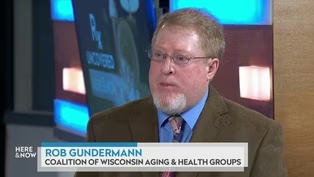
Rob Gundermann on Copay Accumulator Impacts on Health Costs
Video has Closed Captions
Clip: S2400 Ep2425 | 8m 3s | Rob Gundermann on how copay accumulator programs affect patients and their pocketbooks. (8m 3s)
Providing Support for PBS.org
Learn Moreabout PBS online sponsorship
- News and Public Affairs

Top journalists deliver compelling original analysis of the hour's headlines.

- News and Public Affairs

FRONTLINE is investigative journalism that questions, explains and changes our world.












Support for PBS provided by:
Here and Now is a local public television program presented by PBS Wisconsin