Here and Now
Here & Now for November 14, 2025
Season 2400 Episode 2419 | 26m 49sVideo has Closed Captions
Watch the entire episode of Here & Now for November 14.
Watch the entire episode of Here & Now for November 14.
Problems playing video? | Closed Captioning Feedback
Problems playing video? | Closed Captioning Feedback
Here and Now is a local public television program presented by PBS Wisconsin
Here and Now
Here & Now for November 14, 2025
Season 2400 Episode 2419 | 26m 49sVideo has Closed Captions
Watch the entire episode of Here & Now for November 14.
Problems playing video? | Closed Captioning Feedback
How to Watch Here and Now
Here and Now is available to stream on pbs.org and the free PBS App, available on iPhone, Apple TV, Android TV, Android smartphones, Amazon Fire TV, Amazon Fire Tablet, Roku, Samsung Smart TV, and Vizio.
Providing Support for PBS.org
Learn Moreabout PBS online sponsorshipPBS Wisconsin original production.
>> Yes, the federal government will officially reopen with the House vote today.
>> The longest shutdown in history is ended.
[MUSIC] >> Democrats are going to continue fighting every single day for people's health care and food benefits, and we're going to be on you day after day until we get it done.
Vote no.
disagreement over how that end was reached.
[MUSIC] I'm Frederica Freyberg.
Tonight on "Here& Now" Republican Congressman Scott Fitzgerald on the shutdown deal.
And what happens next.
What to expect with energy assistance as rates increase and temperatures outside drop.
A burgeoning but unregulated market is taking hold in Wisconsin.
Building data centers.
A new bill seeks transparency in the process.
And in an act of reconciliation, Catholic sisters transfer land back to the original tribal owners.
It's "Here& Now" for November 14th.
>> Funding for here and Now is provided by the Focus Fund for Journalism and Friends of PBS Wisconsin.
>> The continuing resolution passed with eight Senate Democrats joining Republicans.
Senator Tammy Baldwin was not among them voting against the measure, as it did not include extension of the ACA enhanced tax credits, saying it was the shutdown trade off.
>> I knew that our our best chance of successfully fighting for our afford their health care, especially those who buy it through healthcare.gov, was to tie it to the continuing resolution.
Go back to the past summer and what the president calls his one big, beautiful bill, which took away Medicaid.
To the tune of nearly $1 trillion and cut SNAP to the tune of nearly half $1 trillion in order to pay for tax breaks that disproportionately impact billionaires and profitable corporations.
That tells you who this president is, who the Republican Party is behind.
And we showed you just now who we're fighting for.
And we'll continue to fight for.
>> Senator Baldwin is on a statewide swing denouncing Republicans for blocking attempts to extend Affordable Care Act, enhanced subsidies for the GOP put this shutdown vote in the win column for his reaction.
We turn to Republican U.S.
Representative Scott Fitzgerald of the state's fifth Congressional District.
And thanks very much for being here.
Thank you.
to the successful vote to >> I mean, I go back to September when I voted on the continuing resolution and and actually left for the airport.
By the time the jet hit the ground back in Wisconsin, the Senate had already voted it down.
That that was a message to me that we were on a different track than what we had seen before, with previous continuing resolutions.
But the thing that that was confusing to me is that the Democrats picked one of the most difficult and comprehensive issues to kind of hang their hat on, and that is health care.
So we all know everyone in D.C.
knows that the health care markets, that the programs and that those individual policies are a complete mess right now.
And this is going to take a long, long time to kind of straighten out.
But, you know, like you said, Senator Baldwin's out there kind of using it as a wedge issue right now, but you're not going to get anything done with blaming one party or the other.
We need to come together on that.
But but it can't be done in the in the environment created by shutting down the government.
So it was a it was a huge mistake.
I did predict publicly and almost 3 or 4 days after that, that there's only one way this is going to going to end, and it's going to be for the US Senate to capitulate and and cave in.
And ultimately, that's what they had to do.
>> Do you support a vote in the House on the enhanced ACA tax credits, as it's promised in the Senate?
>> I don't know that we're going to get there.
I think with a two seat majority and with Speaker Johnson already sending a message that we don't have the support for that, I certainly couldn't support it right now.
The way it's been framed up, it's it's just more money to the health insurance companies.
I think we need to continue to look at health savings accounts.
Just this week, Wall Street Journal editorialized on something that goes back to 2017 where individuals have control over their own health accounts.
I think that's another pathway we could we could take.
But the idea that we're just going to keep throwing that was dreamed up at the last second makes absolutely no sense to me.
And and I couldn't support it right now.
>> What is your message to your constituents in your district who may see their ACA premiums more than double when these enhanced credits expire?
>> Yeah, I think the first thing I do is disagree with the premise that they're going to double.
There's a couple of independent think tanks that have done some analysis since the whole shutdown, and there are some instances where you could see a significant increase, but there's others where it will be far less.
And and as a result of that, I think, again, something we don't have a handle on, Congress doesn't have a handle on.
And for us to somehow dream up some new policy without doing the legwork makes no sense to me at this point.
So again, I mean, I take issue with what Senator Baldwin has been saying and continues to say, because I think it's misleading that there's a simple fix to this and it's simply to put more tax money in.
>> Would you like to see a wholesale alternative to the ACA, apart from kind of direct cash payments for health savings accounts, a wholesale alternative to it, and if so, what would that look like?
>> It has to start with portability.
I mean, this isn't something that's new.
This has been around for a long time.
The idea that individuals go from insurance company to insurance company to insurance company every time they change jobs or every time they get a new HSA.
I joke about it because there's a lot of young adults who have switched careers maybe 2 or 3 times early on in their, in their careers.
And, and each one has a different health plan.
So what you end up with are these accounts that have been created, but yet they never grow.
And they're never sizable, sizable enough to have an impact.
I mean, that's first and foremost.
And that goes back to 2017 again, where there were some reforms put in place that, you know, no one's really tapped into because they haven't had to because the government keeps throwing money at these subsidies.
And it's it's just unsustainable at this point.
>> So you were describing how, you know, the issue that Democrats were kind of hanging their hat on was this very complicated health care product.
The continuing resolution runs through January.
Are we going to be right back here to these same kind of shutdown talks at that point?
>> You know, so let me back up a little bit and make a point on that, which is it's another reason many of us were kind of perplexed by the idea that Chuck Schumer and the Democrats in the Senate couldn't come up with a handshake agreement behind closed doors to just say, listen, we'll go out there, we'll vote for this CR.
We won't shut down the government because guess what?
We got to do it all again.
And at that point we were looking at November 21st.
So there was a backstop there.
And here we go again.
There's another backstop.
So I'm not sure why they thought that that shutting down the government was a good idea.
And I think if, if they attempt that again, if they go back there again in January, there would be some huge political fallout for them.
So I think I think right now their best option is to try and sit down and craft something with Senator Thune that can make it out of the Senate, and then the speaker would see if he could pull the votes together.
I mean, he's he's pulled a few rabbits out of his hat along the way here.
I'm not sure what that would look like, and I can't even commit to supporting it, but that might be the best option if if we find ourselves back in the same position again.
>> We'll see what that looks like then.
Congressman Scott much.
>> Thank you so much.
Good to be with you.
>> As the weather turns colder, we all push up the thermostat to heat our homes, families who need financial help to pay their utility bills may have to wait because of the government shutdown, despite it being over last year, nearly 190,000 Wisconsin households received nearly $137 million in assistance, an average of about $315 per household.
The Wisconsin Energy Assistance Program receives both state and federal funding.
Now, the state funding is secure, but the federal funds aren't expected to be released until December or January.
Here with more information on this, we are joined by Assistant Deputy Secretary Diana moss from the Wisconsin Department of Administration.
And thanks very much for being here.
>> Yeah, thanks for having me.
ended the shutdown fully fund the low income Home energy assistance program?
>> Not yet.
It reopened the government, which is great.
And now, as we understand it, our LIHEAP folks in the federal government can get to work in trying to calculate what the allocations will be to each state.
And that's what we expect is still going to take some time.
>> And so how much delayed is this from a usual year when states would get that allocation.
>> Yeah.
At this point you know I would say we're predicting a month or more delayed from a typical year.
It's typical that we don't yet have our dollars at the beginning of the heating season, but we would normally know our award allocation and we don't yet know that.
And so part of that is because of the federal government shutdown.
But now that the government's open again, we expect they're going to take a few weeks to work that out.
>> And how will it affect the people who are trying to apply for that kind of assistance?
Will that also be delayed to them?
>> So they absolutely should apply now.
They should continue applying.
Applications are open and our providers are taking those applications and available to assist in that way so they can find out if they're eligible or ineligible.
And that helps us so that once we receive the dollars, we're able to administer those benefits.
But the good news is folks should continue to apply throughout the season because if they're eligible today, but a circumstance changes, we will continue to recalculate that eligibility throughout the season.
based on income I trust.
>> That's right.
>> So does Governor Evers emergency order this week relating to housing or an energy crisis relate to this?
supplemental support to help those folks in need.
We know that these assistance programs support and serve the same communities that lie.
He continues to serve in the state.
>> So if President Trump, I understand that President Trump laid off the entire staff that administers this LIHEAP, this federal assistance Program for energy, how do you suspect that will affect payments to states?
>> Yeah, it may continue to factor into the delay.
It's you know, we can assume with less folks dedicated to working in this space, it might take longer to do the work.
So that's again, I think another factor that we anticipate will contribute to the delay.
>> So what happens.
We're back to shutdown talk now.
But what happens when the federal funding continuing resolution expires on January 30th?
Should the energy assistance funds already have been made available?
>> We anticipate.
So, yeah, if they were not you know, we're having a different conversation.
The good news is state law in Wisconsin prohibits disconnection April 15th.
So we know that folks will be safe in terms of their heat.
You know, utility companies won't be turning off their heat, but we will absolutely have to figure out the funding if we got to a future date where those dollars weren't yet administered.
>> How do people apply?
>> Yeah, they need to go to energy benefit.gov.
And that will give them all the information about where to find their local provider.
And they have options to apply by phone, in person, mail or right online.
>> So should people expect the same amount of assistance this year as they got last year?
>> We don't yet know because we don't yet have our dollar amount for program year 26.
We anticipate it will be very similar to last year, but we don't know until we get the award.
>> And the way it works is that if you apply for assistance, you are eligible and you are given assistance you that goes directly to your utility or to yourself?
the utility provider on their behalf.
And then we also the same program supports if their furnace goes out and it's a crisis situation, we would then support repair or replacement of that furnace.
But typically the most part of these benefits go directly to the utility company.
keep people warm.
Diana of Administration, thanks very much.
>> Thank you.
>> With more than 45 data centers in Wisconsin and more planned and announced in what feels like every day, local communities already grapple with zoning issues and public pushback.
But now comes a state legislative bill to regulate the centers built by tech giants like Microsoft and Meta to process artificial intelligence data.
Democratic state Senator Jodi Habush Sinykin of Whitefish Bay is author of the bill.
And Senator, thanks very much for being here.
>> Thank you.
I appreciate the invitation.
>> Why does Wisconsin need a law regulating these data centers?
>> Wisconsin currently has no laws on the book books that provide any regulatory oversight with regard to transparency, accountability for water usage, for energy rates, for those community impacts that people are very concerned about.
So this legislation is intended to provide that overarching regulatory framework to fill that current vacuum.
>> How much does the proliferation of these centers feel like?
The wild, wild West?
>> A lot, very much so.
As I have been hearing from my constituents and others around the state, there is this recognition that in the absence of information there.
It creates worry and distrust and uncertainty about the impacts, not just on themselves and their families and communities, but for our futures.
>> How does your bill protect utility ratepayers or consumers?
>> It's a great question because we really wanted to focus on that in terms of the transparency and accountability.
Again, too high in Wisconsin, and with winter coming on, it's very much front and center on people's minds, especially in these uncertain economic times.
So what this bill does is it establishes a very large customer class, which these big data and data centers would fall into, and that class would be responsible for the extremely high energy production needs that they call upon, not individuals or families separate from them.
>> How does it track water usage and to what end?
>> That's also a question that people have in a very legitimate concern.
People are very curious about how much water will be used, particularly from the Great Lakes, is what I hear a lot of.
And again, this bill is very focused on accountability and transparency, which is very much part of Wisconsin's values.
And rather than allowing the water use to be hidden with some of these non-disclosure and the like, it requires the disclosure of how much water will be used and in what fashion.
>> In the face of a state law addressing data centers, how important in your mind is local control?
>> Local control is where it all begins.
People don't always understand that.
So I'm really glad you asked about that.
The idea of where these data centers developments proceed happen at the local level by local city officials and governments.
For the state legislators like myself, I feel we need to show up at the table from the state level to provide some kind of uniformity and a regulatory framework, again, that helps hold these big data centers and big tech accountable to Wisconsin.
>> What kind of bipartisan support do you have for this regulatory bill?
>> Well, we were just introduced it last week, but I'm again, glad you glad that you asked this, because I am very much hoping for bipartisan support for this bill myself.
I'm a Democrat, but my Republican colleagues are hearing from the same constituents with the same concerns about property value impacts, water usage.
As we've already discussed, energy rates, climate change concerns with regard for hopes for renewable energy, all of that.
But because the legislature is very much still controlled by the Republican in both the Senate, Republicans, in both the Senate and the Assembly, we need them to lean into this, an interest in providing a regulatory framework for our state, because they decide where to what committee, and whether or not there will be a hearing held.
And I really want to underscore because that's when the public comes in and shares their thoughts, their concerns, their asks.
And that's how bills across the board become better.
That's the iterative process that is so important here.
But we need Republicans to important next step.
>> All right.
Well, we Habush Sinykin, thank you so much.
>> Thank you very much.
>> In the Northwoods land owned by the Franciscan Sisters of Perpetual Adoration was given back to its original landowners, "Here& Now".
Reporter Erica Ayisi traveled to Arbor Vitae, where the Lac du Flambeau Band of Lake Superior Chippewa Indians reclaimed a part of their indigenous lands from Catholic sisters who operated an Indian boarding school.
>> Signed, sealed and delivered.
officially concludes the transfer of the property to the Lac du Flambeau tribe.
>> The Franciscan Sisters of Perpetual Adoration are the first known Catholic orders of sisters to transfer land to its original Native American owners in an act of reparations for colonization during the federal Indian boarding school era.
>> We fspa have been exploring what it means to unveil our white privilege, including the responsibility that comes with the privilege.
>> Sue Ernster, president of the Fspa, says.
His sisters acknowledge their dark legacy of colonialism through truth, healing and a land transfer of their Marywood Franciscan Lac du Flambeau Band of Lake Superior Chippewa Indians.
how we've been complicit and have benefited from the systems that have kept others out, such as the Lac du Flambeau.
>> Lac du Flambeau children attended the Saint Mary's Indian Boarding School in Odanah, which the Fspa operated for 86 years, during a period when the US government removed Native American children from assimilated them into Euro-American Catholic culture.
Does giving land back to Native Americans reconcile the past?
>> It's a step it does not fully reconcile.
There's nothing I believe that can fully reconcile for the trauma that has been inflicted over these years.
>> Ernster says.
When the sisters realized that they no longer needed their center, they collaborated with Brittany Koteles of Land Justice Futures to learn how to incorporate land justice into their reckoning.
>> We knew that it was the time to reignite the relationship with the Lac du Flambeau and see if they would be interested in purchasing the property.
This is not a market rate transaction, it's a land Bakke.
The tribe is paying $30,000 for the property.
>> The Fspa purchased the property for $30,000 in 1966.
John Johnson, president of the Lac du Flambeau, says his counteroffer was a dollar.
>> I had just asked him.
I said, how did you get our land?
And I don't mean mine, per se, or my tribe, but every Ojibwe person in the state of Wisconsin.
>> The Lac du Flambeau, ceded or gave up their land to the federal government in the 1854 Treaty of La Pointe.
Johnson says the tribe's business department felt $30,000 was fair considering the property's current market value.
>> When I first heard, it was like $2.6 million, and then I heard it was, you know, they had to offer a $3 million.
And, you know, the price could have kept going up and up and up.
>> Marywood is nearly two acres, including an office, lodge and cabins situated along Trout Lake.
>> And as you look out onto these islands out here, those were once inhabited by all of our relatives here.
And there are families in Lac du Flambeau that were raised on the islands.
>> Giving this land back to its original Native American owners presents challenges.
It's situated just outside the Lac du Flambeau reservation, subjecting it to taxation.
>> There's also processes that tribes can place that land into trust and protect it from taxation.
>> Philomena Kebec, tribal attorney and enrolled member of the Bad River tribe, says the process can be complex.
>> The fee to trust application can be opposed by municipalities.
>> We're looking at this for midterm potential opportunities for work in the tribe.
>> For now, Larry Turner of the Lac du Flambeau Business Development not expecting to make a profit from the land transfer and will use the property for professional housing.
>> We have such a huge shortage of professionals in the tribe, including traveling nurses, doctors for the clinic, management for the Business Development Corp, and there's no rentals up here.
>> Xia Johnson says he also wants to use their reclaimed land to sustain their Ojibwe culture to future generations.
>> Hold on a lake here in the wintertime, we're going to probably set up a tent or something, you know, and do some spearing here in the winter for muskellunge and stuff like that.
>> The PFAS former Indian boarding school was demolished and is now Saint Mary's Parish on the bad River Tribal Reservation.
In documents acquired by the Catholic Church, was given at least 10,000 acres of land by the federal government to operate Indian boarding schools across the country, including three schools in Wisconsin.
Although the Catholic Diocese of Superior says all of its land is currently in use and unavailable for land transfers to tribes, the Fspa says their land transfer is about reckoning.
>> What is it?
We can learn from this so that we can move forward.
>> And reclamation for the tribe.
>> All this land that you see around here should be rightfully ours anyway.
>> In Arbor Vitae I'm Eric Ayisi for "Here& Now" and ICT.
>> For more on this and other issues facing Wisconsin, visit our website at PBS Wisconsin.
Org and then click on the news tab.
That's our program for tonight I'm Frederica Freyberg.
Have a good weekend.
>> Funding for "Here& Now" is provided by the Focus Fund for Journalism and Friends of PBS Wisconsin.
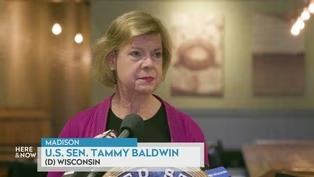
Baldwin Describes Focus on Health Care During the Shutdown
Video has Closed Captions
Clip: S2400 Ep2419 | 1m 14s | Tammy Baldwin explained why most Democrats held out during the 2025 government shutdown. (1m 14s)
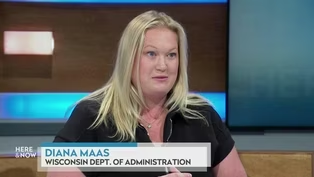
Diana Maas on Funding for Energy Assistance in Wisconsin
Video has Closed Captions
Clip: S2400 Ep2419 | 5m 16s | Diana Maas on the Wisconsin Home Energy Assistance Program's federal funds being delayed. (5m 16s)
Here & Now opening for November 14, 2025
Video has Closed Captions
Clip: S2400 Ep2419 | 1m 22s | The introduction to the November 14, 2025 episode of Here & Now. (1m 22s)
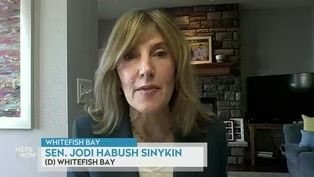
Sen. Jodi Habush Sinykin on a Bill to Regulate Data Centers
Video has Closed Captions
Clip: S2400 Ep2419 | 5m 15s | Jodi Habush Sinykin on a bill to regulate water and energy used by data centers. (5m 15s)
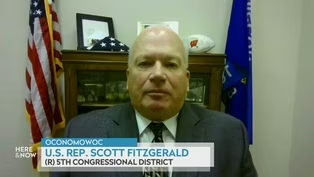
US Rep. Scott Fitzgerald on 2025 Government Shutdown Fallout
Video has Closed Captions
Clip: S2400 Ep2419 | 7m 5s | Scott Fitzgerald on the funding deal that ended the 2025 federal government shutdown. (7m 5s)
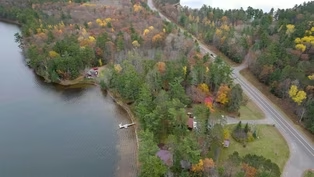
Why Catholic Sisters Sold Land Back to the Lac du Flambeau
Video has Closed Captions
Clip: S2400 Ep2419 | 6m 5s | A Catholic order sold a plot on Trout Lake to the Lac du Flambeau as a land back action. (6m 5s)
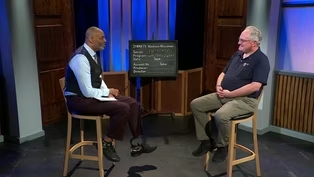
In Focus with Chris Kolakowski: Honoring Wisconsin Veterans
Video has Closed Captions
Clip: S2400 Ep2419 | 43m | Chris Kolakowski on celebrating and telling stories of Wisconsinites in the military. (43m)
Providing Support for PBS.org
Learn Moreabout PBS online sponsorship
- News and Public Affairs

Top journalists deliver compelling original analysis of the hour's headlines.

- News and Public Affairs

FRONTLINE is investigative journalism that questions, explains and changes our world.












Support for PBS provided by:
Here and Now is a local public television program presented by PBS Wisconsin