
Hmong Language and Culture Camp - Cia Siab Inc.
Season 12 Episode 11 | 26m 48sVideo has Closed Captions
Delve into Hmong language and culture with campers at Cia Siab Inc. in La Crosse.
Become immersed in the Hmong Language and Culture Camp at Cia Siab Inc., a social services agency in La Crosse. Host Angela Fitzgerald learns how the nonprofit’s revitalization of Hmong language and culture is tied to their efforts to support women, youth, elders and LGBTQIA+ communities. Then head out around the state for more stories.
Problems playing video? | Closed Captioning Feedback
Problems playing video? | Closed Captioning Feedback
Wisconsin Life is a local public television program presented by PBS Wisconsin
Funding for Wisconsin Life is provided by the Wooden Nickel Fund, Mary and Lowell Peterson, A.C.V. and Mary Elston Family, Leon Price & Lily Postel, Stanley J. Cottrill Fund, UW...
Hmong Language and Culture Camp - Cia Siab Inc.
Season 12 Episode 11 | 26m 48sVideo has Closed Captions
Become immersed in the Hmong Language and Culture Camp at Cia Siab Inc., a social services agency in La Crosse. Host Angela Fitzgerald learns how the nonprofit’s revitalization of Hmong language and culture is tied to their efforts to support women, youth, elders and LGBTQIA+ communities. Then head out around the state for more stories.
Problems playing video? | Closed Captioning Feedback
How to Watch Wisconsin Life
Wisconsin Life is available to stream on pbs.org and the free PBS App, available on iPhone, Apple TV, Android TV, Android smartphones, Amazon Fire TV, Amazon Fire Tablet, Roku, Samsung Smart TV, and Vizio.
Providing Support for PBS.org
Learn Moreabout PBS online sponsorship- Announcer: The following program is a PBS Wisconsin original production.
- Angela Fitzgerald: Coming up on Wisconsin Life: check out the World Euchre Championship in New Glarus, [laughter] a Baraboo candlemaker keeping a longtime tradition burning, a Madison influencer helping others get hands-on with home repairs.
[saw buzzes] - Ingrid Krause: Thank you for coming.
- Angela: A microcar museum in Mazomanie.
- Attendee: [laughs] It's crazy.
- Angela: And a WWII plane turned vacation destination in Deerbrook.
That's all ahead on Wisconsin Life.
[bright music] - Announcer: Funding for Wisconsin Life is provided by: the Wooden Nickel Fund, Mary and Lowell Peterson, the A.C.V.
and Mary Elston Family, the Stanley J. Cottrill Fund, UW Health, donors to the Focus Fund for Wisconsin Programs, and Friends of PBS Wisconsin.
- Camper: Two, four, go!
[bright music] [children exclaim] - Counselor: Oh, nice!
- Nyob Zoo, or hello!
I'm your host of Wisconsin Life, Angela Fitzgerald.
We're joining a Hmong language and culture camp run by Cia Siab, a nonprofit social services agency in La Crosse.
Part of this year's camp is held at Pettibone Park on the Mississippi River, and today, we're going fishing.
[upbeat music] Cia Siab runs the camp each summer.
The organization was founded in 2016 by a group of local women in order to provide holistic, culturally-appropriate care for survivors of domestic violence and assault.
They also run programming to help preserve Hmong culture.
Like this camp, working to revitalize and preserve Hmong language in an active and engaging way.
With the help from instructors, youth come each summer to connect, learn, speak Hmong together, [students sing in Hmong] and sometimes fish.
Before I reel in anything here, let's meet some folks making waves in our state.
As we shuffle over to New Glarus, where teams gather for the World Euchre Championship.
[upbeat music] Every summer in New Glarus, a card game takes center stage.
- Jess Villiger: Euchre!
- Carson Crochet: Euchre!
- Dan Ziegler: Welcome to the World Euchre Championships.
[cards shuffle] - Shelly Johnson: We really have pulled in people from all areas of the country who just love the game of euchre.
It's easy to learn.
Anyone can play, and honestly, we welcome people of all ages and abilities.
Euchre is a very interesting game because there's definitely a skill component to it, but there's also a luck component to it.
- Angela: The balance of luck and skill keeps the game exciting, but it's the memories that make it last.
- Growing up, whenever we would go out to dinner, my dad would have a deck of cards, and whenever we would travel together, we would play euchre together.
- Carson: I literally learned how to play sitting on my dad's lap.
- We've had a euchre league in this community for ever since I can remember, and they'll travel from different communities.
Every community had one or two teams, and they'd travel around competing.
- Angela: For newcomers, it's a way in.
- Midwest game, so we'd heard of it.
Jess had just moved to Chicago and we don't do sports.
We were like, "What league can we join?
How can we socialize with people?"
So, then they taught me euchre so we could join the league, and we've really made her dad proud.
- Yeah, that is so true.
- Angela: Before long, the game wasn't just about the cards.
It was about the people, the stories, and yes, even the costumes.
- I've already had three costume changes.
People that have been here before are kind of, "What are you gonna wear this year?"
- So, something in euchre, it's called fishing for trump.
And so, that's when you play a low card.
It's normally a 9.
- Of whatever trump is.
- Jess: Or a 10.
And then, that pulls out the, like, higher hearts.
- The bowers.
- The bowers, these guys.
So, kind of like we're fishing for these bowers.
Yeah, we have the fishing piece.
We have little, Carson got... - The crawdad.
- Jess: Where's the crawdad?
- Somewhere on my hat.
- Jess: Crawdads.
- Or crawfish.
- Little worms.
So, yeah, we're fishing for trump.
- Angela: The tournament also raises money for the village they love.
- Shelly: It had been used as green space and as the only sledding hill, really, in our community for generations.
The land went up for sale.
We didn't want it to be developed.
We raised the other $75,000 to pay them back for their added contribution.
So, now we're able to gift that over to the village of New Glarus.
- Dan: One of my slogans is "Putting fun back in fundraising."
We need the money, but you gotta have fun doing it.
- Shelly: We're really all here to just have a good time and to raise money to support good local organization and the projects that they're trying to do.
- Angela: Behind the laughter and friendly games, it's all about giving back and passing that joy to the next generation.
- Shelly: It's exciting to see, you know, future generations picking up the game.
- And where we live, it is a lot of young people, but today, everyone we've played, they've been making comments about how they're usually the youngest team and, you know, they're 35 years older than us.
- Angela: The winning hand isn't the cards.
It's the people across the table.
- Shelly: You get to rotate, and you never play with the same group of people twice.
So, it's just, it's fun, right?
It's fun to get to know other people, to learn their stories, how they came to play euchre.
- It's almost like a little family.
- It's the game of life.
You just play it the best you can, play the cards you're dealt and do the best you can, and have a great day every day.
[all cheer] - Angela: Now, we slow things down with a maker in Baraboo keeping a Swedish tradition alive in the dark days of winter.
- Alan Anderson: I have a quote that I printed out.
"Tradition is not the saving of ashes.
It's the maintaining of fire."
I loved it.
[gentle acoustic guitar music] My name is Alan Anderson.
All four of my grandparents were born in Sweden.
Our family has kept a lot of those Swedish traditions alive just because of that reality.
And one of the traditions I have maintained over the years is making a very traditional Swedish Christmas candle called a "grenljus" or branch candle.
And I think, as far as I know, I'm the only one in the United States who's making them and selling them.
I had never dipped candles until I tried this.
And it takes a while.
But when I make a batch, I have to get in the mood.
Get the wax together.
I have a very large pot that holds about 30 pounds of wax 'cause it has to be fairly deep.
The wicks themselves are a braided wick.
So, there's the central wick that forms the bottom that goes into a candle holder and a longer wick that forms the arch.
All that has to get put together.
Some little pins that holds the wicks into this wooden stick, and then you're ready to go.
If you dip too fast, too often, you'll literally melt the wax off of the wick.
So, there's a resting period between dips.
There's this rhythm that I have as you go through.
And it becomes at one level, a bit boring, dipping, and another level very meditative.
Folk art, in my mind, is something that is produced by people by hand, that's functional, but has been added to by something that's beautiful.
I'm interested in wood.
One of the things I've known from visiting in Sweden, every time you see something that a Swedish person has made, a craftsman, a folk artist, somewhere on that piece, there's a set of initials.
They've marked it.
It's a matter of pride.
There's this very human need to identify: I made this.
It's not necessary.
It's ornament.
There's a tradition in Sweden.
A small village would gather and there would be this effort to prepare for the winter.
How do we get through the darkest time in the winter?
We need candles.
Not just for the evening meal, but also for the religious part of that.
Three-pronged candles were made specifically in the old days for Epiphany to celebrate the Three Wise Men.
And a candle isn't necessarily a fancy thing.
It's very functional.
But to take and make the three-pronged candle is an odd one.
Why not just have three candlesticks and three candles?
So, they did something special there.
[bright music] The candles I make will last about six hours.
So, I jokingly say that's enough for three good meals or two fantastic meals.
[laughs] I've told my kids lately I've got about four and a half lifetimes of things I wanna make, and I'm running out of time.
[laughs] For whatever reason, when I think about people hanging on to cultural traditions, it's about hanging onto things that are important to them.
They get those importance from family, from their community, from their culture.
They're memories that they don't want to lose of important things, fun things, beautiful things.
It's a memory infused with love.
Make your own traditions.
Figure out something that's your love to pass on to family, and that becomes a tradition.
I think that's important.
[bright music] - Angela: Next up, we cruise to Mazomanie to meet the founder of a microcar museum, where tiny cars bring big smiles.
[upbeat music] - Attendee 1: What is this little doohickey?
- Ingrid Krause: Thank you for coming!
- Attendee 2: [laughs] It's crazy!
- Attendee 3: I can see where it'd be fun.
[laughs] [car door closes] - We have a collection of microcars.
I have them from Spain, I have them from France, I have them from Italy, Germany.
- This is like a German, Spain.
- Attendee 4: I like it, it's wonderful.
- They are in mint condition.
They've been sitting inside.
I'm Ingrid Krause, and I own the Midwest Microcar Museum in Mazomanie, Wisconsin.
- Attendee 5: Holy cow, the whole roof flips over on this one.
- You'll see, it is made for adults, because once you try... - Oh, dear!
[both laugh] This thing is right in the way.
- It's picture time!
- Now, do you want to jump back out again, or?
We started with the Messerschmitt.
- Dave, come and help me get out!
[all laugh] - Ingrid: The Messerschmitt is a funny-looking car.
It's a fun car.
It's a sort of a nostalgia.
This is my East German corner.
I grew up in Germany.
Post World War II, there were hundreds of small car manufacturers.
You have to realize, after the war, Europe was in shambles.
And so, people were just happy to have something.
There too, we have the motorcycle engine in the back.
You'll see it.
- Attendee 6: Whoa.
[engine pops] Driving one wheel.
Wow.
- You don't really buy 'em as an investment.
You buy 'em because they're funny, and we kind of got a kick out of it.
And then it got to be a hobby gone rogue.
We liked the building.
We just wanted to store the vehicles.
Then everybody said, "Oh, come on.
Just open up so everybody else can see it too."
We thought it was fun.
And now, I just open when I feel like opening.
- Attendee 7: That's nice.
- Ingrid: I like the interactions with people.
I think it's fun.
I have met very nice people all along.
This is the Trabant.
We kind of like goofy-looking cars, and to be honest, they're all goofy-looking.
And you get a smile on your face.
- Thank you for coming.
- It was fun.
- Yeah.
And if you have a smile on your face just looking at those, there's something right about it.
[bright music] - I'm back at camp with Cia Siab at Pettibone Park to learn how language, community, and fishing connect.
I jumped right in to join the Hmong lanuage and culture camp.
[counselor laughs] - There you go!
She's a pro!
- Angela: Trying to reel in our next meal, eating a fresh-caught meal... Thank you.
...while learning Hmong language.
Then, I sat down with Executive Director Xong Xiong to learn about their mission.
- Xong Xiong: We're a Hmong social service agency dedicated to helping victims of crime, especially domestic abuse, sexual violence survivors.
We ground our work in Hmong language and Hmong culture.
We are a linguistically and culturally-relevant agency, and so, we provide services to Hmong folks who don't speak English in a way that they feel comfortable, in a way that's, like, culturally relevant and appropriate and sensitive to their needs.
So, it's that huge difference where you go to and see familiar faces and you don't have to explain certain things about your culture.
- Can you tell us about your youth programming as well?
- Xong: We know that when young people are really proud of who they are or they're really well-grounded in their identity, it's really a lot easier for them to succeed, a lot easier for them to, like, overcome barriers and, like, just, like, really stressful things in their life.
[exclamations] - Camper: It's a tie!
- Absolutely.
And it helps to, like, sounds like preserve the culture so it doesn't get lost over time.
- I think that's one of the biggest reasons why we do it is because we know that English being, like, the predominant language, our young people, a lot of them don't speak it, you know, because of the 50 years since we've been in the United States.
This is an opportunity for us to also, like, teach them parts of our language and parts of our culture and things that are really important to Hmong people.
- Twirl this around it.
- Angela: What is some of the feedback that you hear from youth or from families as a result of the work that you do?
- Xong: I think a lot of them really appreciate the work that we do.
When they come here, we serve them the food that they're familiar with.
We have staff that speak to them and, like, care for them in a way that, like, they don't get anywhere else.
So, even for our elders coming here, it's a place where they get to be with other elders, you know, and share and have that common shared history and struggle.
- Eat your food!
Enjoy!
[cheers and applause] It's a good space, you know?
I think a lot of them say that it's a really safe space for them to be, like, who they are and be really happy and proud.
- Thank you so much, Xong.
I appreciate your time.
- Yeah, of course.
Thank you.
[bright music] - Angela: We now head to Madison to link up with a social media influencer empowering others with the tools to tackle home repairs.
[bright piano music] - Mercury Stardust: It's all about helping the person who's the most marginalized, right?
It's all about helping the person who knows the least in the room.
Nothing makes you feel more of a human than when you are helping people in need.
Hey there, hi, my name is Mercury Stardust.
I'm the intersectional feminist trans maintenance lady.
I can help you.
I was a professional maintenance technician at a property management company where I had to take care of 150 units, about 500 residents.
It was a really tough job.
On day one, I heard people talk about racial slurs.
Day one, I heard people say transphobic things.
That can be really difficult to be able to be a marginalized person in that space because you want there to be change, and you don't wanna be a problem.
I was scrolling TikTok, and then I saw someone who was very upset.
It was as a mom of, like, two or three kids.
She was, you know, crying in this video, saying, "Hey, I don't know what to do."
And when you're watching a video like that, as a person who was often told I was stupid for not knowing certain things, I related to her in that moment and I wanted to educate her in a way that I wish I was educated to.
So, I turned on the camera and I said, "Hey, I'm gonna make a video."
I had no idea what I was doing.
Oh, that is a great question.
Let me show you what this little thing does.
I posted the video and I didn't really think much of it.
Woke up the next morning, I had, like, 100,000 followers.
That video had now hit, like, 600,000 people.
And my life changed so fast.
A lot of you are new here, so let's do an intro, shall we?
My name is Mercury, and I am the Trans Handy Ma'am.
Get a piece of cardboard, place it right underneath the nail.
This is a flange plunger.
It's gonna make your life a whole lot easier.
I would work my 10-hour shift and then I would clock out, and then I would go and do, like, a four-hour live.
And I would sit there in a live stream and just answer questions.
- This video is for Mercury Stardust, the maintenance lady.
- When the management came to me and said, "Hey, we found your TikToks and those funny little videos online," as they called them, were not rubbing them the right way.
I left in 2021, about three months after I started my TikTok career.
But yeah, I haven't looked back since.
But now, you just gotta go a little bit farther.
But you're in the right direction.
And that's gonna be the plunger and your Cobra skinny drain cleaner.
That's called acting.
It's kind of bringing an intersectional lens to the DIY space, where if you can help the person who's the most marginalized, the person who's most affected by the systems that are oppressing, then you're able to kind of help every single person.
But I am telling you right now, you can wear jeans, overalls, no bra, and do this work and get a little dirty, and have nail polish still, and get a job done.
It doesn't matter.
[saw buzzes] It's been a wild thing.
I mean, I wrote a book, to become a number-one New York Times bestselling book.
I also do a podcast called The Handy Ma'am Hotline.
I answer questions all the time.
Naturally wanna come and swing out.
Do you know what I mean?
I also raise money for Point of Pride.
Point of Pride is a nonprofit organization that provides gender-affirming care for people who are not able to access it.
- In unison: And share the live!
- In the last three years, I've raised $4.5 million total.
It's a wild experience to be, like, you're strapped to a rocket and you're just shooting off into space.
And now, here you are, trying to figure this out.
[laughs] I think the overarching theme of all the work that I do is about just taking up space.
It's about just being myself and doing the things that I care about.
Right now, trans people are the center of every gosh darn topic.
We are 1% of the population, but we're 95% of the conversation.
We're being talked about, but never talked to.
Thank you for sharing that story.
The world that I care about is about providing services to others.
Be it from providing gender-affirming care to people who can't access it.
[Mercury cheers] - We just jumped up to a million and five!
- What?
Being providing, you know, home repair knowledge.
You already know how to solve this problem before you even start.
Be it just connecting with people on a human level.
I enjoy those things.
I wanna let you know, you don't have to shave your eyebrows off.
You know?
[laughs] Am I gonna be here in five years?
I don't know.
Am I gonna be here in 10 years?
I don't know.
But I would love to be the Betty White of the maintenance world.
[laughs] Live until I'm 105, fixing drywall and making people smile.
That'd be great.
Have a good day, take care, and remember, you're worth the time it takes to learn a new skill.
Buh-bye!
[bright music] - Angela: For our last story, we fly over to Deerbrook to check into an overnight destination that's taking flight.
Flying over northeast Wisconsin, there are endless lakes and forests.
- Joe Draeger: It does look quite unique from the air.
- Angela: And there's a chance to get a glimpse of something unusual suspended in the trees.
- Joe: It's about eight feet wide.
I'm gonna guess and say it's roughly 45 feet long.
Certainly unique when you pull in here and you see this DC-3 sitting here in the middle of the woods.
- Angela: Joe Draeger landed on an idea to float a World War II aircraft in the northwoods canopy near Kempster.
- I'm not a pilot.
I'm not an aviator by any sense of the means.
- Angela: What Joe is is an entrepeneur who came up with a plan to put the air in B&B, turning this vintage DC-3 warbird into an overnight destination.
- Joe: Someone had told me that they had one possibly here in Wisconsin.
And we brought it up here on a flatbed truck, and then we had a crane come in and set it.
And it's a lot of work, metal bending and engineering just to get it up there, get it built.
It took us probably 10 months minimum from start to finish before it was ready to be inspected by the state.
All right, we'll go up the top.
It's a unique spot.
Now, this is Catfish Lake out here.
It's actually a pretty good fishing lake.
It's sitting on 100 acres here.
- Angela: At one time, this military plane, nicknamed "Lady Luck," could travel hundreds of miles with 20 Marines on board.
- Historically, why's it was in the South Pacific, it flew somewhere between Guam, midway, Pearl Harbor.
I think it was built in 1939.
Very dependable plane.
They're very iconic.
People who are in the aviation business are very familiar with the DC-3.
They always say it was the plane that won the war.
[door creaks] - Angela: Enter the cabin and you step back to a wartime footing.
- Joe: This is the original door, there's original flooring that was in it.
We had it all redone.
So, it's got a little makeshift kitchen here with the sink and the fridge.
And it's got a bathroom.
The cockpit is probably the nicest part of the plane.
I think the kids that come up here like to sit in the seat.
I can't imagine flying this thing, being shot at.
Most of the stuff that was originally in here is not in here anymore.
There was literally a thousand toggle switches between these two pieces that we took out.
The wiring harness was about that big.
- Angela: Any overnight flight at this Airbnb comes with a copilot, free of charge.
- Joe: As you see in every movie, there's always a skeleton that went down with the plane.
Captain Bones, as he's referred to.
[chuckles] - Angela: Family and friends may have had their doubts about Joe's adventure in the sky.
- Joe: Well, I suppose they thought I was half nuts.
I suppose most people thought it was kind of a crazy idea, but anyone that's been back here to see it is like, "It really did turn out nice."
It is a lot of work to have an Airbnb like this.
It's been fun.
[groovy music] - We've explored tradition, community, and language while celebrating people from around our state.
To check out more, visit WisconsinLife.org.
Reach out on social media or by emailing stories@wisconsinlife.org.
From the campers at Cia Siab, I'm your host, Angela Fitzgerald, and this is our Wisconsin Life.
- Campers: Sib Ntsib Dua!
[bright music] - Announcer: Funding for Wisconsin Life is provided by: the Wooden Nickel Fund, Mary and Lowell Peterson, the A.C.V.
and Mary Elston Family, the Stanley J. Cottrill Fund, UW Health, donors to the Focus Fund for Wisconsin Programs, and Friends of PBS Wisconsin.
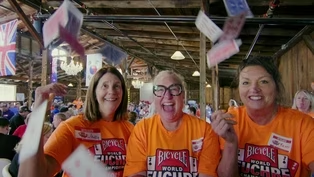
World Euchre Championship draws players to New Glarus
Video has Closed Captions
Clip: S12 Ep11 | 3m 46s | In New Glarus, the World Euchre Championship celebrates cards, tradition and community. (3m 46s)
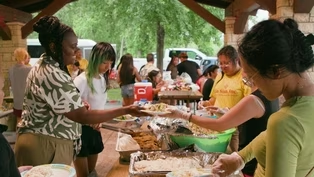
Cia Siab connects youth to Hmong heritage
Video has Closed Captions
Clip: S12 Ep11 | 2m 47s | At Pettibone Park, a Hmong culture camp connects youth to heritage and identity. (2m 47s)
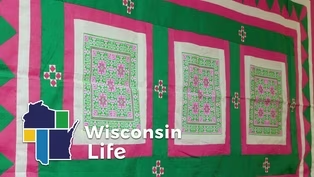
Preview: Hmong Language and Culture Camp - Cia Siab Inc.
Preview: S12 Ep11 | 30s | Delve into Hmong language and culture with campers at Cia Siab Inc. in La Crosse. (30s)
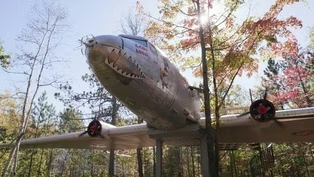
Sleep in a WWII warbird in the Wisconsin Northwoods
Video has Closed Captions
Clip: S12 Ep11 | 3m 16s | Lady Luck, a 1939 DC-3, now floats among the Northwoods pines as a one-of-a-kind Airbnb. (3m 16s)
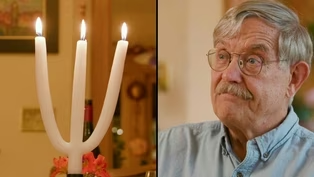
Keeping a Swedish candle tradition alive
Video has Closed Captions
Clip: S12 Ep11 | 4m 59s | Alan Anderson makes traditional Swedish “grenljus” candles in Baraboo. (4m 59s)
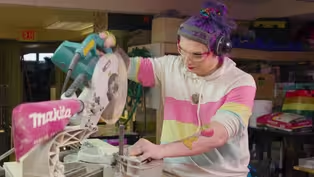
The Trans Handy Ma'am wants to help you repair your apartment
Video has Closed Captions
Clip: S12 Ep11 | 4m 59s | Mercury Stardust cares about two things — teaching home repair and helping those in need. (4m 59s)
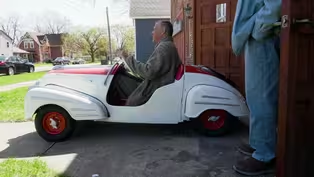
MicroCar museum showcases 'goofy-looking' vehicles from post-war Europe
Video has Closed Captions
Clip: S12 Ep11 | 2m 50s | The Midwest MicroCar Museum houses diminutive vehicles with historic significance. (2m 50s)
Providing Support for PBS.org
Learn Moreabout PBS online sponsorship












Support for PBS provided by:
Wisconsin Life is a local public television program presented by PBS Wisconsin
Funding for Wisconsin Life is provided by the Wooden Nickel Fund, Mary and Lowell Peterson, A.C.V. and Mary Elston Family, Leon Price & Lily Postel, Stanley J. Cottrill Fund, UW...