Here and Now
Mapping a History of Covenants and Segregation in Milwaukee
Clip: Season 2400 Episode 2422 | 8m 51sVideo has Closed Captions
Researchers and volunteers examine where and how racial covenants shaped Milwaukee County.
Researchers and volunteers with the Mapping Racism and Resistance project in MIlwaukee County are examining millions of documents to chronicle where and how racial covenants shaped the community.
Problems playing video? | Closed Captioning Feedback
Problems playing video? | Closed Captioning Feedback
Here and Now is a local public television program presented by PBS Wisconsin
Here and Now
Mapping a History of Covenants and Segregation in Milwaukee
Clip: Season 2400 Episode 2422 | 8m 51sVideo has Closed Captions
Researchers and volunteers with the Mapping Racism and Resistance project in MIlwaukee County are examining millions of documents to chronicle where and how racial covenants shaped the community.
Problems playing video? | Closed Captioning Feedback
How to Watch Here and Now
Here and Now is available to stream on pbs.org and the free PBS App, available on iPhone, Apple TV, Android TV, Android smartphones, Amazon Fire TV, Amazon Fire Tablet, Roku, Samsung Smart TV, and Vizio.
Providing Support for PBS.org
Learn Moreabout PBS online sponsorshipvery difficult to get that done in time.
>> All right.
Well, Barry Burden, thanks so much.
>> Thanks for having me.
>> In other news, to understand why Milwaukee ranks as one of the most segregated big cities in America, two Wisconsin based researchers have been taking a close look at housing records and the racially charged language in them.
Here and now, reporter Murv Seymour shows us how the Mapping, Racism and Resistance project inches toward the finish line.
Despite the recent loss of federal funding, some viewers might find the language in this story disturbing.
>> This project is incredible.
It's important.
It is not historical.
It is alive.
>> From a place known as the hub for learning.
>> And it needs to flourish so that we can continue to push back against racism and segregation.
>> Something historic is happening at Milwaukee's downtown public Library.
>> It's one thing to say, oh, there's systemic racism.
It's another thing when you see the language.
>> It's jarring.
>> Whites only, Caucasians only colored people.
>> University of Wisconsin-Milwaukee professors Anne Bonds and Derek Handley have been busy for nearly three years.
>> These covenants cover housing that is now predominantly occupied by African Americans in Milwaukee.
>> The two have been leading an effort that peels back the hateful history of racial covenants in Milwaukee County, and has helped shape Milwaukee along racial lines.
Racial covenants a clause written into property deeds that forbid the sale, least or occupation of a property to a person because of their race, ethnicity, or religion.
>> We have this deep history of racial and I've been wanting to know more about it, and I started digging into racial covenants.
students, you know, why do you think there are Black communities in these different cities that you go in?
By seeing these maps, you can get a better understanding to that question.
A lot of Milwaukee was part of or the Black population were part of the Great Migration.
They came here with hope.
There were certainly jobs over a period of time.
Black people knew what places they were not supposed to be.
>> After searching nearly 5 million documents from 1910 to 1960, the Mapping Racism and Resistance Project found.
Get this 32,506 racial covenants blended into the language of housing deeds throughout Milwaukee County.
certain kinds of language words like whites only, Caucasians only.
We knew that terms like and colored and African and Ethiopian would probably appear, because that's the language that was being used at the time.
>> We've seen covenants that mention no Italians.
We've seen covenants that mentioned no Mexicans.
>> According to the research, not every racial covenant explicitly said no Blacks or no colored person.
Some said white only or Caucasian only.
And bond says in practice, all of the covenants they found targeted Black people.
The one exception Blacks could live in white only communities if they were working there as a servant.
>> Derrick and I could never have identified all of these racial covenants without the work with the community.
California, more than 6000 volunteers, many of whom transcribe their findings.
They used a site called Zooniverse to discover and meticulously document racial covenants and the language used in them.
Mary Roberts says she became a transcriber because of her passion for history.
>> You'd have one, two, three, four, five items of things that you couldn't do on a property, and then all of a sudden, there it was a racial covenant.
It's one thing to learn in your history books about how segregation happened, or to read about the Fair Housing Act and to read about the civil rights marches.
But it was really a whole nother experience to be reading property deed after property deed after property deed with these racial covenants in it.
>> Once found, each racial covenant is verified and documented by five different people, word for word, regardless of its racially discriminatory tone.
>> One person was so offended by the language that was used in the covenants that they didn't want to transcribe that language.
>> Some of these are like a they're they're a sucker punch.
People find these, and the general reaction is, whoa, like, I don't I don't want this.
I don't want to be associated with this.
And and for many people of color, they encounter these.
It's very devastating to think about living in a place that was constructed through this kind of racial exclusion.
has always been known within the Black community.
And now we have the evidence to show people.
>> Racial covenants prevented access to the best and most well resourced neighborhoods.
>> We learned the story of the Columbia Savings and Loan.
>> What did this bank near North Avenue?
The 16th Street Bridge on the south side, a historic landmark to the north, and a 1950s Wauwatosa home to the west, all have in common.
>> The founding of that institution was because of racist housing covenants.
>> They represent examples of resistance in the Mapping, Racism and Resistance project, located in the heart of what's known as the Bronzeville community on fond du Lac Avenue, this Columbia Savings and Loan bank rescued Black families by offering mortgages at a time when white owned banks wouldn't.
More than 100 years later, from a new building, the bank remains in business.
Today, it's Wisconsin's only Black owned bank.
This historic landmark celebrates Boniface and its fearless priest, Father James Groppi.
Groppi once led nonviolent civil rights marches for 200 straight days across the 16th Street Bridge, which at the time was considered an imaginary racial boundary between the predominantly Black north side of Milwaukee and the then predominantly white south side of town.
And when you think of Wauwatosa, Derek Handley says.
>> Think about Zeddie Hyler and his brothers sitting at night with shotguns.
>> Zeddie Hyler migrated from Mississippi to worked at Milwaukee's downtown post office.
In 1955, he became the first Black property owner in Wauwatosa.
just a very stark reminder of what was going on during the day.
sharing a tiny piece of the story of his.
Against all odds journey to build his dream home in Wauwatosa.
>> He was very ambitious.
I have photos of him, and he's posing with an all white contingent of privates, and he's the sergeant.
>> Mr.
Hyler and his brothers was would sit out there with shotguns in the evening to protect the property from being from being vandalized.
This is Kern at the same time as the Montgomery Bus Boycott in Alabama.
>> Lora Hyler tells this audience uncle Z was able to build his dream home in Wauwatosa thanks to multicultural resistance.
The home is now considered an historic landmark.
>> There were 37 or 39 white women in the city of Wauwatosa who were upset with the treatment that he was receiving, showing up for the meetings, getting denied, and they basically pulled together a petition, which all of them signed.
>> And he had his white friend buy the property.
And then after the white friend bought the property, he then sold it to to Z.
>> And they said, given the Bill of rights, this man has a right to live any place that he can afford to.
So we demand that his approval be granted.
>> Haley Anne Bonds say the history and impact of racial covenants in Milwaukee is only part of the story of segregation in Milwaukee.
The site is still being tweaked, but they encourage people to interact with the Mapping, Racism and Resistance website to learn about racial covenants in their community.
>> You can zoom into neighborhoods, and you can look to see where the racial covenants were and what the language was, the year that they were implemented.
We can get rid of these in our records, but that doesn't mean that they haven't already done the job that they were meant to do.
>> To help set the record straight, while helping fix housing failures of the past, Anne Bonds says Wisconsinites should pay close attention to what's happening in Washington state, which has done similar research.
>> There's a new state law that allowed people to, you know, actually pay to have these records removed and the funds that were raised through that removal process that were then reinvested in a fund for first time home buyers.
>> There's a lot of generational wealth that was that, that one whole segment of our society was cut off from building.
We really have to to face that if we're going to try and if we're going to try and

Barry Burden on Lawsuits over Wisconsin's Congressional Maps
Video has Closed Captions
Clip: S2400 Ep2422 | 7m 15s | Barry Burden on two lawsuits that seek to redraw Wisconsin's congressional district maps. (7m 15s)

Here & Now opening for December 5, 2025
Video has Closed Captions
Clip: S2400 Ep2422 | 1m 4s | The introduction to the December 5, 2025 episode of Here & Now. (1m 4s)
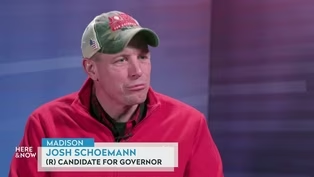
Josh Schoemann on the 2026 Primary for Governor of Wisconsin
Video has Closed Captions
Clip: S2400 Ep2422 | 5m 30s | Josh Schoemann on running for Wisconsin governor in 2026 and politics of the race. (5m 30s)

Tom Tiffany on the 2026 Primary for Governor of Wisconsin
Video has Closed Captions
Clip: S2400 Ep2422 | 3m 53s | Tom Tiffany on running for Wisconsin governor in 2026 and politics of the race. (3m 53s)
Providing Support for PBS.org
Learn Moreabout PBS online sponsorship
- News and Public Affairs

Top journalists deliver compelling original analysis of the hour's headlines.

- News and Public Affairs

FRONTLINE is investigative journalism that questions, explains and changes our world.












Support for PBS provided by:
Here and Now is a local public television program presented by PBS Wisconsin