TvFilm
Muckville | How to Live With a Friend
Season 16 Episode 3 | 28m 45sVideo has Closed Captions
Join our host Jermaine Wells to watch two short films, “Muckville” and “How To Live With a Friend”.
“Muckville” by Jeff Mertz examines the ongoing mental health and suicide epidemic on American farms through the eyes of a 4th-generation onion farmer in New York’s Black Dirt region. “How to Live With a Friend” by Jeremiah Wenutu is a pseudo-how-to comedy exploring the trials and tribulations of living with a roommate; the good, the bad, the weird and, ultimately, how we grow as people.
Problems playing video? | Closed Captioning Feedback
Problems playing video? | Closed Captioning Feedback
TvFilm is a local public television program presented by WMHT
TVFilm is made possible by the New York State Council on the Arts with the support of the Office of the Governor and the New York State Legislature.
TvFilm
Muckville | How to Live With a Friend
Season 16 Episode 3 | 28m 45sVideo has Closed Captions
“Muckville” by Jeff Mertz examines the ongoing mental health and suicide epidemic on American farms through the eyes of a 4th-generation onion farmer in New York’s Black Dirt region. “How to Live With a Friend” by Jeremiah Wenutu is a pseudo-how-to comedy exploring the trials and tribulations of living with a roommate; the good, the bad, the weird and, ultimately, how we grow as people.
Problems playing video? | Closed Captioning Feedback
How to Watch TvFilm
TvFilm is available to stream on pbs.org and the free PBS App, available on iPhone, Apple TV, Android TV, Android smartphones, Amazon Fire TV, Amazon Fire Tablet, Roku, Samsung Smart TV, and Vizio.
Providing Support for PBS.org
Learn Moreabout PBS online sponsorship(upbeat music) (upbeat music) - Welcome to "TV Film."
I'm Jermaine Wells "TV Film" showcases the talents of upstate New York media makers across all genres.
In this episode, we begin with a film from Jeff Mertz.
"Muckville" examines the ongoing mental health and suicide epidemic on American farms through the eyes of a fourth generation onion farmer in New York's Black Dirt region.
- I moved up to Hudson Valley in summer of 2020, along with a lot of other people.
And in the course of doing that, I started doing some video work with agricultural nonprofits in the area.
So I was already sort of doing agricultural documentary work in the area.
And it was through that work that I sort of learned about the issue of farmer suicide.
Very quickly, it became clear that, you know, the sort of sphere of influence of climate change and capitalism and all these sort of broad, you know, paradigms that we're wrestling with now as, as a country and a species, like all of that comes to roost on a farm.
So if we want to maintain a food system that is autonomous and feeds us and nourishes us, we have to take care of the people who are growing the food and we have to take care of the environment that is creating the conditions in which food can be grown.
So this is just one short film that, you know, adds nuance to that discussion and can hopefully, you know, garner more support for small farmers.
(upbeat music) (soft music) - My great-grandfather came over from Poland by the turn of the previous century, I think somewhere around 1908 when he came over, he had to actually swear off allegiance to Czar Nicholas II and basically he never left Poland.
He never learned English, never learned the customs.
He would walk along the highway and pull down his pants and pee as cars went by and the whole deal, he bought a preexisting dairy farm that stretched back to the Civil War era.
And he kind of did what he did when he was in Poland.
He grew a bunch of different vegetables and the like, and onions in particular.
There was a major wave, a number of Polish immigrants were coming into this area and settling it.
It was all a cedar swamp for the most part.
And it was primarily cleared by a lot of these immigrants that turned in that previous century in the early 1900s.
And it was cleared by hand.
And that clearing process went on for the next 60, 70 years.
My grandfather came over from the muck areas in Poland, so he was familiar with the soil.
Onions was a well suited crop for the muck soils there and for here as well.
And that's when they were familiar with, and that was one of the primary crops that he grew.
My father took over the farm when his father passed away, which was in 1967.
I started working on the farm when I was five years old and we would harvest.
I had, you know, hand labor jobs of picking onions up that fell out of the crates and putting 'em into the crates, and then hand weeding and the like.
And my summers, my breaks were all helping on the farm, springtime, helping plant, helping my dad.
Then during the summer, helping hand weed, picking stones, you know, and then helping harvest.
So it worked like an adult.
Then from '93 onward, I saw my dad every day and I worked with him virtually every day for years and years and years.
(soft music) Muck refers to the type of soil that's deep, rich, dark in color, high in organic matter.
This area is the largest producer of fresh greens that are supplied for the green markets in New York City.
And onion wise production has gone down significantly.
Back in early '90s, there was like 60 some farmers, and I think at that time there was at least eight or 10,000 acres of onions that were grown, which accounted for over 7% of the nation's storage onion production.
Currently today, my understanding is it's roughly 3000 acres.
It's down to like maybe 15 farmers, and that percentage is dropped like under 3%.
The reason the percentages of onions have gone down, I put it on two factors.
One is pressures from the market and specifically overproduction in the United States and Canadian exports.
The other thing that's been very problematic has been, we've had significant number of weather disasters.
And I would argue that those were precipitated by, or caused by or exacerbated by climate change.
- [Reporter] The 30 mile long black muck basin boas some of the richest soil in the nation, this spring, its saturated soil, relentless rains, debris, choked, river beds, all are being blamed for the floods, which destroy seeds and force planting delays.
Farmers say the only thing draining around here is their wallets.
- We've had major crop losses in onions over the years that were just overwhelming.
'96 hailstorm, '98 massive hailstorm, '99 a drought that was up and down the eastern seaboard and then some floods.
And in particular the flood of 2011 with Irene and Lee caused the Walkie River to flood twice.
When I get wiped out by a storm, it's not just I'm losing my potential income for the year, I'm also losing everything I invested before that.
So it's like you, every, you're losing your job and you're taking everything out of your bank.
You're emptying out your bank account too.
When I was hit by the hail '96, we had to get an emergency loan.
It was like something like, I forget, like 60, 70,000.
And then we just kept having subsequent events.
The amount of money I made on the farm wasn't enough to significantly reduce the debt.
I mean, basically I was treading water.
(soft music) - We had purchased crop insurance or thought, they're like, well, we should be okay.
Right, all of a sudden you find out you've been tricked in a shell game and that no, you're only gonna get paid on 1%.
'cause the 50% you lost, that was your deductible.
We're like, this is insane.
This is some type of strange, I don't know, Kafkaesque world.
- [Host] They say their tears are not caused by the onions.
- In '96, I think I cried every single time I had to sit down and do the bills, in '98, I didn't cry so much as when I did the bills.
I cried more when I came out to the fields 'cause there was nothing.
- [Host] And in 1999 Pawelski says they're crying again as they face another loss of tens of thousands of dollars.
Even with their insurance.
(soft music) - You had an insufficient federal crop insurance program and disaster rate programs only, they typically provide maybe 10 cents on the dollar on your losses.
It's just, it's very hard to survive when you have, you know, hundreds of thousands of dollars in production expenses and you're not taking any money in at all.
It's hard to survive that.
- You know, he tells me, we can make money at this.
And I, yeah, that I never, my mom, he would say, you know, it's possible.
And I'm like, I've never seen it.
I've never seen it.
I'm going a decade here and I've never seen it, so I don't believe you.
(soft music) I had gotten very bitter and it just buried a lot of stuff.
It wasn't until, our parents started to get ill that it really put a huge nother level of pressure on us.
- My father became ill.
He was diagnosed with stage four renal cancer in August of 2016.
He was dead six months later, my dad's passing, I mean, it did a number of things.
Isolation.
It led to, yes, I guess would be like losing a limb.
I mean, when, you know, you spend so much time with someone over such an extended period of time, it's kinda like almost being married and then all of a sudden gone.
I mean, just boom, it's jarring and it's sad and it's depressing and hard and I'm still having a hard time adjusting to it.
It's been very difficult.
(soft music) - If I look back at something that was alarming to me, it was shortly after, shortly after Richie, his dad had passed.
He was freaking out about how was he gonna, how was he gonna do this?
How was he gonna run the farm by himself?
And pretty much having a meltdown.
(soft music) - The way things progressed that led to thoughts of suicide.
I try and look at things logically.
You're trying to think of ways out.
I start thinking about like, when my father died, he no longer had to worry about paying this bill, making sure there's enough salt for the water softener, making sure the filter's fixed, making sure this is done.
Make it, you know, it's all done.
It's gone.
This doesn't exist anymore.
And that starts to be appealing, 'cause it's just, you know, it's so much pressure when periods of time have happened where I've lost everything.
I have no ability to, as it appears to pay for anything.
Bills, expenses and the like, it's weird.
It starts as a rational thought.
Well, here's an option.
I got a life insurance policy.
If I die, then that money can go to pay off all those debts.
Now my wife and kids to be taken care of.
Then step two logically is that, how are you gonna do it?
You type into Google what is the least painful way to commit suicide.
I have to say that they all sound equally horrible.
Maybe that's how your mind works to try and stop you.
You start thinking about, okay, what happens afterward?
You know, if you're successful and who finds you?
(soft music) - I know there were times that, and I know we both talked about, yeah, well, do you find that sometimes you're thinking about like how, how you could off yourself now, how could do it?
And I was like, yeah, there doesn't seem to be a really good way to do it.
He said, it's not a clean way.
If you come up with a clean way now, I can't seem to come up with a clean way.
(soft music) I was frustrated and I wanted him so badly to just, you know, just just get a grip, you know, just, and I know I said things that were not kind.
I've threatened him.
I'm like, you can't, like, don't you dare you promise me you will not leave me with this mess.
Do not leave me with this mess.
I don't think I was the best person I could be.
I realized, and I remember telling him, I said, it's not that you don't think it's that you really want to die, it's just that you want this to end.
There's gotta be some end to this, some, some resolution.
(soft music) - 2019 was the year that put me out.
I simply just couldn't sell.
I took a massive beating.
I lost a few hundred thousand dollars, and which I had, I could not pay back.
And between that and COVID we sat down together and we decided that couldn't afford to grow onions again.
At least not for a while.
Our decision to stop growing onions, which was something my family's done for decades and decades, and I've done since I was a small child, came in part in being able to sit down and adequately assess where we were at.
Not just monetarily, but emotionally and mentally and where we were at and where we were before ended going.
We were unhappy.
My wife could see I was much more depressed and she was the one that really urged me to go see a therapist, which is what I did.
And I saw a therapist for two years and it was, it was helpful.
I've had people tell me that I seem a lot happier.
My sense locally is that, you know, I'm not unique.
Over the years there have been farmers who have committed suicide and from farming pressures from after storms happen and so on and so forth.
And it's not something that's new.
It's been that kind of pressure and the like, and depression has been going on for a very long time.
It's getting worse.
So many people are quitting.
I mean, again, we went from in the black dirt area, you went from like 60 some farmers down to like basically 15 operations or so, give or take.
People just couldn't take it anymore.
I don't think that it's mutually exclusive.
You know, farming as far as, you know, feeding the population and being happy.
There's enough income within the sale of farm products to basically make the farmer and anyone else along the line happy.
The problem is the food system, along with everything else, has been consolidating a handful of entities control as the outlets.
They have way too much negotiating power, way too much economic power.
Farmers are basically at their mercy within the system.
When I sell a bag of onions, the seed rep gets paid.
The chemical rep, if I'm renting from someone that landlord, the repair guy and the government entities, I pay taxes to the labor force that works for me.
The chemical input companies, fertilizer company, all of 'em get a part of that.
And the only person that quite often doesn't is me, sometimes in discussion with people on the internet and they come up and they'll say, you know, we're subsidizing you.
And I says, you got it, bass backwards.
We subsidize you because the price that we're getting paid for it is leading to something that is basically artificially reduced as far as the value in the cost and the like.
So I mean, we have one of the cheapest food supplies in the world in the United States.
What we pay in our disposable income is 10% or less.
Much of the industrialized west is in the twenties or 30% in some cases in non-industrial world, much higher.
So we pay so little for our food, ever since people were starving back in the Great Depression and federal policy was like, that will not happen again.
So we have a policy that ensures that for the most part, I subsidize the economy.
You know, it's on my back.
If you want to survive, you have to eat.
And you know, I am not compensated, you know, to what degree, how important what I do is to, you know, basic human survival.
And that's due to the system we have set up.
And it just, it's not sustainable.
You're going, you know, have full oligarchy and a lot more abject poverty or you're gonna have to change the system and make some major economic adjustments.
It's one or the other.
Magic is over.
I get hope from the fact that, you know, I think it's becoming more and more apparent to the public and to elected officials that this situation is not sustainable.
- Good morning.
The Senate Committee on agriculture, nutrition and forestry will now come to order, Chris Pawelski.
- Unfortunately, there are two facets of the MPCI policy that we've made no headway on, and it's for this reason, for the first time since 1996, we on our farm have not purchased buy-up coverage for this year.
And so have most of the, of the crop growers in Orange County.
We believe that the minimal catastrophic coverage is virtually worthless, but we've paid the administrative fee for this coverage so as to have access to the USD programs.
I've worked on issues on the local, state and federal, local from, you know, changing the speed limit on the road in front of my house to on the federal level just recently getting a major provision in the Inflation Reduction Act.
If it's implemented the way it sounds, it should be then, then our USDA debt will be forgiven.
Having the debt forgiven mentally is huge.
It doesn't eat as me as much and I can sleep and it's just a lot less stress and worry and it's even more so for my wife.
And that means a great deal.
The fact that my wife doesn't have the same kind of pressures right now, that means a lot.
If I didn't have my wife and kids, who knows if I'd still be here by now.
I don't be honest with you.
(group laughing) - I was and still am exceedingly proud of him, of the courage that it took to say, okay, I'll stop.
I don't think people who haven't had a family farm, you know, understand the depth of what that person is doing.
There's a reason why farmers commit suicide rather than go do something else and others don't understand.
They're like, well just do something else for a living.
What's the big deal?
The big deal is that farming has become part of your identity and it's not just who you are.
It's who your family is.
And the fact that you are the fourth or fifth generation and now you are the one who is deciding that all of this history, all of this that has been preserved and led up to this point, you are the one who's going to make it end.
You are the one who's going to make it stop or change it in some way.
It's not a simple amount of dollars.
(soft music) Farmers commit suicide 'cause of those added layers of pressure.
He made that decision and survived it.
So yeah, how could I not be, how could I not be proud?
(upbeat music) (upbeat music) (birds chirping) (upbeat music) - Next filmmaker Jeremiah Wenutu shares a humorous how to video covering bases of living with a roommate.
The good, the bad, and those aren't my dishes.
- So at the time that I made this movie and I wrote it, I was looking back retrospectively at years of living with friends in my early twenties, and I wanted to kind of explore what it is to have this relationship with a housemate that's completely different from any other friend you might have or relative.
It's like, it's its own biome relationship you have with someone you live with.
So I started looking at, okay, what are the things that you know are the great things about living with a friend?
What are the terrible things and ultimately how does it affect us and affect each other?
So we were supposed to shoot it in 12 days and being that we were all working filmmakers, constantly busy, it took three or four years of principal photography and then COVID hit.
But I think that allowed us to do something really unique and interesting, which was also watch each other grow and evolve as we were making this movie.
So it holds a very special spot in my heart.
Our production company "West From Center" was based on where I lived at the time on West Center Street in New Paltz.
And it was formed with my two friends, Steven Teeter and Matt Brunner and Matt Brunner actually came to be a roommate, ended up not being a roommate, but we ended up making this movie together.
And tragically as we were in the final legs of editing, our good friend Matt Brunner passed away very suddenly.
And it was a big surprise.
And that was very, very tough on all of us because we of course, work so closely together and we have such a strong relationship as friends.
So we had to try to figure out, you know, how do we, how do we finish this movie, you know, and really do our best for Matt.
So this film is dedicated to Matt.
Matt Brunner was loved by everyone in his community.
He worked at Marist and had friends and colleagues in the film industry, in the city and here.
And the outpouring of love as we were making this movie was tremendous.
So this is for Matt Brunner and all of his friends and family.
We hope you enjoy it and we love and miss him very much.
- [Presenter] This is you.
(upbeat music) One day you might find yourself in college dorming or maybe off campus or just in the real world in general, but living on your own is expensive.
And in college you don't really get a choice unless you want to live with mom.
And at a certain age, not a lot of people want to live with mom.
Which brings us to this nifty guide on how to live with a friend.
If you have to, step one, pick a friend, someone you've known a long time, someone who shares your taste in music, does the same things as you, not too invasive.
What the fuck is going on in here?
Who let this guy in my house?
Someone you'd like to be around.
So you hang out with each other.
Talk about the opposite sex with each other.
Talk about something else problematic with each other.
Watch the same movies.
Do the same drugs.
Make grand plans with each other.
Do nothing with each other.
Realize they're your best friend.
Get wasted with each other.
Be a wingman while you're at it.
Get oddly annoyed when they have other plans on a day you both have off.
Get annoyed with their significant other.
Did you see that?
Did you just see that I have my hand, right?
I was, I was going, I was right there.
I get annoyed at messes they make, secretly pile your own mess.
Realize you hate your best friend.
Get in a fight about something.
Vent to your friends about them.
Start focusing on yourself, focusing on your passion projects.
Have an awkward tension with each other.
Start succeeding in your passion projects.
Have an awkward drinking session.
Have an awkward venting session.
Make peace.
Start hanging out again.
Start going out again.
Keep focusing on your passion project.
Realize they're your best friend.
Ignore each other's shit.
Let things become chill and mundane around the place.
Let them bring up the lease ending.
Huh?
The lease ending.
They talk about some ideas they have or some options they've considered.
And maybe ask if you'd want to bunk with them another year.
And you think about it, you think about the good times you've spent together, that face they make when they fire you up.
The nights drinking, the nights you were serious, that one crazy thing they did for you.
Of course you think about all this, but there's the new you.
The you, you've been working on the one that's having big dreams, doing well with their projects.
The you from five years from now does not still live here.
He's in your dream location.
So you politely decline, not because you don't like them, but because it's time to move on, change things up, take the next step.
So you do it.
You follow your ambitions and chase your dreams.
You find yourself in a new place.
Wow.
It's weird, your best friend isn't here, but it's okay.
There's always step one if you have to.
(upbeat music) (upbeat music) (upbeat music) (soft music) (upbeat music) - [Narrator] "TV Film" is made possible by the New York State Council on the Arts, with the support of the office of the Governor and the New York State legislature.
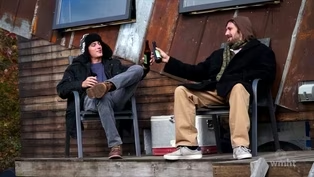
Jeremiah Wenutu: Extended Interview
Video has Closed Captions
Clip: S16 Ep3 | 8m 8s | Jeremiah Wenutu discusses working on the short film “How to Live With a Friend (If You Have to).” (8m 8s)
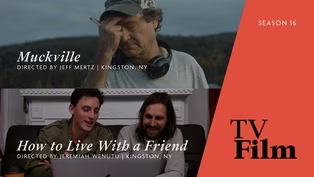
Muckville | How to Live With a Friend: Preview
Video has Closed Captions
Preview: S16 Ep3 | 21s | Join our host Jermaine Wells to watch two short films, “Muckville” and “How To Live With a Friend”. (21s)
Providing Support for PBS.org
Learn Moreabout PBS online sponsorship







Support for PBS provided by:
TvFilm is a local public television program presented by WMHT
TVFilm is made possible by the New York State Council on the Arts with the support of the Office of the Governor and the New York State Legislature.