
Upham Woods Outdoor Learning Center
Season 12 Episode 9 | 26m 48sVideo has Closed Captions
Adventure through the forest in Wisconsin Dells at Upham Woods Outdoor Learning Center.
Join Angela Fitzgerald at Upham Woods Outdoor Learning Center for an up-close look at the natural beauty found in Wisconsin Dells, while exploring outdoor classrooms and critters found in the waterways. Then join Bigfoot believers in Marinette hoping to see the elusive legend and travel to Grantsburg to watch snowmobile races on water?!
Problems playing video? | Closed Captioning Feedback
Problems playing video? | Closed Captioning Feedback
Wisconsin Life is a local public television program presented by PBS Wisconsin
Funding for Wisconsin Life is provided by the Wooden Nickel Fund, Mary and Lowell Peterson, A.C.V. and Mary Elston Family, Leon Price & Lily Postel, Stanley J. Cottrill Fund, UW...
Upham Woods Outdoor Learning Center
Season 12 Episode 9 | 26m 48sVideo has Closed Captions
Join Angela Fitzgerald at Upham Woods Outdoor Learning Center for an up-close look at the natural beauty found in Wisconsin Dells, while exploring outdoor classrooms and critters found in the waterways. Then join Bigfoot believers in Marinette hoping to see the elusive legend and travel to Grantsburg to watch snowmobile races on water?!
Problems playing video? | Closed Captioning Feedback
How to Watch Wisconsin Life
Wisconsin Life is available to stream on pbs.org and the free PBS App, available on iPhone, Apple TV, Android TV, Android smartphones, Amazon Fire TV, Amazon Fire Tablet, Roku, Samsung Smart TV, and Vizio.
Providing Support for PBS.org
Learn Moreabout PBS online sponsorship- Announcer: The following program is a PBS Wisconsin original production.
- Angela Fitzgerald: Coming up on Wisconsin Life: We check out snowmobiles racing on...water?
[snowmobiles buzz] A pup and his owner spreading joy in Antigo, [resident laughs] a world-renowned classical guitarist in Milwaukee, and a group in Marinette hoping to spot Bigfoot!
That's all ahead on Wisconsin Life.
[whooping] [bright music] - Announcer: Funding for Wisconsin Life is provided by: the Wooden Nickel Fund, Mary and Lowell Peterson, the A.C.V.
and Mary Elston Family, the Stanley J. Cottrill Fund, UW Health, donors to the Focus Fund for Wisconsin Programs, and Friends of PBS Wisconsin.
[bright acoustic guitar music] - Hello, and welcome to Wisconsin Life.
I'm your host, Angela Fitzgerald.
I'm wading through the natrual world here at Upham Woods Outdoor Learning Center, a river classroom for all ages.
Right off the Wisconsin River, the Center is surrounded by the beauty of the Dells.
[bright music] Managed by UW-Madison Division of Extension, Upham Woods offers year-round programming like camps, environmental education, leadership activities, and conservation work, including on-site research.
In the warmer months, visitors can venture across the river to Blackhawk Island, a wooded state natural area with hiking trails through distinctive terrains.
The area was once inhabited by Ho-Chunk and Menominee people until the land was taken by settlers and became a lumber highway.
In 1901, the land was purchased by Horace Upham and became privately owned.
Wanting to preserve the natural beauty, sisters Elizabeth Upham Davis and Caroline Upham Keene donated the land to the UW in 1941 for it to be used "as an outdoor laboratory "and camp for youth "in the advancement of conservation, of agriculture, and rural culture."
Before we go too deep, let's hear from other Wisconsinites who are sharing their passions.
As we head up to Grantsburg, where the competition is heating up as snowmobiles race on water instead of snow!
[snowmobile engines rev] [heavy rock music] - Rachel O'Brien: I was mesmerized, was my first feeling of it.
It was so cool.
- Kim Hallberg: They think it's jet skis on water, and I oftentimes am like, "No, it's actually snowmobiles."
- So watercross snowmobiling is actually exactly what it sounds like.
It is a snowmobile that we make slight modifications to.
We have two categories.
You can actually be an open mod, which, that's kind of sky's the limit.
Or you can be a stock, which is very few modifications.
And we make them for water, and we're a race association that you actually race them on water.
These really, really heavy machines actually become extremely light, and they carve a lot, like you would be riding in the mountains, actually, is how a lot of people describe it.
[snowmobiles rev] - Watercross was formed in 1977, and it just started with a bunch of snowmobile riders jumping waves across the lake, and in the winter, they had a hole, I guess, in the lake, and they would just go across.
And then they thought, "Hey, we can do this all year."
And badabing, badaboom.
[snowmobiles rev] - Rachel: A normal race for us is, we have qualifying heats on Saturday, so every driver per class gets three guaranteed heats that they're going to race.
If you have a race where you get a first place, that's worth one point.
Second place, two points, so on and so forth.
And then, what you want is the lowest amount of points for the day.
Our course consists of two different types of laps.
There's the inside lane, and then there's one we like to call the equalizer lane, or most of us call it the EQ.
You have to take the EQ at one point in your race for a lap.
The selection is entirely up to you.
It's actually very strategical when you take that EQ lap because it is a very, very wide lap.
That can be detrimental to your race if you pick to go out to that at the wrong time.
Otherwise, it's always guard the front and look for clean water.
[snowmobiles rev] These sleds are really easily going 70 now, very, very easily in a very short, y'know, 1,000 feet, very short amount of time.
I would say consistently, our pros are probably in the 50s, 55 range in the oval course just because of the buoy to buoy action, and you wanna stay tight and not blow it.
People will actually tell you too, they don't care who they're racing.
They're just gonna go out and get in front and try to beat everyone.
This year, we're doing our first annual big jump contest.
And what that's gonna be is into three categories, we're gonna have the crowd favorite, which, y'know, our guys, they're into it, they're excited, like to dress up.
We have a time trial.
Now, that is, they get two minutes on the clock, and they have to make as many jumps as they can in two minutes.
And then we also have furthest distance.
So, how far can they send the sled off of the jump going, so that's gonna be really exciting.
We did clarify to each driver that it was how far the sled went, not necessarily the body.
- The races are amazing.
We couldn't have a more gracious, genuine group of racers, who, they love to see the kids involved, they love to sign autographs.
- It brings together us with family, community, friends with an abnormal sport, so it's just a great weekend overall.
- This is probably the most Wisconsin thing you can find.
[heavy rock music] - Angela: Next, we make our way to Antigo, where a dog owner thinks his beloved pup is pretty super!
Dennis Erickson has had quite the eclectic career.
There's one thing all his jobs have in common.
- Dennis Erickson: I like bringing joy, I like helping people.
- Angela: Now retired, Dennis still works part-time at Eastview Health and Rehabilitation Center in Antigo.
- Thank you.
- I initially just wanted to go in there and volunteer.
But they said, "With all your experience, we'd love to have you be on staff."
- Angela: A year after starting at Eastview, Dennis met Rocket, a short-legged Jack Russell terrier.
- Dennis: I came over here to visit the humane society and happened to see Rocket.
He was just very energetic and friendly.
I told Theresa, the manager here, that I would take Rocket.
I've always appreciated dogs, and especially well-behaved ones like Rocket.
He's just, he's so good with people.
- Angela: It wasn't long before Rocket's big personality landed him a job at Eastview too.
- Dennis: I took him to the nursing home where I work, and the administrator fell in love with him.
- Shari Zoern: Rocket got involved about three years ago.
I was on vacation, and when I came back, there were dog treats in my office.
I didn't know about Rocket.
I said, "What are these dog treats doing in there?"
"Oh, well, they're for Rocket."
I said, "Well, who's Rocket?"
"Well, Dennis's dog."
- His name is on the door, he's on the work schedule.
One day, the director of nursing came up to me and she said, "I wanna let you know "that Rocket is the number-one staff person "at this facility.
"The only complaint I have is once in a while, he'll nap when he's at work."
- Angela: Although Rocket hasn't had any offical therapy dog training, he's learned his fair share of new tricks.
- Dennis: He sits on the residents' laps.
We'll deliver mail, and Rocket will help with that.
- Bingo Caller: G 48.
- Dennis: Then we have activities that we do with the residents.
- Angela: For many Eastview residents, it's hard to put into words what Rocket means to them.
- Sometimes, people that don't necessarily, they're not able to communicate verbally, but they can communicate with facial expressions.
- Angela: Their smiles say it all.
- Sharon: He's just happy all the time, and he brings joy.
- There you go, little boy!
- Angela: For Rocket, it's a new leash on life.
And for Dennis, it's the job of a lifetime.
- Dennis: I enjoy the interaction with the residents.
They've become like extended family and they all love Rocket, so it's a win-win for everyone.
- Angela: Now, Dennis is hoping Rocket can help people beyond Eastview by starring in his own children's book.
- This story about him just needs to be told.
And I think a children's book is the way to do it.
- Angela: Dennis conscripted local cartoonist Brian Ponshock to illustrate the book.
- Brian Ponshock: I hope that we can get it to reach a lot of people and that the local community can be proud of something that was made right here in town.
- Dennis: The book is gonna be called Rocket: The Superhero Therapy Dog.
- Angela: Whatever happens with the book, Dennis knows that Rocket will always be a hero to everyone he meets.
- I have a favorite lines of a folk song.
It says, "You take the little that you know "and you do the best you can, and you save the rest for the quiet faith of man."
He kind of epitomizes that.
[gentle music] [indistinct conversation] - I'm in Wisconsin Dells, checking out Upham Woods and the natural beauty that's found here in every season.
[gentle music] I dove right in with On-Site and Accessibility Coordinator Rachael Lewandowski-Sarette to learn about their programming.
- Rachael Lewandowski-Sarette: We have lots of programs that are very seasonally based because we do place-based education.
And so, in the winter, we're doing some of our cross-country skiing and snowshoeing, and we even play broom ball with all the kids, which is kind of like floor hockey.
And in this transitional season, we get to start introducing some of our spring activities as well.
We also try to offer a few public programs like our Early Childhood Nature Club.
And so, they really get to explore this place over a course of a month and explore different things from shapes and letters and sounds to our forest ecosystem and our water ecosystem.
Summer months is chaotic.
[Angela laughs] We can have up to 200 kids here at once.
And so, this place gets really filled with laughter and chaos.
And then, we get to head across the open water to Blackhawk Island and take kids hiking for three to five miles in that state natural area.
And just because it's summer and we're having fun doesn't mean the science stops.
We still try to incorporate science, and one of the fun summer activities is called Wacky Water Critters.
And so, it's a great way to have fun in the water, splash around, catch things, but also do some science.
- Angela: Absolutely.
Can you tell us about the historical significance of the land and what that means for the learning opportunities that people can have here?
- Rachael: For a long time, this land belonged to Indigenous people, specifically the Ho-Chunk and the Menominee.
And so, we partner with the Ho-Chunk Nation to lead different educational opportunities and also try to infuse different Ho-Chunk cultural teachings into other programs.
We also have a class called Life of a Logger, where we focus on 18th-century logging camps and kids get to have the giant saws and, like, saw really big things.
[instructor exclaims and applauds] - And so, Rachael, you use the term place-based learning.
Can you tell us why that's so important and how that contributes to the uniqueness of Upham Woods?
- Rachael: So, having kids come to a space that they can feel grounded in ownership in has so many mental health benefits.
Getting outside and moving also has a lot of physical health benefits.
And also specifically, thinking about accessibility.
A lot of kids with ADHD and autism, there's studies out there that spending time in nature actually reduces stress and reduces triggers back in the classroom.
And so, combining place-based education and environmental education with classroom learning can have a whole host of benefits.
[playful music] - Wow, so definitely, school groups should be hitting you up to come out to Upham Woods.
- Yes.
- Thank you, Rachael.
- Instructor: You ready?
- Angela: Uh-huh.
I jumped into the activities.
Whoo!
This is an arm workout.
From trying to live like a lumberjack... Whoo!
To wading in the river, looking for wacky water critters.
- That looks good.
- So if you see these things, it means the water's pretty clean.
- Rachael: Yeah.
- Angela: It's all about cultivating curiosity and getting outdoors here at Upham Woods.
Now, we leave sounds of the woods for the sound of strumming, as we join a world-renowned guitarist studying in Milwaukee.
[bright classical guitar music] Kevin Loh is a guitar prodigy from Singapore who plays with purpose and precision.
- Kevin Loh: I try to provide a sort of refreshing take on classical guitar repertoire that really pushes classical music to the next level.
[bright classical guitar music] - Angela: Kevin is pursuing a master's in guitar performance at the University of Wisconsin-Milwaukee.
On the classical guitar, he is a virtuoso.
- René Izquierdo: I knew that minute I heard him play the very first time that he was gonna be one of the great guitarists of our time.
- Angela: That's saying a lot, coming from René Izquierdo, a maestro on classical guitar and Kevin's music professor.
- René: He's a quick learner, very quick.
And maybe with the right side of the nail to get, there you go.
- I first met René in 2014.
It was at a guitar festival in Iserlohn, Germany.
[René singing] I was just mesmerized right away as to the level of teaching that René was giving.
And for me, it was a matter of when, not if, as to when I'd arrive in Milwaukee to pursue further studies with him.
There's a difference between [note plays] and [note plays].
One of the biggest lessons that I had already heard of, but it was really reinforced with René, was that talent alone is not enough.
[bright classical guitar music] - René: When you find that talent meets desire and sacrifice, that's where you have all those elements to make a great musician.
- Angela: Before René, another man started Kevin on a path from Singapore to success.
[gentle classical guitar music] - Kevin: My father and I were simply just playing the guitar in our living room, and my mother would be behind the camera, filming us.
[bright classical guitar music] - Angela: Within a few years, these home videos had been viewed worldwide on the family's YouTube channel.
[gentle classical guitar music] - Kevin: So, it was around 9 or 10 years of age when people were saying, "Okay, there's something here.
We can push this further a little bit."
That was when the bigger performances started to come in, giving me my debut at the Esplanade Concert Hall, which is, like, one of the two big concert halls in Singapore.
At that point, my father and I were like, "Wow, okay."
You know, all these opportunities came along because of this added exposure.
I performed in the Berlin Konzerthaus.
I've played in the London Wigmore Hall.
I've also played in places like the Suntory Hall in Tokyo.
All of these places are real prestigious sort of venues.
[bright classical guitar music] - René: Everyone on the world stage knows him.
People can tell every time they hear him playing, even the simplest pieces, that this is just beyond playing guitar well.
This is just guitar at its best.
- Angela: Kevin has won the highest national and international awards for classical guitar, and he could also win a medal for modesty.
- Kevin: It's not so much about the results or the glamour necessarily.
It really is appreciating the craft and understanding that it's the journey.
- René: This is one of the best in the world because right now, he has nothing else left to prove.
- It feels really weird because normally, he will make sure to avoid saying anything of the sort.
- That's true.
[both laugh] - Angela: The accolades are welcome, but what Kevin still cherishes is the musical advice from his dad.
- Kevin: He was the one who brought the guitar idea to the table to begin with.
[laughs] He's taught me a lot of life lessons.
He often brought those lessons through the guitar sessions that we had.
I'm very grateful for that because I feel that contributed to the passion of music making very much.
Very good.
- Angela: Today, Kevin is sharing that passion with UWM students he helps mentor.
[note plays] - Kevin: Yeah.
I find myself saying the exact same things that he's taught me.
If you're taking a breath physically, take a breath musically.
And I have that out-of-body experience where it's like, "Damn, I'm really turning into my father."
[laughs] [gentle guitar notes] - Angela: Classical guitar is the instrument that taught Kevin your passion can become your profession.
[gentle classical guitar music] - René: No doubt he's gonna be concertizing, performing, teaching at the highest level anywhere he would be.
- You're forging your own path.
You create your own story.
And you only live once, right?
I am just really fortunate to be here.
[laughs] [gentle classical guitar music] [applause] - Angela: Our last story celebrates the believers of the unseen, as we go to Marinette on the hunt for an elusive legend of the woods.
[eerie music] - Kim Lonetree: There is a trail right next to a bunch of woods.
I was with a couple other people and I heard footsteps in the woods following us.
- Rich Daniels: There's something big moving in the woods.
- Avery Barsch: I would describe it around eight feet, really hairy.
- Rich: This thing was massive.
[knocking] - Barnaby Jones: Something very large came through the woods towards us.
[snapping] - Rich: And it caught my eye and I stared right at it.
[animalistic howling] - Kim: This was a Bigfoot encounter.
[whooping] [whooping] [whooping] - My name is Barnaby Jones.
I am a cryptozoologist and the founder of Cryptids, Anomalies, and the Paranormal Society.
100%, I believe in Bigfoot.
In 2017, they launched the first convention here in Marinette, and they had a huge success.
And then, this is the third year that we've been back up running, so six conventions so far, including this one.
Today, we are here to talk about Bigfoot, and Bigfoot on a very local level.
- In particular in the Bigfoot field, they believe they have some sort of close contact, some sort of intimate connection to the creature.
- They had all these people, and they wanted to bring in speakers that were knowledgeable about the topic.
- He believed he had encountered something not of this universe.
- Barnaby: To come in and present their findings to people local in the area.
[recording of roar] - It's all about Bigfoot, and it's all these individuals that are very interested in Bigfoot and cryptids coming out to this conference.
- This is a phenomenon that's not just on TV.
It's not just in the Pacific Northwest.
It's all over this country.
- A lot of people come the conventions like this because they have nowhere else to go.
They have these experiences, they have these stories, and if you tell somebody that you see a Bigfoot, you've had a ghost encounter, a UFO encounter, people look at you and they're gonna think that you're crazy.
So events like this, it gives people an outlet to come and be with their people.
[eerie music] [aerosol spraying] Through almost every inch of this property, so I have a pretty good idea of what most things are.
We're going out on this property, we are taking groups of people because everyone wants to go out with us and see this.
So we're gonna go out on the property, we're gonna see what happens.
We're looking out over here, and this creature is standing there looking at us, and the lights are-- the eyes are illuminated to the fact that I can take my flashlight away and they still shine.
[coyotes yelping] That's coyotes.
- Rich: It's the perfect laboratory for studying this field, because there's activity almost every time you walk out there if you're paying attention.
- Barnaby: We have gathered every kind of evidence that is possible.
We've gotten thermal, we've gotten trail cameras, we've gotten audio, footprints.
We've gotten it all off this property.
- Kim: I personally believe that what they've experienced on that property is real.
[animalistic yelping] - Is that you or something natural?
- Rich: I thought that was you.
- It was an amazing experience.
- We got to hear a howl, followed by a lot of coyotes howling at the same time.
- Barnaby: And that's what draws people to these things like the paranormal, ghosts, Bigfoot, all of that.
Because people want to believe in something more.
That there's not just an end to this.
That there's more out there to be discovered.
It's the sense of adventure.
- If you go out looking for these things and you expect to find them every time, you're gonna be very disappointed.
- If you go out there to share stories, spend time with people, you're always gonna have a good time.
- Rich: One thing's for sure.
Once you have an experience with this, it never leaves you.
[person howling] - We've enjoyed the great outdoors in one of the most scenic spots in Wisconsin here at Upham Woods.
Connect with us on social media or by emailing stories@wisconsinlife.org.
Find more on our website, WisconsinLife.org.
Until I see you again, I'm Angela Fitzgerald, and this is our Wisconsin Life.
Bye!
[bright music] - Announcer: Funding for Wisconsin Life is provided by: the Wooden Nickel Fund, Mary and Lowell Peterson, the A.C.V.
and Mary Elston Family, the Stanley J. Cottrill Fund, UW Health, donors to the Focus Fund for Wisconsin Programs, and Friends of PBS Wisconsin.
Preview: Upham Woods Outdoor Learning Center
Preview: S12 Ep9 | 30s | Adventure through the forest in Wisconsin Dells at Upham Woods Outdoor Learning Center. (30s)
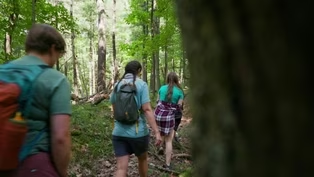
Seasons of science and outdoor fun
Video has Closed Captions
Clip: S12 Ep9 | 3m 28s | Kids hike, saw logs and study river critters at Upham Woods. (3m 28s)
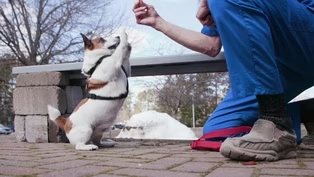
Video has Closed Captions
Clip: S12 Ep9 | 4m 13s | Dennis Erickson shares his therapy dog with residents of an Antigo nursing home. (4m 13s)
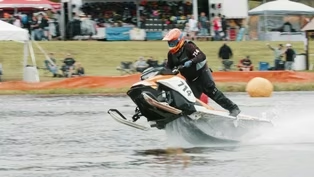
Watercross: Racing snowmobiles on water
Video has Closed Captions
Clip: S12 Ep9 | 3m 36s | Winter and summer fun come together as modified snowmobiles race on Wisconsin lakes. (3m 36s)

Kevin Loh brings classical guitar from Singapore to Wisconsin
Video has Closed Captions
Clip: S12 Ep9 | 6m 25s | World-renowned classical guitarist Kevin Loh studies his craft at UW-Milwaukee. (6m 25s)
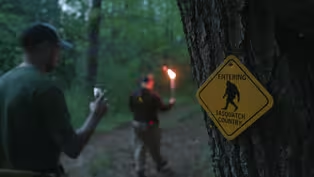
Marinette draws in the Bigfoot believers
Video has Closed Captions
Clip: S12 Ep9 | 4m 37s | Cryptid researchers and believers gather for the annual Bigfoot convention in Marinette. (4m 37s)
Providing Support for PBS.org
Learn Moreabout PBS online sponsorship













Support for PBS provided by:
Wisconsin Life is a local public television program presented by PBS Wisconsin
Funding for Wisconsin Life is provided by the Wooden Nickel Fund, Mary and Lowell Peterson, A.C.V. and Mary Elston Family, Leon Price & Lily Postel, Stanley J. Cottrill Fund, UW...