
Washington Week with The Atlantic full episode, 6/12/26
6/12/2026 | 56m 46sVideo has Closed Captions
Washington Week with The Atlantic full episode, 6/12/26
As the United States approaches the 250th anniversary of the Declaration of Independence, we're looking at the state of our democracy and where we’re headed. On a special edition of Washington Week, Jeffrey Goldberg sits down with The Atlantic's Tim Alberta, Idrees Kahloon and Ashley Parker, Stephen Hayes of The Dispatch, Peter Baker of The New York Times and Susan Glasser of The New Yorker.
Problems playing video? | Closed Captioning Feedback
Problems playing video? | Closed Captioning Feedback
Major funding for “Washington Week with The Atlantic” is provided by Consumer Cellular, Otsuka, Kaiser Permanente, the Yuen Foundation, and the Corporation for Public Broadcasting.
Washington Week with The Atlantic full episode, 6/12/26
6/12/2026 | 56m 46sVideo has Closed Captions
As the United States approaches the 250th anniversary of the Declaration of Independence, we're looking at the state of our democracy and where we’re headed. On a special edition of Washington Week, Jeffrey Goldberg sits down with The Atlantic's Tim Alberta, Idrees Kahloon and Ashley Parker, Stephen Hayes of The Dispatch, Peter Baker of The New York Times and Susan Glasser of The New Yorker.
Problems playing video? | Closed Captioning Feedback
Where to Watch Washington Week with The Atlantic
Washington Week with The Atlantic is available to stream on pbs.org and the PBS app.
Buy Now
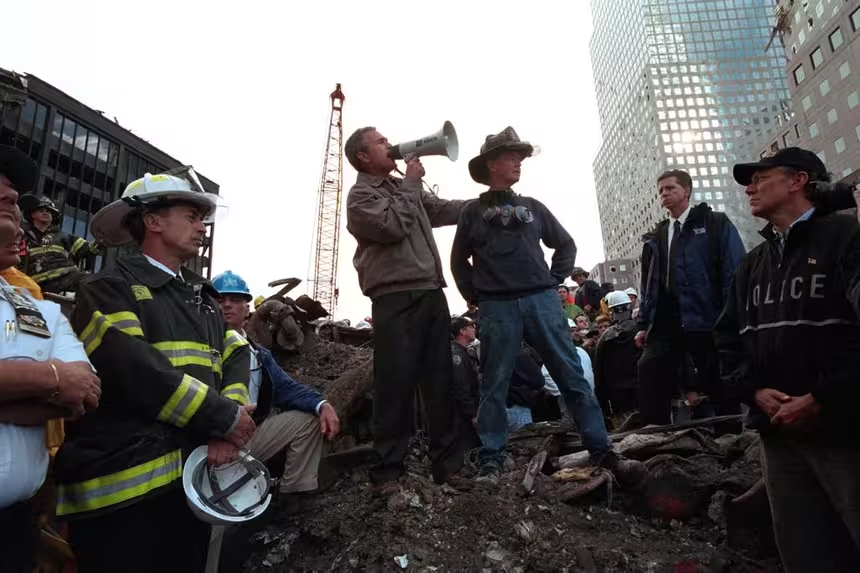
10 big stories Washington Week covered
Washington Week came on the air February 23, 1967. In the 50 years that followed, we covered a lot of history-making events. Read up on 10 of the biggest stories Washington Week covered in its first 50 years.Providing Support for PBS.org
Learn Moreabout PBS online sponsorshipJeffrey Goldberg: As the United States approaches the 250th anniversary of the Declaration of Independence, our panel will look at the state of our democracy and discuss where we're headed.
That's tonight on a special birthday edition of Washington Week, next.
Good evening, and welcome to a special edition of Washington Week.
Our country's about to turn 250 years old and we wanted to do something a bit different in anticipation of this milestone.
We had been planning to host a cage match that would feature our favorite panelists duking it out in front of a live studio audience, but President Trump beat us to the punch, quite literally.
So, we kept the live studio audience, and instead of gouging each other's eyes out in the shadow of the White House, we're going to talk about our history, the state of our democracy, and the successes, failures, and challenges of the American experiment.
Joining me tonight, Tim Alberta, a staff writer at The Atlantic, and author of "The Kingdom, the Power, and the Glory: American Evangelicals in an Age of Extremism", Stephen Hayes is the editor and CEO of The Dispatch, Peter Baker is the chief White House correspondent at The New York Times, Idrees Kahloon is a staff writer at The Atlantic, Susan Glasser is a staff writer at The New Yorker, and the author, with Peter Baker, of "The Divider: Trump in the White House".
They're married, by the way.
And Ashley Parker is a White House correspondent at The Atlantic.
Thank you all.
So, just make believe there's no audience and it's just us talking.
We haven't done this before.
It's kind of fun.
I'm looking forward to this.
I want to start, we have to cover 250 years of history and then we have to predict American history 250 years into the future.
So, we got to get going.
Peter, I'm going to start with you.
I just want to talk about the importance of this moment.
250 years is a long time to maintain a representative democracy.
Is this -- you know, it's kind of a signal achievement of the United States that it maintained this so long.
Obviously, there were problems along the way.
But is -- have we maintained fidelity to the principles that were -- the abstract principles that were formulated in Philadelphia 250 years ago?
Peter Baker, Chief White House Correspondent, The New York Times: Yes.
Jeff, thank you very much for asking and for talking about this importance of that because I think that this anniversary has become so politicized that we've lost sight of what it really is about, right?
It is about the country, not about blue America or red America, but about 250 years of this great experiment.
And I think the thing that makes America so distinctive, people often say this, it's not a new thought, but that America, the United States, is not a country born out of an ethnicity or a religion or a tribe or a race.
It was born out of an idea, the idea that we could find a better place to live, that we could form a more perfect union, right, the phrase in the Preamble of the Constitution.
We're not perfect.
It's not perfect now.
We're going to talk about all the ways our representative democracy tonight is not perfect and feels threatened, as we speak, and yet it is still the aspiration toward a more perfect union that makes us distinctive.
I was reading de Tocqueville's take on America, and he actually has this, I think, remarkable quote.
He says, what makes America special -- I'm paraphrasing, this isn't exactly what he said, but what makes America special is not that it's more enlightened than other countries, but that it has the capacity to repair itself.
And I think that's the story of our 250 years, is our effort to try to repair ourselves and get to a better place.
Jeffrey Goldberg: Did everybody read Tocqueville before they got here?
Peter Baker: Was that in the assignment?
Jeffrey Goldberg: Yes, that was in the assignment.
You never follow the assignments, but that's all right.
You read it organically.
It's great.
But I have to ask you this, just as a follow-up.
We thought -- if you asked 10 years ago, 15 years ago, this -- the difference between creedal nationalism and an ethnic-based nationalism, most people would say, well, that's a pretty settled question.
The United States is different than most countries because you join yourself to America by accepting a group of principles.
You don't have to join by blood.
Now, it's an open discussion.
Were you surprised that it's become a kind of continuing discussion or a live discussion again?
Peter Baker: Yes.
I would say I was surprised.
Maybe we shouldn't be, because history is cyclical, right?
We do go through these periods in our history where we question what our principles are and what our values are, and sometimes we go in directions that today's Americans would look back on with some degree of shame or regret.
Obviously, we have not always been perfect.
But it is a reminder that as we go through a tough time right now, we are at least debating big things.
We're debating what our country should stand for.
And that's something that, in fact, we do every Friday night on Washington Week in a way, and I'm glad that we have the debate and that we can have this debate.
Jeffrey Goldberg: I want to get to transactionalism versus idealism in a bit, but, Susan, I want to turn to you and note, again, if we're taking the long view.
Just in the last century, the United States defeated fascism and communism, pretty good track record, many mistakes along the way.
But the long night of authoritarianism might have fallen across the whole globe had it not been for the United States.
Is the United States still that beacon?
Susan Glasser, Staff Writer, The New Yorker: Well, first of all, I want to say thank you, Jeff, for convening us in person.
I assure you Peter and I are not arguing over de Tocqueville at the breakfast table.
Jeffrey Goldberg: I don't believe you, but, you know, that's fine.
Susan Glasser: I swear, you know, because he's wrong.
But, no, I'm kidding.
I'm really -- I think this is getting at the essence of it, right?
You know, ten years into it, part of what is a struggle for so many people I think about the Trump era is that he seems to reject basic tenets of what we would call, you know, small D democracy, both in his approach to governing the United States at home and also certainly in terms of his worldview.
And, actually, if you do a study of this, and people have done this, Donald Trump even uses the language of democracy and the word democracy itself far less than other presidents.
That makes sense because it's not, I think, foundational to who he is as a politician.
And when you think about the sort of incredible global traumas of the last century, right, and the role that the United States played in it, democracy was not really a partisan issue for much of this period of time.
I mean, I think back to, you know, World War II, it was very explicitly framed not just by the Roosevelt administration, but Americans viewed themselves as the arsenal of democracy and as the very much in a global conflict between the forces of what they called, you know, either dictatorship or totalitarianism at the time versus democracy.
Coming out of that, you had the creation of something like Freedom House, which was a joint project initially of Eleanor Roosevelt and Wendell Willkie, who ran against FDR in the election and lost, the Republican nominee teaming up with Eleanor Roosevelt.
And it was a sort of a bipartisan idea about what the U.S.
stood for globally.
Ronald Reagan was sort of the next wave of democracy promotion, was the idea that this was America's key advantage in the Cold War, was this idea of unlocking freedom for people around the world.
And so to then have the Republican Party in this age of stunning reversals, you know, to have it seeming to have a leader who's walked away from the basic principles of democracy, I think that's why a lot of people react so viscerally to Trump, because it's both a foreign policy statement and a statement about what he's doing domestically.
Jeffrey Goldberg: We'll come back to that as well.
I want to move to Idrees.
And I ask you this because, I mean, the truth is that Idrees was the Washington bureau chief of The Economist, but when he came to The Atlantic, I just heard economist, so I think he's an economist.
So, I ask him all these questions that he just can't possibly answer, but I'm going to ask you.
Why has America been the economic engine of the world for so long?
I don't think it's chauvinistic to say that we've invented a disproportionate number of the things that were worth inventing here.
What is the secret of that success and how does it relate to democracy?
And what is its future if democracy itself is on a kind of a rear movement, a retreat?
Idrees Kahloon, Staff Writer, The Atlantic: So, it's a hard question, especially because I covered politics for The Economist.
Jeffrey Goldberg: Yes.
So, I found out late.
Idrees Kahloon: But I'll try.
I think a few things.
You know, America is a continent-sized free trade area which, you know, is valuable.
It's been protected by oceans on either side.
It's been able to develop for a long period without really getting embroiled into wars until it became hegemonic later in its life.
But there are also other things foundational to it.
So, you know, patents and intellectual property are actually written into the Constitution as an enumerated power that Congress has to promote.
And over time, we have also gained tremendous population through immigration waves, and that has, you know, never really gone down easily.
You know, in 1840 when Irish and Germans and Nordic people were coming over, like that was very, very controversial, right?
That was not accepted.
But, you know, those people contributed to our economic development.
We saw in like the 20th century when we leaped ahead in scientific progress, a lot of that was, again, you know, immigrants who came over.
And we see that now as well, right?
There is something about America, not just the fact that it brain drains the rest of the world, which I think is really the American superpower and has been for a long time, but also that you know, we have deep financial markets.
We set up after World War II a global trade system in which we were the hegemon of that too.
We have the dollar that everyone trades in.
We should be sitting very pretty.
But to your point about what comes next, you know, we have gotten tired of this role of being an economic hegemon and a militaristic hegemon as well, right?
We want to kind of pull away from all of this.
One of Trump's nominees on the Federal Reserve says that, you know, countries should pay us for the privilege of using the dollar, which is a great way to get them to move away from doing that.
We're tired of the free trade system that we've benefited from so much.
And, of course, we're pushing as hard as we can to tamp down on immigration, both legal and illegal.
And we are also politicizing justice in a way that, you know, could at some point threaten property rights, but I don't think we're there yet.
But all of which is say that we've ascended to this peak.
You know, we're doing a lot better than Europe is in a lot of ways.
But in terms of where we're moving, I think that is a harder place to kind of be optimistic about.
Jeffrey Goldberg: Let me ask you a follow-up.
It's akin to the question I asked Peter a little while ago.
Are you surprised that, on the one hand, the data shows that immigration is a net benefit to the economy of the United States and is the engine of growth and innovation?
Are you surprised by the way people have thought about immigration has shifted so radically in our country over the last 10, 15 years?
Idrees Kahloon: It's a cycle, right?
So, you see in the 1840s, when we have mass migration of people from Ireland and Germany, that's the advent of nativism at the time, right?
You have the Know Nothing party anti-Masonic league in 1920, right, right before the Ellis Island, the heyday of the Ellis Island immigration.
That's when the border slammed shut in 1924 and stayed shut for 40 years.
So, in all of those times, you know, there's a big surge, and then there's a huge nativistic backlash.
Those migrants were then incorporated into the American body politic.
They're not thought of as, you know, Irish American.
They're thought of as American.
And that happened 100 years ago.
It happened almost 200 years ago, and I feel like it's happening now as well.
Jeffrey Goldberg: Right.
Not unrelated, Tim, you're an expert on American religion and American politics as well, and how they coexist.
In your mind what are the philosophical and religious ideas that propelled America forward?
And I'm particularly curious to hear you out on this question of single group domination of a democracy.
We are shifting as a country toward a multicultural, multi-confessional democracy.
That sort of thing doesn't generally work on this planet.
Talk about the broadest trends that you've seen in religiosity and the role of religion in creating civic religion.
Tim Alberta, Staff Writer, The Atlantic: Yes.
I mean, look, the wide lens historically here is that America has been pretty exceptional in this regard.
You think about a country that for 250 years now has been sort of, elementally Christian, and yet administratively secular.
And that contradiction in many ways is really at the root of America's genius, this idea that many of these founders who came together to build this country, to found this country did so, on a spectrum of religiosity.
Some of them were outspoken Christians, many of them were just sort of deists.
They would appeal to scripture or to the idea of a divine hand at work in the forming of this country.
And yet, simultaneously, those same figures were very explicit about the threat of state religion and they talked about it as being sort of antithetical to this idea that they were building.
And this is why, you know, George Washington in 1789, he had famously warned about the horrors of spiritual tyranny.
This was alluding to the fact that so many of these people who were present at the founding of the country, their families, their ancestors, had sought refuge here and had fled the Old World because of this promise of a country in which they could choose to exercise their religion freely.
They could also choose to not exercise any religion at all, and ultimately, that they would be welcoming and tolerant of other competing religions.
And so this is where you have Washington and Madison and Jefferson and Adams and others who are trying to thread this very interesting needle at the time of the founding.
They're quite emphatic that they want religion to be this robust and central component of American life, and yet at the same time, they're equally emphatic that there cannot be a religion, a particular religion, that is dominant in civic life.
There should not be a religion that enjoys preferential treatment from the state.
And that all, Jeff, sort of builds this great experimental question here, can a country that is populated by a supermajority, massive majority of people of one faith, can that country be simultaneously governed by secular institutions and welcoming and tolerant to those other faith traditions?
The answer to that question across world history time and time again has been no.
It just hasn't worked.
There have been experiments, and those experiments have ended quite disastrously.
In America, it has worked.
And it's worked to, I think, an astonishing degree.
I think it's worth recognizing that it has been good for America.
It has been good for the state, but it has also been very good for the church.
And that being said, I think we are now dealing, maybe not for the first time, but it would seem to me that we are dealing with an accelerated threat, and in some ways an unprecedented threat, of people who are willing to sort of set aside that long-term record of success because of the immediate threats that they sense to their country, to their faith, to, you know, this idea of civilizational decline, and the barbarians are at the gates, so maybe it's time that we need to fight fire with fire.
And that is taking a very short-term view of, again, what have been these longer term successes that have brought us to this point.
Jeffrey Goldberg: How would the founders have looked at this question of the separation of church and state being good for the church, not just the state?
How would they have articulated that?
Tim Alberta: Well, we have some examples of it.
I mean, and I think the thrust of what they would argue is the idea that religiosity in the public square is a good thing because religiosity is able to shape one's sort of core moral and ethical convictions around certain issues, and that those ethical and moral calculations are then able to be applied to matters of great local and state and national import in the political process.
But it was always sort of an outside in process.
They believed that the church should be distinct from the state in part so that the church would not be co-opted by the state, and that the church would not simply just become an appendage of the state or of different factional interests related to governing this country.
And, again, that is an idea that was widely endorsed, not only by secular actors in the state, but it was embraced for centuries by leaders of the church.
Jeffrey Goldberg: Right.
Ashley, I want to ask you about a not unrelated subject, the behaviors of democratic peoples.
We've talked about this a lot, that part of the secret of American success is that, historically, most of the time, people don't say everything that's on their mind, that there's some -- that one has to compromise politically in their own civic life, in their personal life in order to get along with other human beings.
What are those - - talk a little bit about the traits, and as a political reporter, talk about the traits that you've seen that help democracy and the traits that you might think now are not so helpful.
Ashley Parker, Staff Writer, The Atlantic: Sure.
So, I will not start with de Tocqueville, but another great American pastime -- Jeffrey Goldberg: It's already been done.
Ashley Parker: The road trip, the great American road trip.
Jeffrey Goldberg: Well, he was on a road trip, a slow road trip.
Ashley Parker: And in 2014 when Donald Trump was only on people's tongues, the tip of their tongues as the host of a pretty good and pretty entertaining show -- Jeffrey Goldberg: Not as entertaining as this one, by the way.
Ashley Parker: I took a road trip for work where I basically drove halfway across the country.
I got from D.C.
to Indiana, that's where I flew back, and I talked to dozens and dozens of voters just about what they were feeling in the lead up to the 2014 midterms.
And what I found was a lot of these people were furious.
They -- this gets optimistic, but we have to start here.
They were furious, and because they felt like they had done everything right.
They had moved into the right district for their kids' schools, they had worked hard, they had put money aside in their pensions or their 401(k)s, they had bought a house that the banks assured them it would have been irresponsible not to buy.
And then those clowns, although they would have used more choice words, in Washington, New York, had not just crashed the economy, but paid no price, and these were the voters paying the price.
But in doing this trip, I also realized all of these people I was talking to sort of embodied the best of America and the best of democracy, and in certain ways, that's why they were so upset, because they felt so betrayed.
So, all of these houses, they may have needed an extra coat of paint, but they all had American flags or sort of their own mini victory gardens, red, white, and blue flower pots with flowers.
And what you heard from these people are all these things we think of as quintessentially American traits and also traits you need to make a democracy work.
And that was, first of all, patriotism and a belief in the American dream.
Again, that's why they were so upset, optimism and hope, hard work, wanting a better life for their kids or for the next generation, being an active member of their neighborhood or their communities.
And those are all things that I think are absolutely key to the American experiment and for a functioning democracy.
Now, we can talk about how that kind of gets thwarted, and they didn't have the language for this, but what they were essentially saying to me was, drain the swamp.
I want you to burn it all down.
And so when -- and these were Democrats and Republicans.
And so when Trump came, they had this perfect vehicle in messenger.
But those are the traits that help, and those are the traits also that when you feel like your country is not living up to your promise and you feel like that ideal is betrayed can turn pretty dark and corrosive pretty quickly.
Jeffrey Goldberg: Right.
Absent social media, would they have sounded the way they sounded?
Ashley Parker: It's a good question.
But this is 2014, so it's Twitter, but it's not Twitter as we now know it, you know, moderated or rather not moderated by Elon Musk.
And I don't think we're quite into the really vitriolic manosphere podcast.
I think that level of anger, I worked hard, I believed in this, I did everything right, and now I'm getting a raw deal, I think they still would have been expressing that in some way, shape, or form.
Jeffrey Goldberg: We'll come back to those questions of technology and democracy because it's an open question whether a democracy can survive social media the way we have it.
But, Steve, I want to turn to you and talk a little bit about political practices and systems that have worked for the United States and made it a functioning democracy.
Talk about the ones that have worked, talk about the ones that are under pressure right now.
Stephen Hayes, Editor, The Dispatch: Well, I think in some senses they're all under pressure right now, and that's part of the challenge of the moment.
But I think if you look back, and, you know, this isn't a terribly original answer, but I don't think we spend enough time thinking about this.
The way that the founders built the structures of the United States and its government were to constrain its powers.
And you heard this in what Idrees said about the inclusion of economic constraints and preservation of freedoms, economic freedom for individuals in the Constitution.
You heard it with what Tim said in religious freedom.
And I think the genius in the design, whether we're talking about separation of powers or an independent judiciary or federalism, was that they built the country to constrain the powers of government.
And, of course, this came out of their experience, right?
I mean, this is what they were doing, and it wasn't just the Stamp Act and it wasn't just 1775, 1776.
This was decades of what they regarded as an increasingly intrusive and oppressive government.
So, they built structures that allowed for the American people to innovate and to do the kinds of things that freedom allows the American people to do, and I think we've been lucky to have been the beneficiaries of that foresight from these, you know, young men, and they were all men, and they were mostly young at the time.
And I think it's those structures at the core that have allowed us to have the success that we've had.
And in this moment, I think the challenge is you don't see people -- we can all have different understandings of what the proper role of government, what the size and scope of government ought to be, but I don't see or I don't hear many people making the argument today about size.
There's not really much of a discussion.
We don't really have, in my view, a political party devoted to limiting the size and scope of government anymore.
Republicans filled that role for a while.
They don't really much anymore.
You don't hear those governments.
I mean, you don't hear those arguments about the government, and I think it's one of the challenges that we face right now.
It worked for 250 years.
Jeffrey Goldberg: Right.
Stay on this point for a second.
And, look, I don't want to make this conversation at 250 mainly or even partially, although I'm going to fail at that, about Donald Trump.
Although, obviously, I think we all recognize that he's the most consequential American leader of the 21st century, and I include the first black president of the United States in that assessment.
But what is different now in the American approach to constitutional norms and safeguards?
What is different in the Trump administration approach to the approaches of previous presidents, possibly going all the way back?
Stephen Hayes: Yes.
Look, I mean, I think you would hear from defenders of Donald Trump that this is not necessarily that new, that this is something that we've seen at least to a certain degree in previous presidents, including recent presidents, but I think it's the emphasis on outcomes over process.
For a long time, there has been this sort of respect for the process, for the way things are done, for the way the government operates, again, largely built, at least initially, by the founders.
And what you're seeing increasingly today is sort of ends justify the means arguments and an abandonment of process where process really matters.
And I think the process in some ways within those constraints was the genius of the founding.
Jeffrey Goldberg: Right.
I think everyone in America -- I mean, it's very hard to find a unifying principle today, but everyone in America agrees that something's broken, something's off.
Some people have a set of reaction -- one set of reactions, other people have another set of reactions.
But, Susan, is Donald Trump, is the presidency or the double presidency of Donald Trump, is it a symptom of this dysfunction, this polarization, or has he been a cause of it?
Or you obviously have a choice C, which is both.
Susan Glasser: Yes, I mean, look, there's no question he's an accelerant and you know, a divider, one might even say, you know, by nature, but he wouldn't have been elected -- Jeffrey Goldberg: Are you selling your book right now?
Susan Glasser: He wouldn't have been elected if he didn't play to what a large segment of our society has been asking for.
I think relevant to that, you have to look at the fact that a majority of the country has not said that the country is on the right track.
You have to go back to the early George W. Bush era.
So, we're talking two decades.
You know, the lifetime of our children has been one of complete kind of dystopia as far as the public space, as far as young people are concerned today.
They're astonished when we talk about you know, this sort of mythic past when there was a national consensus, when we were promoting democracy at home and abroad, because the new normal for them is this contentious, divided, polarized environment.
So, Americans don't believe -- what they're united in is believing the country's gone to hell, that they don't think the country's on the right track.
There's been a general diminution in support and belief and faith in all institutions.
That includes religious institutions.
It includes institutions of the government even the military, which until recently had been, you know, and still has higher, you know, ratings.
But even that, as we see in a purposeful way, we do have a political party now that has very purposefully organized itself to attack the legitimacy and foundations of institutions.
That to me is one of the signal differences of Donald Trump, right, is that he is going after the things that make our society work.
The individual -- you know, the sort of superstructure of American democracy are the very things Donald Trump every day calls into question, and that has been very effective in a society that already had major questions.
And partially, Jeff, I think it's been really fascinating to hear these answers, to have pull out of the news and, you know, and hear a little bit more foundational conversation.
But one thing I would say that's so different and head-snapping right now is that we speak still of one America.
We say, well, America is in a tough place right now, or America is no longer promoting democracy abroad.
But it's actually not that.
I mean, it's that we have different, starkly competing visions of America right now, that we can't say there's one American view at 250 years.
I think we can say that there is a clash of definitions, and we've seen head-snapping changes.
Just three years ago, we had a president who believed that promotion of democracy was the essence of American foreign policy, who convened a global summit of democracies as his item one of his presidency.
So, it's not that we've abandoned that, it's that we have a country that can't decide what it wants, and is veering wildly between different competing and incompatible visions of itself.
Jeffrey Goldberg: Yes.
Steve, jumping off something that Susan said, I've used this before on this show and elsewhere, but it the question that plagues me is this.
Are we experiencing, in America at 250 a -- is this a head cold, a nervous breakdown, a midlife crisis, or a terminal illness?
Stephen Hayes: I mean, I didn't go to medical school for a reason.
Jeffrey Goldberg: Right.
But you are an economist, though, right?
Stephen Hayes: Look I don't know.
To be honest, I don't know the answer to that question.
Jeffrey Goldberg: I mean, how do you feel?
I mean, I say that advisedly because this is a show about thinking, not feeling, but -- Stephen Hayes: Yes.
Jeffrey Goldberg: But does it feel recoverable?
Stephen Hayes: Look, I think anything's recoverable.
We've had hard moments in the past.
We had a Civil War, we went through the Civil Rights era.
There's this, you know, Winston Churchill, this may be an apocryphal quote, said, Americans always do the right thing, only after they've tried everything else.
Jeffrey Goldberg: Right.
Stephen Hayes: I feel like we're trying everything else.
We're in the middle of that right now.
Yes, it's recoverable.
I wouldn't pronounce the country dead at this moment.
But I think that these are real concerns.
Like Susan touched on some of them.
And, you know, to return to Ashley's answer, I think one of the biggest questions facing the country right now is sort of the pace of information, the speed of information, and the sort of willingness or even eagerness of the populace to have its views affirmed rather than challenged, and, you know, the relative lack of interest in the truth.
And I don't know that I would say that's new.
It certainly has always been the case, but now it's constant.
And, you know, this isn't a 24/7 news cycle, this is a nanosecond news cycle.
And people are turning to find the things that they think they already know, just to have them told that they're right.
Jeffrey Goldberg: Right.
Stephen Hayes: And in that kind of an environment, I think the challenge is to the country to having a one America.
I mean, we're never all going to agree on anything, but to having a one America and having a conversation about those founding principles and about the things that we've been talking about becomes very, very difficult.
Jeffrey Goldberg: Right.
We have a bit of geographic diversity on this panel, and I want to ask Tim, who lives in Michigan, and Idrees, who's from Kentucky, to comment on what Steve is talking about in terms of what people you live around who aren't immersed.
One of the things that makes them different from what we do in Washington is that they're not thinking about all this stuff all the time.
They actually have lives.
And so I'm wondering, from what you're picking up, is it the speed of information that's overwhelming people?
Is the information just worse than ever?
What is it from your perspective?
Tim Alberta: So, I would cede the point that we are living through this epistemological crisis right now, and it's really, really, really dangerous.
And I just don't think that we could devote an entire panel to talking about the threat of what happens when you have people who no longer share a lived reality or no longer operate from a common baseline of fact and information.
I mean, it's really damaging, and we see it every day, and I think it's accelerating.
I would argue, though, that I think that epistemological crisis is actually downstream from a crisis of trust.
And the thing that is so striking to me, not only when I jump in my truck and do road trips for reporting, but just with friends, family in southeast Michigan in my backyard, people who I grew up with, these are people who -- to the point about sort of institutional decline, these are people who have reached the conclusion that no one is looking out for them, that no one has their best interest in mind, and that no one can be trusted, whether that's higher education, whether that's law enforcement, whether it's the government, whether it's the press, whether it's Major League Baseball, right?
I mean, these are people who have become sort of deeply cynical, deeply calloused.
And I think in that space of real wounding, there is an opportunity for them to be preyed upon and to be manipulated and to be demagogued.
And that is where certain actors in American life have been very successful, Donald Trump chief among them, but he's not the only one.
And I do think that it's very difficult for us to discuss this idea of is it a head cold, is it a terminal illness, how do we rebuild, how do we heal the body politic, until we've really done deep diagnostic work to understand this erosion of trust and what can be done about it.
Jeffrey Goldberg: Right.
Ashley, you understand Donald Trump better than almost anyone.
What -- that's an actual serious observation.
And we thank you for your service.
Ashley Parker: Yes.
Jeffrey Goldberg: You understand Donald Trump.
You spent a lot of time with Donald Trump.
What does he understand about the American people that so-called elites didn't understand?
Ashley Parker: Well, I think it's a couple things.
I think it's what Tim said and what I experienced on my road trip, this sense of grievance, first of all, that people feel like no one is looking out for them, and he is going to take that grievance and channel it, and sort of cast himself as the martyr on their behalf.
He also benefits -- what he understands is that just -- and a lot of these things when I say understands, is at a true sort of gut, visceral level, but that shamelessness is a superpower.
And it's much easier, frankly, to be shameless in a world where trust in information sources and in reality is so polarized to begin with.
I mean, just briefly to go back to the previous question, I was thinking, we have always made choices about our information, right?
Subscribing to The Wall Street Journal or The Washington Post, that's a choice.
You're going to get slightly different news sources watching Fox News or MS NOW, slightly different choices.
But I think what we have not accounted for is that social media, you're not -- at this point, you are not even making a choice.
When you open your phone, based on an algorithm that recognizes that you spent two and a half seconds looking at something, the algorithm is feeding you something it wants you to believe, something it reinforces, something that you may not even consciously know that you believe.
And so if you get fed a bunch of videos that cats commit crimes at an alarming level, right, that influences your thinking.
He understands all of that.
And he also understands that for a lot of Americans, for these reasons we stated just now, facts are fungible.
So, I mean, I think it's worth stepping back and saying he didn't like the results of the 2020 election because he lost.
It was a free and fair election.
But the idea that he just intuitively understood that if he just said, I won this election, it was stolen, and he said it shamelessly enough and frequently enough that he could get a huge portion of the population to believe that in their bones, I mean, that is real understanding of something.
Jeffrey Goldberg: Right.
Idrees, why are cats committing crimes at an alarming rate?
I want you to answer the same question I asked Tim, about what people are thinking and using -- how they're using social media in places that are not Washington, New York, Los Angeles, and so on.
You're from Kentucky.
Talk about that a little.
Idrees Kahloon: Yes.
I think there, there can be a kind of -- you know, in Washington, people are very interested in politics and people who are interested in politics tend to be the ones who sort themselves into these rival camps with these rival epistemologies, and they lob, you know, grenades at each other through podcasts and whatever else.
They're kind of fighting over a kind of mass of people who are, you know, not trusting of politicians, disinterested in politics.
If you look at the voting behavior, they're not terribly consistent from one year to another.
You know, from 2012 up until 2024, probably 2028, Americans have voted for a different presidential party every year.
The midterm elections, they always cycle in and out.
Political scientists have this thermostatic conception of American voters that, you know, they turn it up and then they turn it down, and they turn it up, they turn it down.
And that's been a good model for how people are.
So, in terms of what we're talking about, it's true and it's important, but it's also important to see that that's a description of elite behavior and people who are interested in politics.
And that's important because elites, I think, matter for voting patterns.
They matter for all the things that we're talking about.
You know, respect for losers' consent elections, et cetera, all of that matters.
But I think that, you know, if you go outside of Washington or New York, a lot of people are getting on with their lives.
As we said earlier, America's really rich, and people are -- a lot of people just enjoy having a nice life.
That does still happen here, which is sometimes harder to see for all that we're debating.
So, it's not to say that what we're saying is not right.
It is right, but it's also -- there's also a lot else that's going on.
Stephen Hayes: But I would just add to that quickly.
You know, I think we're separating ourselves in other ways.
It is the case that that's largely an elite phenomenon.
And you have conversations with partisans in Washington, D.C., that like literally don't even make sense to real people in the real world.
They don't think like this.
Why would you vote for a Republican who, you know, is against all of your values and does things that you abhor just because that person's a Republican?
Same thing for Democrats.
But we're also dividing ourselves, I think, in another way.
You have this sort of massive middle of the country that is increasingly so turned off by our politics that they're checking out.
These are people who are news avoiders.
These are people who maybe at one point paid attention in sort of out of civic obligation, and are just saying, I'm helpless to do anything here, so I'm not going to do it.
Jeffrey Goldberg: Right.
Stephen Hayes: And then I think the corollary to that is that the partisanship you see in Washington, we've seen this for a long time in Washington, sort of bleeds out into the rest of the country, where people are now increasingly building their identities around their partisan associations.
And that is, I think, growing at the same time that you have this group that is either apathetic or feels like they can't make a difference.
Jeffrey Goldberg: Peter, small question for you.
Is the post-World War II international liberal order created and maintained by the United States over?
Peter Baker: Yes.
Jeffrey Goldberg: Okay, thanks.
Ashley -- Peter Baker: That doesn't mean that the United States isn't still the most dominant actor on the stage.
It is, obviously.
To Idrees' point earlier, we are still the most, you know, potent economic and military force, even if we don't want to be the world's policemen, even when we don't want to be the hegemon, we don't want to be the leader.
But, certainly, our understanding of what we thought the world order was for the last 80 years is over.
It is.
It just is.
Now, it doesn't mean it can't change again with another president, but this president's made very clear that he does not see it as America's role to be friends with Europe the way every president, Republican or Democrat, since World War II did.
He does not see it as his role to stand up to autocracy, to Susan's point about Biden's summit.
In fact, he is perfectly comfortable with autocrats, maybe more so than with Democrats.
He himself has said that.
It is a very different way of looking at the world.
Having said that, he does not come at it with this coherent ideology other than -- you know, I mean, with his first term, we used the word isolationist a lot.
Today, we would not use that word.
We would use maybe imperialist.
I mean, he's kind of himself evolved over time as he's become more comfortable with power.
But he's using it in a way that Reagan and Truman and Eisenhower and Obama would never have used it.
And I think that that is challenging our conception of who we are in the world, and whether we stand out as that beacon you asked about earlier for the rest of the world.
What strikes me is, how do people see us today?
Do they see us as, you know, a country that's led by Trump, and we may or may not agree with Trump, or do they see America as being what Trump says we are?
And I think that when we have at times been alienated from our friends in Europe, you know, over the Iraq War or over, you know, Pershing missiles during the Cold War or whatever, people didn't lose faith in America.
They might have disagreed with America's leader at the time.
And the difference today, I wonder, and I'm not smart enough to know, is whether we are changing our -- the way we present ourselves to the world and how they see us.
Jeffrey Goldberg: You know, it's interesting, whenever we do something morally dubious in the world, let's use the abandonment of Afghan allies as an example, you hear people say, well, that's not who we -- the critics will say, that's not who we are.
But if you ask Kurds or Iranian dissidents right now, or a thousand -- and this is the question.
I mean, I'll put it open to the panel.
I mean, are -- is the nature of America right now transactionalist in the style of Donald Trump, or is that aberrational?
And, actually, is there idealism left at 250?
Susan Glasser: Well, I mean, I think the important point is that we are the most erratic and unstable force in the globe.
Because of our disproportionate both economic and military power, the United States, the uncertainty that we have ourselves, these questions that we're asking ourselves, we're returning on our 250th anniversary, we're having a lot of pretty basic questions about core principles in our society and how long they're going to last or how well they continue to work.
That is a source of global instability.
And I think we tend to be pretty myopic here.
You know, we're a big inward-looking country buffeted by two oceans.
That's been our great strength historically, not just in foreign policy, but in terms of our own ability to, you know, solve problems without reference to the outside world.
Right now, what's happening is the entire world is dependent upon a kind of uncertainty and a kind of superpower crisis of conscience that they don't get a vote in.
And, you know, for me, I just come back to this sort of signal moment for me couple weeks into the Trump era in early 2017, you know, sitting with the head of the Brookings Institution at the time and he said, you know, I just had the Japanese national security adviser here, and I asked him, you know, what brings you to Washington, you know, thinking what's the issue that you're here for.
And he said, well, I'm here because the United States is the number one source of global instability in the world, and I want to, you know, sort of see what's happening.
And I think that's the frame of reference for me, Jeff, that's shaped this last ten years.
Ashley Parker: But can I just add briefly?
I think after Trump's first term, when then Biden won, there was a sense from our allies around the world that Trump won was sort of like a fever dream that they could PTSD black out, right?
And we could go back to being the flawed, complicated, but like America that they had known for almost 250 years.
And Biden reinforced that, right?
I mean, I was on his first foreign trip, and I can't remember if it was a G7 or a G20, but, I mean, he literally arrived and says like America is back.
And once Trump won again, I don't think that our country or our allies know what comes next, but there is a very clear sense that this was not an aberration, and perhaps that Biden interregnum was the aberration, and we have to prepare for where we don't know if the next leader is going to be a J.D.
Vance or someone more far right or skewing to the socialist extreme of the Democratic Party, but it's just all uncertain.
Tim Alberta: Well -- and I would add to that.
I think that, you know, we are dealing with sort of a horseshoe populist phenomenon here.
You go back to 2016, and we, of course, focus so much on Donald Trump.
But you also think about Bernie Sanders in that 2016 election.
And the fact that the two candidates who did the most to energize young voters in this country in their respective party bases had one thing in common, which is that neither of them had ever belonged to those parties, right?
Both Donald Trump and Bernie Sanders were sort of introducing this idea that actually the problems here at home are far worse than have been described to you by the governing class and by these institutions that you've lost trust in, and we need to commence a massive rethink of our priorities geopolitically and economically and otherwise.
And I think that's ten years ago.
We're ten years removed from that.
The fascinating thing for me is when I talk with young people go around the country, speak on college campuses, far left to far right, everywhere in between, the one great sort of generational point of unity is that these are folks who are quite comfortable with the transactional foreign policy.
These young people believe that we have been sort of cheated by previous generations that have paid too much attention to what's going on overseas.
And I think that the question you're posing, Jeff, we don't quite know the answer in this moment, but my suspicion is that 10, 15, 20 years into the future, when these young people, whose entire political consciousness has been shaped by these past ten years of the Sanders-Trump phenomenon, this sort of horseshoe populism, my sense is that they're going to render a verdict on this that we're not going to like.
Idrees Kahloon: I just am reminded, Kurt Vonnegut once wrote, you are who you pretend to be, so be careful who you pretend to be.
And I think that matters because America, as you pointed out, has made lots of mistakes over its period.
But the fact that it pretended to care about democracy, and sometimes did, I think, mattered a lot.
The argument that China and Russia have made to the rest of the world is America's just as nakedly self-interested as everyone else.
It's wrong to trust them, it's wrong to think of them as the kind of rightful hegemon.
And the fact that we have abandoned that that's one thing that Trump has done.
You know, presidents have always ordered troops to do things without really regard for Congress.
I mean, the War Powers Act has never really worked in the way intended.
But what's different is that we're not even saying that we care about those things, and I think that that itself matters.
Jeffrey Goldberg: Right.
I want to read a quote from Jim Mattis, the former defense secretary, the most revered living Marine.
All of us have interviewed him in the past, and one of the things he always -- this is something that he says constantly.
He said -- and if you've asked him this question, you know the answer.
If you ask Jim Mattis what's the most dangerous thing, dangerous threat facing America he'll say, and this is the way he wrote it once, the surest path to catastrophe is to sever those bonds of affection tying Americans together.
And, you know, of course, these worries aren't new.
James Madison in Federalist 10 wrote, so strong is this propensity of mankind to fall into mutual animosities that where no substantial occasion presents itself, the most frivolous and fanciful distinctions have been sufficient to kindle their unfriendly passions and excite their most violent conflicts.
So, the question, Steve, I'll start with you, is how much of this disunity is real, and how would you go about fixing it?
Stephen Hayes: Well, I think a lot of it's real, but it's certainly the case that our enemies are doing everything they can to make it more stark.
There was a fascinating interview that Marco Rubio gave, I think, it was October of 2020 with The Washington Post.
He did this Washington Post Live with Robert Costa, now of CBS News, and they went back and forth on talking about the Russia investigation and all these things, and questions about election integrity and election security, and the divisions among Americans.
And Costa asked him sort of, what's your worst-case scenario?
And Rubio said, Can you imagine if our enemies are successful in getting the American populous or one party or the other to believe that an election was fraudulent, that the results weren't real.
And then, of course, two months later, we saw this in Donald Trump, and four years later, Marco Rubio is his secretary of state.
I think the divisions exist.
I think we are causing ourselves real damage if we pretend that they don't exist.
But we also have to be mindful of the fact that this is being drummed up externally as well in, you know, whether it's the pace of information, whether it's the kind of things that we're seeing on social media in this sort of rapid fire, whether it's what young people are seeing via TikTok and external manipulation of these divisions.
Our enemies want to exacerbate them.
Jeffrey Goldberg: So, Peter, can we survive?
Can democracy survive social media?
Peter Baker: It's a great question because, you know, to Tim's point, you know, when we grew up there was, you know, a more or less common base of facts that we started from, and then we had our debate, right?
We had a relatively commonality among media sources and so forth.
And today you can live in completely different realities if you spend time on the algorithm, you know, that Ashley referred to.
It's not just that.
It's even -- we're physically separating from each other.
We're more and more living in places with people who agree with us, and we don't encounter people who don't.
Jeffrey Goldberg: Right.
Peter Baker: We go to the different media outlets and the social media outlets.
And so the question then is how do you bring them back together?
And I don't see an obvious way to put that genie back in the bottle.
You're not going to fix social media.
You can't have legislation that's going to suddenly make social media nice, you know, and get rid of the sewer aspect of it.
It's just not going to happen.
Jeffrey Goldberg: Right.
Peter Baker: So, absent some sort of external force that brings us together, like a World War II, like a 9/11, I'm not sure what does.
And the truth is, I'm not even sure that one of those would anymore.
I'm a little nervous to think if we had some horrific catastrophe -- Tim Alberta: Maybe like a pandemic.
Peter Baker: Yes.
Exactly right.
Exactly right.
So, how do we come -- Jeffrey Goldberg: You really are dark today, huh?
Peter Baker: And that's what worries us.
Jeffrey Goldberg: Maybe a Martian invasion.
I've been sort of pro-Martian invasion for that reason.
I want to ask you all -- we're going to run out of time soon, but I want to ask you all to go back in time and imagine that you could speak to the founders of the United States 250 years ago, and give them a warning about something, a warning in the way the Constitution is written, a warning in the way the government is constructed, a warning about a problem that they could not foresee.
What would it be?
Steve, sorry.
You're in the hot seat.
Stephen Hayes: No.
No, I mean, I'm thinking very quickly.
This will sound maybe silly.
I don't know that I have a warning.
I mean, I think if you go back and you look at what they did in the Federalist Papers and what they anticipated about faction, about the potential of a demagogue, I think they saw a lot of this.
I mean, obviously, there's so much they couldn't have anticipated.
I think they anticipated a lot.
Jeffrey Goldberg: Yes.
Let's whip through it, because we only have a couple of seconds.
What, Idrees?
Idrees Kahloon: You know, they wrote slavery into the Constitution three times, and that sowed the seeds for the almost destruction of the republic.
You know, it was a compromise, but that's what happened.
Jeffrey Goldberg: That's a pretty big one.
Idrees Kahloon: That's a pretty big.
Jeffrey Goldberg: You're right, yes.
You're right.
Ashley?
Ashley Parker: I guess I would just ask them to address what happens when you -- and again, they recognized some of this, but when people disregard norms and niceties.
And what about one of the branches of government doesn't want to be a check on another, and they just abdicate that, what then?
Jeffrey Goldberg: Right.
Susan Glasser: Yes.
I mean, look, we are seeing the case study right now.
They may have anticipated and worried about a demagogue or a man who wanted to be king, but they gave us an impeachment process that doesn't work in an age of extreme partisanship.
Jeffrey Goldberg: How would you redesign that impeachment process in 10 seconds?
Susan Glasser: Well, I think we better acknowledge that Congress is not governed by its institutional interests as much as its party interests.
Jeffrey Goldberg: But the question is, is it the bravery of the people who are actually elected to represent us, or are there systems, structures that could be fixed?
Peter Baker: I think the biggest problem that wasn't anticipated then, that is affecting our politics today, aside from social media, is money, money and politics.
Because we've defined now money to be speech, they want to.
They want to protect speech, but money obviously drives parties, it drives politics in a way that I don't think they anticipated.
Jeffrey Goldberg: Right.
Tim?
Tim Alberta: I'm sort of with Steve.
You know, if men were angels, no government would be necessary.
These guys were pretty clear-eyed about the threats that we faced.
I don't know that any of this is necessarily new under the sun, but it is new to us.
And I think that's what's so disconcerting as we celebrate 250 years, wondering how we got to this place and how we get out of it.
Jeffrey Goldberg: Well, this has been a great conversation.
I wish we could go on all day, but we can't.
I want to thank everyone on the panel, really, for your expertise and your analysis.
And I want to thank everyone here in our studio, and everyone at home for joining us.
And I want to leave you this evening with a thought from President Reagan, who said in his farewell address, because we're a great nation, our challenges seem complex.
It will always be this way.
But as long as we remember our first principles and believe in ourselves, the future will always be ours.
I just want to say that we do indeed live in strange and unsettling times, but I take comfort in the fact that for 250 years, the United States has forged its way through great and terrible challenges.
And sometimes we merely muddle through, and sometimes everything seem to hang in the balance, but we've consistently made our way to the far side of crisis, and I have faith that we will continue to do so into the future.
I'm Jeffrey Goldberg.
Good night from Washington.
Has America upheld the principles formulated 250 years ago?
Video has Closed Captions
Has the United States lived up to the principles formulated 250 years ago? (5m 49s)
Is America driven by democratic ideals or self-interest?
Video has Closed Captions
Is America driven by democratic ideals or transactional interests? (12m 51s)
Is Trump a symptom or the cause of political polarization?
Video has Closed Captions
Is Trump a symptom or the cause of political polarization? (16m 16s)

Why is America the economic engine of the world?
Video has Closed Captions
Why has America been the economic engine of the world for so long? (3m 58s)
Providing Support for PBS.org
Learn Moreabout PBS online sponsorship New Episode
- News and Public Affairs

Top journalists deliver compelling original analysis of the hour's headlines.
 New Episode
- News and Public Affairs

FRONTLINE is investigative journalism that questions, explains and changes our world.
 New Episode
 New Episode
 New Episode
 New Episode


 New Episode
 New Episode

 New Episode
Support for PBS provided by:
Major funding for “Washington Week with The Atlantic” is provided by Consumer Cellular, Otsuka, Kaiser Permanente, the Yuen Foundation, and the Corporation for Public Broadcasting.