
Appraisal: F. Douglass Letter & Free Will Baptist Archive
Clip: Season 30 Episode 22 | 4m 49sVideo has Closed Captions
Appraisal: F. Douglass Letter & Free Will Baptist Church Archive
Watch Catherine Williamson’s appraisal of a Frederick Douglass letter and Free Will Baptist church archive in 250 Years of Americana.
Problems playing video? | Closed Captioning Feedback
Problems playing video? | Closed Captioning Feedback
Funding for ANTIQUES ROADSHOW is provided by American Cruise Lines and Ancestry. Additional funding is provided by public television viewers.
Support provided by:


Appraisal: F. Douglass Letter & Free Will Baptist Archive
Clip: Season 30 Episode 22 | 4m 49sVideo has Closed Captions
Watch Catherine Williamson’s appraisal of a Frederick Douglass letter and Free Will Baptist church archive in 250 Years of Americana.
Problems playing video? | Closed Captioning Feedback
Where to Watch Antiques Roadshow
Antiques Roadshow is available to stream on pbs.org and the PBS app.
Buy Now

ANTIQUES ROADSHOW's 2026 Production Tour
Enter now for a chance to win a pair of free tickets to one of the three stops on ANTIQUES ROADSHOW's 2026 Tour. Sweepstakes entry deadline is April 6.Providing Support for PBS.org
Learn Moreabout PBS online sponsorshipGUEST: I brought you a series of letters that were signed by abolitionists.
They were invited to the 100 year anniversary of the Free Will Baptist Church.
And the letters in the back are those that could not attend the ceremony in Weare, New Hampshire.
I inherited it from my father who inherited it from an elderly gentleman he befriended.
APPRAISER: The title of this book is the "Centennial Record of Free Will Baptists, 1780 to 1880."
It was published in 1881 and it's a record of the convention or the celebration that the Free Will Baptist Church held in 1880 to celebrate 100 years from their founding.
This copy seems to belong to a gentleman named William Foss who may have been an attendee or an organizer.
He collected all of these things and put them together, like a scrapbook.
The Free Will Baptists are a denomination within the Baptist church was an important abolitionist organization.
Not only did they agitate to end slavery in America, they also provided important assistance to enslaved people after they escaped from the south and moved upwards through New England.
And in the back are bound-in photographs.
I love this photograph of the building of the Free Will Baptist Church that was built in 1819.
And then as you said, several letters, from really prominent abolitionists are bound-in.
People who were invited to this ceremony but for one reason or another, were not able to attend.
The first one is from Frederick Douglass, who is one of the most prominent abolitionists.
A former slave who became one of the most prominent writers and speakers of the abolitionist movement, and he was invited and not able to make it.
But he wrote this incredible letter in which he specifically said, "When I escaped from slavery 42 years ago and sought liberty in New England, the Free Will Baptist churches were about the only churches "open as a rule for the advocacy of the cause of the slave.
You were not ashamed of the negro's cause when it was hated and despised, when he was persecuted and mobbed from city to city."
It's a two-page letter, and you can see his signature down here.
Right behind Frederick Douglass is a letter from Harriet Beecher Stowe, who is the author of "Uncle Tom's Cabin."
She was also invited, could not make it.
She talks about having used the records of the Free Will Baptist Church to write "The Key to Uncle Tom's Cabin," which was the follow up book.
There was a lot of criticism of "Uncle Tom's Cabin" that it was fictionalized and romanticized and therefore not something we should take seriously.
And so she wrote another book to say, no, here is the evidence that supports the drama that I included in my book, and there's also a letter from James Garfield.
His letter is not as exciting because he basically says, "I'm, I can't attend, I'm too busy."
But he was too busy because he was running for president.
(chuckles) This is really a terrific memento of the abolitionist movement.
The Frederick Douglass letter, even though this letter is a little bit later in his career, the fact that he mentions his escape from slavery puts this letter in a much higher tier.
It's not hard to find something signed by Frederick Douglass.
There are all of these government documents are signed by him.
It is hard to find a letter in which he talks so eloquently about his struggle and about the people who helped him along the way, which this does.
At auction, I would put the Frederick Douglass letter, if-if you just had it by itself, the Frederick Douglass letter would be $50,000 to $70,000.
(chuckling) Right?
The Harriet Beecher Stowe, also very popular, would be $3,000 to $5,000.
And the rest of the materials would probably be another $2,000 to $3,000.
So at auction, the entire book, I would say $55,000 to $75,000.
If you wanted to insure it, you should put it at a minimum......of $110,000.
GUEST: Deep breath.
(chuckles) APPRAISER: Deep breath!
GUEST: Thank you.
Thank you very much.
APPRAISER: You're welcome.
GUEST: A lot more than I thought.
APPRAISER: It's a big deal.
It's a really big deal.
It's such an incredible piece of American history.
I love it.
Preview: 250 Years of Americana
Video has Closed Captions
Preview: S30 Ep22 | 30s | Preview: 250 Years of Americana (30s)
Appraisal: Paul Revere Jr. Silver Pitcher with Diary, ca. 1775
Video has Closed Captions
Clip: S30 Ep22 | 2m 46s | Appraisal: Paul Revere Jr. Silver Pitcher with Diary, ca. 1775 (2m 46s)
Appraisal: Flag Quilt, ca. 1880
Video has Closed Captions
Clip: S30 Ep22 | 2m 43s | Appraisal: Flag Quilt, ca. 1880 (2m 43s)
Appraisal: Tiffany Studios Turtle Back Glass Shade
Video has Closed Captions
Clip: S30 Ep22 | 2m 22s | Appraisal: Tiffany Studios Turtle Back Glass Shade, ca. 1915 (2m 22s)
Appraisal: WWII Propaganda Posters
Video has Closed Captions
Clip: S30 Ep22 | 3m 50s | Appraisal: WWII Propaganda Posters (3m 50s)
Appraisal: 1775 Abilmeleck Uncus-carved Powder Horn
Video has Closed Captions
Clip: S30 Ep22 | 3m 10s | Appraisal: 1775 Abilmeleck Uncus-carved Powder Horn (3m 10s)
Appraisal: Washington's Inaugural Ball Sash, ca. 1789
Video has Closed Captions
Clip: S30 Ep22 | 3m 33s | Appraisal: Washington's Inaugural Ball Sash, ca. 1789 (3m 33s)
Appraisal: 1954 Fender Stratocaster
Video has Closed Captions
Clip: S30 Ep22 | 51s | Appraisal: 1954 Fender Stratocaster (51s)
Appraisal: George Nakashima Grass Seat Chair, ca. 1965
Video has Closed Captions
Clip: S30 Ep22 | 4m 2s | Appraisal: George Nakashima Grass Seat Chair, ca. 1965 (4m 2s)
Appraisal: 1968 Warhol Campbell's Soup Can Screenprint
Video has Closed Captions
Clip: S30 Ep22 | 3m 18s | Appraisal: 1968 Warhol Campbell's Soup Can Screenprint (3m 18s)
Appraisal: Colt Single-action Army Revolver, ca. 1880
Video has Closed Captions
Clip: S30 Ep22 | 21s | Appraisal: Colt Single-action Army Revolver, ca. 1880 (21s)
Appraisal: Women's Carved Surfboard, ca. 1925
Video has Closed Captions
Clip: S30 Ep22 | 1m 4s | Appraisal: Women's Carved Surfboard, ca. 1925 (1m 4s)
Appraisal: 1941 Sportsman's Park Panorama
Video has Closed Captions
Clip: S30 Ep22 | 3m 11s | Appraisal: 1941 Sportsman's Park Panorama (3m 11s)
Appraisal: George Ohr Pottery, ca. 1900
Video has Closed Captions
Clip: S30 Ep22 | 4m 37s | Appraisal: George Ohr Pottery, ca. 1900, in New Orleans Hour 2. (4m 37s)
Appraisal: 1796 & 1799 Mary Way Dressed Miniatures
Video has Closed Captions
Clip: S30 Ep22 | 3m 11s | Appraisal: 1796 & 1799 Mary Way Dressed Miniatures (3m 11s)
Appraisal: 1960 Ansel Adams Portfolio III
Video has Closed Captions
Clip: S30 Ep22 | 2m 16s | Appraisal: 1960 Ansel Adams Portfolio III (2m 16s)
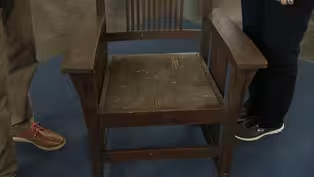
Appraisal: Gustav Stickley Armchair, ca. 1905
Video has Closed Captions
Clip: S30 Ep22 | 34s | Appraisal: Gustav Stickley Armchair, ca. 1905 (34s)
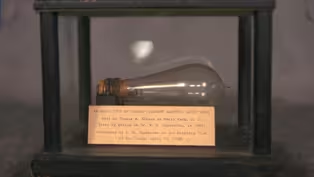
Appraisal: 1884 Edison Light Bulb & Plaque
Video has Closed Captions
Clip: S30 Ep22 | 2m 36s | Appraisal: 1884 Edison Light Bulb & Plaque (2m 36s)
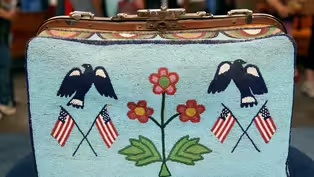
Appraisal: Claymore Beaded Bag, ca. 1895
Video has Closed Captions
Clip: S30 Ep22 | 1m 55s | Appraisal: Claymore Beaded Bag, ca. 1895 (1m 55s)
Providing Support for PBS.org
Learn Moreabout PBS online sponsorship New Episode
- Home and How To

Hit the road in a classic car for a tour through Great Britain with two antiques experts.

 New Episode










Support for PBS provided by:
Funding for ANTIQUES ROADSHOW is provided by American Cruise Lines and Ancestry. Additional funding is provided by public television viewers.