
Appraisal: George Ohr Pottery, ca. 1900
Clip: Season 30 Episode 22 | 4m 37sVideo has Closed Captions
Appraisal: George Ohr Pottery, ca. 1900, in New Orleans Hour 2.
Check out David Lackey's appraisal of George Ohr pottery, ca. 1900, from New Orleans, Hour 2.
Problems playing video? | Closed Captioning Feedback
Problems playing video? | Closed Captioning Feedback
Funding for ANTIQUES ROADSHOW is provided by American Cruise Lines and Ancestry. Additional funding is provided by public television viewers.
Support provided by:


Appraisal: George Ohr Pottery, ca. 1900
Clip: Season 30 Episode 22 | 4m 37sVideo has Closed Captions
Check out David Lackey's appraisal of George Ohr pottery, ca. 1900, from New Orleans, Hour 2.
Problems playing video? | Closed Captioning Feedback
Where to Watch Antiques Roadshow
Antiques Roadshow is available to stream on pbs.org and the PBS app.
Buy Now

ANTIQUES ROADSHOW's 2026 Production Tour
Enter now for a chance to win a pair of free tickets to one of the three stops on ANTIQUES ROADSHOW's 2026 Tour. Sweepstakes entry deadline is April 6.Providing Support for PBS.org
Learn Moreabout PBS online sponsorshipGUEST: My mother gave me these, but she got them from her mother, my great grandmother's sister married George Ohr.
APPRAISER: Wow.
And so these were made by...?
GUEST: George Ohr.
APPRAISER: Did you ever meet any of his family?
Did you ever go there?
GUEST: Yes.
I met what I believe was his daughter.
They lived out in the country and I went with my mother and my aunt.
And I remember, like, a, a house and a barn.
APPRAISER: Uh-huh.
GUEST: Maybe a barn setting.
It was a rural setting.
APPRAISER: Sure.
GUEST: And I saw, like, shelves of pottery and I went inside their house for a little while.
It wasn't any mansion, that's for sure, it was just regular people.
APPRAISER: Right.
The pottery, was there a lot of it?
Did you see it?
Did you re-- have any memories of that?
GUEST: Yeah, and from what I can remember, it was, like, on tables, and it was on shelves.
It was everywhere.
APPRAISER: And just stacked everywhere.
GUEST: Yes, sir.
APPRAISER: Yes, sir.
And the family just didn't think much about it?
GUEST: No.
(chuckles) They did not.
No.
APPRAISER: Isn't that interesting?
Tell me about these pieces here.
GUEST: Well, as far as I know, I have a rabbit ear puzzle mug.
Then that particular puzzle mug, it's got a strange kind of etching on the handle.
APPRAISER: Uh-huh.
GUEST: And then the little house over there is an inkwell.
APPRAISER: Yes, that's correct.
GUEST: And then a pitcher.
APPRAISER: Okay George Ohr made lots of puzzle mugs.
A puzzle mug has little holes in the handles and in the rim, but there's a hole at the bottom of the handle.
And so to drink out of it, you tilt the mug, and then you have to put your fingers over certain holes.
GUEST: Ah.
APPRAISER: And then you can......usually suck one of the holes and get the liquid out-- but you have to know the puzzle, and I don't know what it is.
GUEST: (laughs) Okay.
APPRAISER: But there is a trick to drinking out of it without spilling it.
So that's, that's why it's called a puzzle mug.
GUEST: Okay.
APPRAISER: And then the pitcher is a little unusual for George Ohr in that it's really utilitarian.
Most of his stuff was decorative.
What I really love about the inkwell is it's, is the shape of a house, exactly what was like in his community.
With even doors and windows, the roof line.
And I think it was a really interesting design that he made it like that.
Now, there's a number of different marks that he used.
And one of the examples of the marks is actually on the house.
He just scratched in hand.
He put Biloxi.
He also sometimes signed by hand.
GUEST: Right.
APPRAISER: So this one has his name, George Ohr, which he signed in script, and the other two have the same mark.
The impressed mark there was like a little die stamp that he pressed into the clay with his name and Biloxi.
Now, the date of all these pieces, they were made by George Ohr between about 1895, about 1900.
What year were you there?
GUEST: '59, '60, possibly.
APPRAISER: Okay, yeah.
In about 1969, a man came down from the Northeast and bought most of that pottery and hauled it off.
So you saw it before he hauled it all off-- the mugs, you could look online and see some kind of high prices.
And the prices on Ohr has fallen a little bit; in some cases more than others.
But since those are relatively common, actually, these days, they only sell for normally around $500 to $750 apiece.
The pitcher has a few little damages, which is not that unusual for Ohr.
A lot of it does have a little damage, but it would still be worth between $1,250 and $1,750.
And then the inkwell is the best piece, and that one would probably sell for at least $2,500 to $3,500.
And so the collective total would be somewhere between $4,750 and $6,750.
GUEST: okay.
APPRAISER: However, if it went to auction, the family connection, the provenance might bump the price up a little bit more.
GUEST: I see.
APPRAISER: How much do you think all that pottery is worth now that you were looking at?
GUEST: That I was looking at then?
Millions.
APPRAISER: You got it.
GUEST: Millions.
APPRAISER: We talked about it.
I talked about it with some of the other appraisers, and we estimate all that pottery is now worth somewhere between $50 and $100 million.
GUEST: Wow.
That's a lot of money.
APPRAISER: As a little girl, if you had known that.
GUEST: (laughing): Yeah!
Preview: 250 Years of Americana
Video has Closed Captions
Preview: S30 Ep22 | 30s | Preview: 250 Years of Americana (30s)
Appraisal: Paul Revere Jr. Silver Pitcher with Diary, ca. 1775
Video has Closed Captions
Clip: S30 Ep22 | 2m 46s | Appraisal: Paul Revere Jr. Silver Pitcher with Diary, ca. 1775 (2m 46s)
Appraisal: F. Douglass Letter & Free Will Baptist Archive
Video has Closed Captions
Clip: S30 Ep22 | 4m 49s | Appraisal: F. Douglass Letter & Free Will Baptist Church Archive (4m 49s)
Appraisal: Flag Quilt, ca. 1880
Video has Closed Captions
Clip: S30 Ep22 | 2m 43s | Appraisal: Flag Quilt, ca. 1880 (2m 43s)
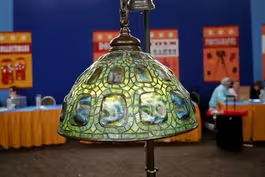
Appraisal: Tiffany Studios Turtle Back Glass Shade
Video has Closed Captions
Clip: S30 Ep22 | 2m 22s | Appraisal: Tiffany Studios Turtle Back Glass Shade, ca. 1915 (2m 22s)
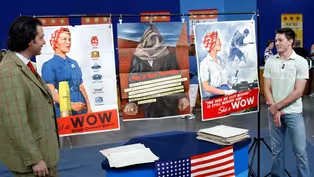
Appraisal: WWII Propaganda Posters
Video has Closed Captions
Clip: S30 Ep22 | 3m 50s | Appraisal: WWII Propaganda Posters (3m 50s)
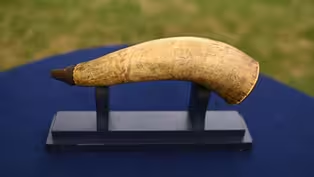
Appraisal: 1775 Abilmeleck Uncus-carved Powder Horn
Video has Closed Captions
Clip: S30 Ep22 | 3m 10s | Appraisal: 1775 Abilmeleck Uncus-carved Powder Horn (3m 10s)
Appraisal: Washington's Inaugural Ball Sash, ca. 1789
Video has Closed Captions
Clip: S30 Ep22 | 3m 33s | Appraisal: Washington's Inaugural Ball Sash, ca. 1789 (3m 33s)
Appraisal: 1954 Fender Stratocaster
Video has Closed Captions
Clip: S30 Ep22 | 51s | Appraisal: 1954 Fender Stratocaster (51s)
Appraisal: George Nakashima Grass Seat Chair, ca. 1965
Video has Closed Captions
Clip: S30 Ep22 | 4m 2s | Appraisal: George Nakashima Grass Seat Chair, ca. 1965 (4m 2s)
Appraisal: 1968 Warhol Campbell's Soup Can Screenprint
Video has Closed Captions
Clip: S30 Ep22 | 3m 18s | Appraisal: 1968 Warhol Campbell's Soup Can Screenprint (3m 18s)
Appraisal: Colt Single-action Army Revolver, ca. 1880
Video has Closed Captions
Clip: S30 Ep22 | 21s | Appraisal: Colt Single-action Army Revolver, ca. 1880 (21s)
Appraisal: Women's Carved Surfboard, ca. 1925
Video has Closed Captions
Clip: S30 Ep22 | 1m 4s | Appraisal: Women's Carved Surfboard, ca. 1925 (1m 4s)
Appraisal: 1941 Sportsman's Park Panorama
Video has Closed Captions
Clip: S30 Ep22 | 3m 11s | Appraisal: 1941 Sportsman's Park Panorama (3m 11s)
Appraisal: 1796 & 1799 Mary Way Dressed Miniatures
Video has Closed Captions
Clip: S30 Ep22 | 3m 11s | Appraisal: 1796 & 1799 Mary Way Dressed Miniatures (3m 11s)
Appraisal: 1960 Ansel Adams Portfolio III
Video has Closed Captions
Clip: S30 Ep22 | 2m 16s | Appraisal: 1960 Ansel Adams Portfolio III (2m 16s)
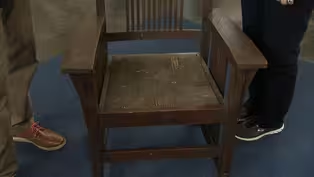
Appraisal: Gustav Stickley Armchair, ca. 1905
Video has Closed Captions
Clip: S30 Ep22 | 34s | Appraisal: Gustav Stickley Armchair, ca. 1905 (34s)
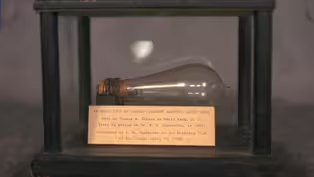
Appraisal: 1884 Edison Light Bulb & Plaque
Video has Closed Captions
Clip: S30 Ep22 | 2m 36s | Appraisal: 1884 Edison Light Bulb & Plaque (2m 36s)
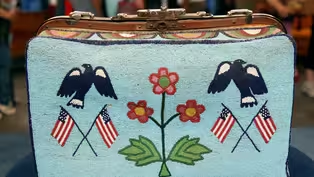
Appraisal: Claymore Beaded Bag, ca. 1895
Video has Closed Captions
Clip: S30 Ep22 | 1m 55s | Appraisal: Claymore Beaded Bag, ca. 1895 (1m 55s)
Providing Support for PBS.org
Learn Moreabout PBS online sponsorship New Episode
- Home and How To

Hit the road in a classic car for a tour through Great Britain with two antiques experts.

 New Episode










Support for PBS provided by:
Funding for ANTIQUES ROADSHOW is provided by American Cruise Lines and Ancestry. Additional funding is provided by public television viewers.